
Category Archives: CULTURE.VN
Gus Kenworthy tells VP Mike Pence to ‘eat your heart out’ on Instagram

Gus Kenworthy took a jab at Vice President Mike Pence during the Opening Ceremony Friday. (Reuters)
More
Freestyle skier Gus Kenworthy sent Vice President Mike Pence a not-so-subtle message from the Opening Ceremony at the 2018 Winter Olympics in PyeongChang.
Pence attended the ceremony as the ceremonial head of the United States delegation. Kenworthy, who is gay, told the vice president to “eat your heart out” in the caption of a picture on Instagram with figure skater Adam Rippon.
“The Opening Ceremony is a wrap and the 2018 Winter Olympic Gaymes are officially under way!” Kenworthy wrote. “I feel incredibly honored to be here in Korea competing for the US and I’m so proud to be representing the LGBTQ community alongside this amazing guy! Eat your heart out, Pence.”
Kenworthy also tweeted pictures with Rippon, but left out the part including the vice president.
Rippon, who is also gay, made a comment against Pence at qualifying for the Olympics because of a campaign statement made by Pence’s congressional campaign in 2000 that advocated against federal funding being given to “organizations that celebrate and encourage the types of behaviors that facilitate the spreading of the HIV virus.” Instead, Pence’s campaign said “resources should be directed toward those institutions which provide assistance to those seeking to change their sexual behavior.”
Many, including Rippon, feel that Pence’s campaign was making a reference to the ridiculous practice of homosexual conversion therapy.
Following Rippon’s comments at qualifying, USA Today reported that Pence’s staff tried to set up a meeting with Rippon, which the figure skater refused. Pence’s team publicly has said they did not reach out to the skater in the hopes of a meeting. The skater told USAT that he wouldn’t rule out meeting with Pence … after the Olympics.
“If I had the chance to meet him afterwards, after I’m finished competing, there might be a possibility to have an open conversation,” Rippon said in the interview last month. “He seems more mild-mannered than Donald Trump. … But I don’t think the current administration represents the values that I was taught growing up. Mike Pence doesn’t stand for anything that I really believe in.”
Pence was the governor of Indiana when the state passed the “Religious Freedom Restoration Act.” The widely-criticized law claimed to protect religious freedom in the state, but drew immediate scorn for the ability for people to discriminate under the law. The law was so heavily protested that an amendment was passed not long after that protected LGBT people against discrimination.
The vice president was seated not far from Kim Yo Jong, the sister of North Korean dictator Kim Jong Un during the Opening Ceremony. Pence also did not stand when the unified Korea delegation walked into the arena in the ceremony.
2 Vets Celebrate Love: ‘If You Came To See The Bride, You’re Out Of Luck’

Jerry Nadeau, 72, (left) and his husband, John Banvard, 100, stand outside their home in Chula Vista, Calif.
Cam Buker for StoryCorps
When John Banvard, 100, met Gerard “Jerry” Nadeau, 72, in 1993, neither of them had been openly gay.
“When we met, we were sort of in the closet, and I’d never had a real relationship. Now, we’ve been together almost 25 years,” Jerry tells John during a StoryCorps interview.
“What would it have been like if you didn’t meet me?” Jerry asks John.
“I would have continued being lonely,” John says. “I’d been absolutely lost.”
Both are veterans, having served in World War II (John) and Vietnam (Jerry), and when they moved into the veterans home together in Chula Vista, Calif., in 2010, Jerry says people there wondered what their relationship was.
“Well, when we got married, they knew what our relationship was,” Jerry says, laughing.
The couple married in 2013, and John says he was surprised by the warm reception they received. “I was expecting we’d be ridiculed, and there was very little of that,” he says.
“We’d gotten married at the veterans home, and we said, ‘If you came to see the bride, you’re out of luck.’ Do you remember that?” Jerry asks John.
“Yes, of course,” John says. The two indulge in the memory of a casual wedding — a frank display, if you will, of their unabashed love — featuring hot dogs as a main course, which, John says, “is hardly wedding food.”
Later, their achievement was affirmed by a simple introduction. “I was with you in the cafeteria, and somebody came up with their family, and they said, ‘This is Gerard Nadeau, and this is his husband, John,’ ” Jerry recounts. “I’d never heard that before.”
“Yes, that was very nice,” John says.
“You’ve made my life complete,” Jerry tells John.
“I could say the same to you,” John replied. “I think we’re probably as happy together as any two people you’re likely to meet.”
Produced for Morning Edition by Liyna Anwar.
StoryCorps is a national nonprofit that gives people the chance to interview friends and loved ones about their lives. These conversations are archived at the American Folklife Center at the Library of Congress, allowing participants to leave a legacy for future generations. Learn more, including how to interview someone in your life, at StoryCorps.org.
Guess Who: The 2018 Politically Correct Version
This Guy Paints the Sex He Allegedly Has with Aliens

All images courtesy of Brad Abrahams. Detail from First Time by David Huggins (left); Film still of Huggins from Love and Saucers (right)
Losing your virginity is supposed to be memorable. Most people look back on the act with affection and, probably, a little embarrassment. But David Huggins says the first time he had sex was more—er, out of this world—than most.
“When I was 17, I lost my virginity to a female extraterrestrial,” the 74-year-old says in a documentary about him called Love and Saucers. “That’s all I can say about it.”
The coitus in question allegedly went down in 1961, when Huggins was a teenager living on his parents’ farm in rural Georgia. It wasn’t the first time extraterrestrials had appeared to him; he’d been seeing strange creatures since he was eight. But on this day, as he was walking through woods near his house, an alien woman appeared and seduced him. “I thought, if anything, I’d be losing it in the backseat of a Ford—something like that. But it didn’t work out that way,” he says in the film.

Film still from Love and Saucers, picturing Huggins holding his painting First Time
According to Huggins, these visits from extraterrestrials, and his sexual relationship with them, continued into adulthood. When I interviewed him for this story, Huggins told me his last encounter with Crescent, his name for the woman in the woods, was six months ago. “I was sitting down in a chair, and the woman, Crescent, was behind me, and she put her arms around me,” he said. “And that’s about it. I don’t know anything else outside of that.”
Huggins is unnervingly matter-of-fact when he talks about his encounters. It sets him apart from what most of us expect from truthers and UFO enthusiasts. He’s not in it for the notoriety and doesn’t care if anyone believes him. When Huggins talks about fathering hundreds of alien babies—and yes, that’s another facet of his encounters—he sounds about as even-keeled as a farmer explaining crop rotations.
It’s one of the things that drew filmmaker Brad Abrahams to track Huggins down in Hoboken, New Jersey, where he lives now. Abrahams heard Huggins’s story on a podcast about UFOs and the paranormal. “In a sea of outlandish claims, there was one that rose to the surface,” he said. “And that was David’s story.”
Huggins was born in rural Georgia in 1944. In Love and Saucers, he talks about hunting for arrowheads in nearby fields for fun and not liking the evangelical Baptist church his grandparents took him to sometimes. When strange beings that no one else could see started appearing to him around the farm, he thought he was losing his mind.
“I am sitting under a tree, and I hear this voice say, ‘David, behind you.’ And I turned around and there is this little hairy guy with large glowing eyes coming straight towards me. I thought it was the bogeyman. I didn’t know what to think of it,” he says in the film. Another day, an “insect-like being” that reminded Huggins of a praying mantis appeared. “I was very terrified,” he says. “It was like, ‘What in the world am I looking at?’ And for an eight-year-old, you don’t know what to think.”
Once the shock wore off, Huggins says his encounters were weird, but not all that threatening. When he left Georgia in the mid 60s for art school in New York City, the beings followed. Nocturnal visits from Crescent, the ET who deflowered him, became routine. “My relationship with Crescent was warm and friendly. A little strange. What do I mean, a little. Very strange. She was my girlfriend, really,” Huggins says in the film. “A very unconventional relationship,” he adds.

Floating Up, David Huggins (left); Huggins in his studio with a painting of an alien woman he says he had sex with (right)
One of the first paintings Huggins ever made was of him and Crescent, having sex. “[The painting’s] not really all that good. She was on top of me, I reach my climax, then she and the insect being leave,” he says. Similar paintings fill his apartment. They’re surreal and a little childlike, dominated by deep blues and greens.
This is another thing that sets Huggins apart from most people with alien abduction stories: He paints his encounters. It started in 1987, when Huggins started remembering details from early visits. He says the deluge was triggered by Budd Hopkins’s book Intruders: The Incredible Visitations at Copley Woods.
“It was like a compulsion. I was being led to the book,” he says in the film. “There is this chapter ‘Other Women, Other Men,’ and I start reading it. And I go, Oh my God, this is the woman I never told anyone about. As I was reading it, memory upon memory came flooding back. It was image upon image. They wouldn’t stop. I think what bothered me the most is I didn’t know what to do with it. I was so scared.”
“It seemed like he was almost going crazy… from not being able to process these experiences that happened to him. What were they? Why him? It really sounded like he was losing his grip on his life and reality,” Abrahams told me. “And then, apparently, he got this message from [the beings] that he should paint the experiences, and as soon as he started doing that, it changed him.
“He said it was a release. He was able to sleep for the first time in weeks. And since then, he has painted every single detail of every encounter. A hundred-something paintings. It is art therapy. I don’t know if that’s how David would describe it, but that was a big part of what I wanted to show, too. Once he found a way to show the rest of the world, or even just himself, [what happened] visually through art, he was able to process, make sense of, and come to peace with whatever it was that happened to him,” Abrahams said.
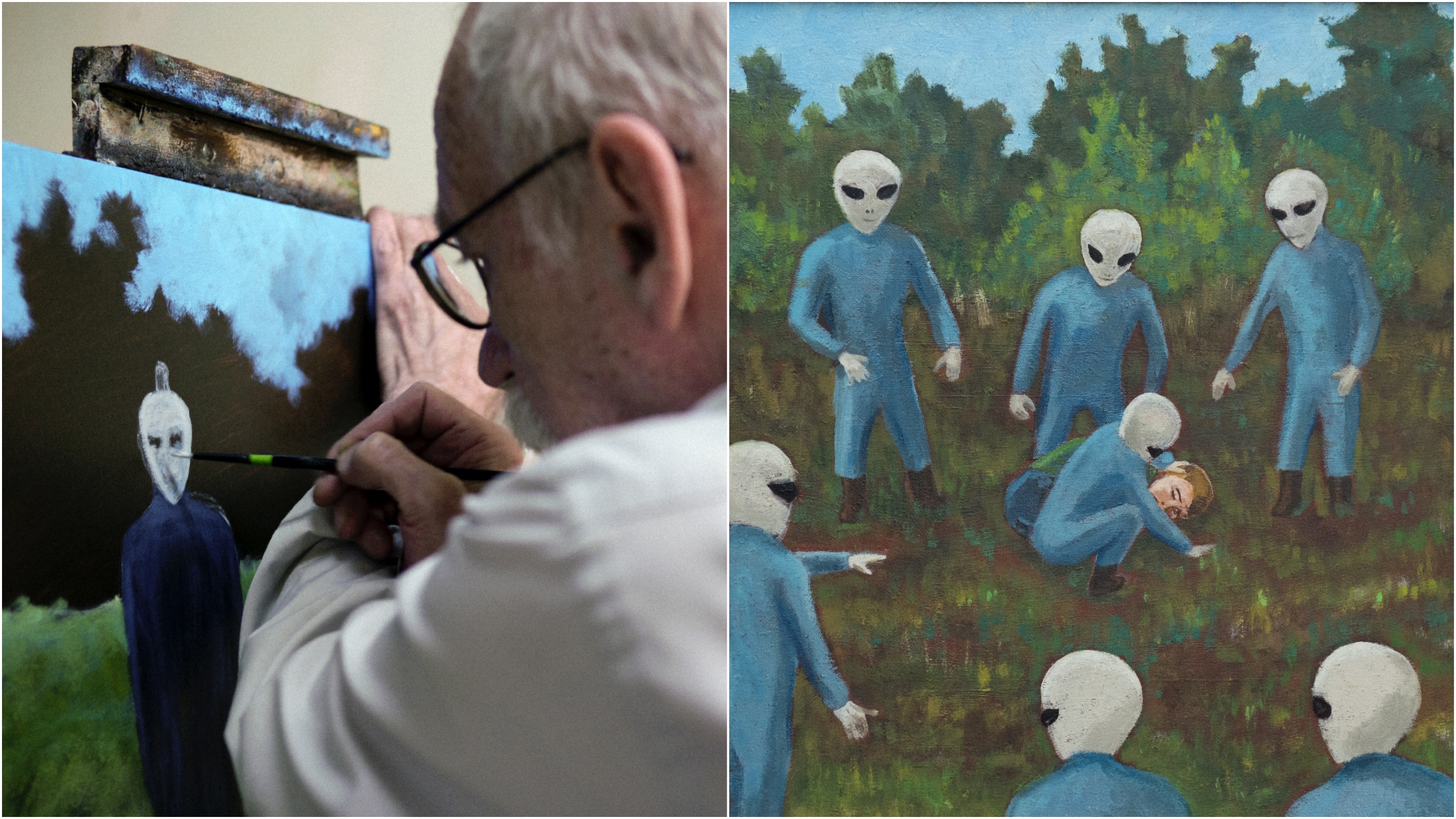
David Huggins works on a painting (left); Caught, David Huggins, oil on canvas, 1989 (right)
What makes Love and Saucers a very good documentary about a man who paints himself having sex with aliens is that Abrahams lays out the details of Huggins’s story and lets viewers come to their own conclusions. At its core, Love and Saucers is a film about belief. The first half is Huggins telling his own story, but the second half is interviews with his friends and neighbors. Some of them weren’t aware of Huggins’s encounters beforehand. But they all believe him.
Then there is Jeffrey Kripal, a professor of philosophy and religious thought at Rice University in Texas. He spent the early part of his career studying erotic mysticism, which led him to study alien abduction literature. “The whole history of religions is essentially about weird beings coming from the sky and doing strange things to human beings, and historically, those events or encounters have been framed as angels or demons or gods or goddesses or what have you. But in the modern, sort of secular, world we live in, they get framed as science fiction,” he says in Love and Saucers.
Kripal believes Huggins. He says the mix of terror and euphoria Huggins describes lines up with age-old descriptions of humans encountering the sacred. Plus, details of Huggins’s abductions mirror those described by other people Kripal has interviewed who believe they’ve had supernatural experiences. “I’m completely convinced they’re not lying; they’re being very sincere. But again, what it is is an entirely different question, and that’s where I think we need a lot more humility,” he says.

Her Eyes, David Huggins
Whether or not you think Huggins has really been having sex with aliens for the past 50 years, what’s apparent is that Huggins himself believes it. “Consider that this man isn’t lying and that he’s communicating something that he’s experienced, but it doesn’t have to be taken literally. Someone can not be crazy but still claim to have these completely unexplainable experiences,” Abrahams said.
What I think is more fascinating than whether or not “the truth is out there” is what stories like Huggins’s say about the impulse to explain away what we do not understand, and our limited ability to interpret all the sensations, experiences, and randomly firing neurons that come with being human.
When I asked Huggins why he thinks the beings appear to him, he said, “I have a feeling that tens of millions of people, perhaps hundreds of millions, have had [similar] experiences. Mainly as children. That’s all I can really say, but I think as children we are so open to things, that these beings can appear to us. I know I never closed up on it, because it has continued through my whole life.”
Love and Saucers is available to watch on a number of platforms here.
Poland’s Holocaust law should terrify you
(CNN)When politicians manipulate history for political purposes, we should worry. When they write laws, ordering prison terms for those who counter their version of history, we should challenge them.
Polish President Andrzej Duda just announced he will sign a controversial bill making it illegal to accuse Poland of complicity in the Holocaust. The developments in Poland come at the intersection of two troubling trends taking place in many countries — the upsurge in Holocaust denialism and the political manipulation of the truth for political purposes.
Poland’s bill rises from a legitimate concern. After behaving in largely heroic ways during World War II, Poles are tired of hearing others blame them for the horrors of the Holocaust, some of whose worst chapters took place on their soil. The law aims to defend the “good name of Poland,” but instead it criminalizes talk about historical truths.
The Nazis built Auschwitz-Birkenau, Treblinka and other death camps there, murdering 3 million Polish Jews. The Poles, whose country suffered horrifically under Nazi occupation, have bristled when hearing people refer to “Polish death camps.” Soon using words such as these could land you in jail for three years.
The law will inevitably turn the world’s attentions to the fact that even though Poland resisted and fought the Nazis and many Poles risked their lives to help Jews, there were, indeed, Poles who actively helped the Nazis. That is a historical fact, recounted by people who survived the massacres.
Instead of drawing attention to the heroism of the Polish nation, the law will highlight the misdeeds of these individuals. So why would the government make such a foolish, counterproductive move? Because it’s good politics at home.
Poland’s ruling Law and Justice Party, a right-wing nationalist party that has steadily eroded democracy in Poland and is turning it into a magnet for xenophobes, has found an issue that resonates across the nation, and is exploiting it to inflame “patriotic” feeling. The more the world complains, the more Poland’s ruling party can boast of defending the nation against the world.
The United States has warned Poland of “repercussions” — or costs to its international relationships — if it does not reconsider the legislation, and its alliance with Israel — until now a close friend of Poland’s — is in crisis.
Israel’s centrist opposition leader, Yair Lapid, tweeted his condemnation of the proposed law, writing that “hundreds of thousands of Jews were murdered without ever meeting a German soldier.” When the Polish Embassy in Israel responded that the law was to “protect truth against such slander,” Lapid fired back, “I am a son of a Holocaust survivor. My grandmother was murdered in Poland by Germans and Poles. I don’t need Holocaust education from you.” The Israeli parliament is considering changing the law banning Holocaust denial to include “denying or minimizing the involvement of the Nazi helpers and collaborators.”
Poland’s efforts to rewrite history are a new twist on Holocaust denial, which is a perverse maneuver that always has political and ideological objectives but usually hides under the deceptive claims of pursuing historical accuracy.
Denial goes hand in hand with other forms of ideological extremism. Not surprisingly, Holocaust deniers don’t hate only Jews; they are also prejudiced against other minorities.
In the United States, a Holocaust denier and brazen anti-Semite is on track to become the Republican nominee for Illinois’ 3rd Congressional District. Arthur Jones, a retired insurance salesman, has run for the seat seven times. This time no other Republican is on the ballot. His website describes the “Holocaust racket” as a Jewish scam, uses the Confederate flag as “a symbol of White Pride and White resistance,” and his blog blames leftists for the violence in Charlottesville, Virginia, where an admitted neo-Nazi has been charged with murder in the death of Heather Heyer, who was protesting against white supremacists.
Jones’ Holocaust denials are built, like all others, on falsehoods. The Holocaust is one of the most thoroughly documented events in history — with mountains of data, testimony, and artifacts demonstrating beyond question that the Nazis set out to annihilate Europe’s Jews, and nearly succeeded, killing 6 million of them, along with tens of thousands of homosexuals, hundreds of thousands of Roma (Gypsies), disabled people and others.
And yet deniers persist.
When Trump became President, many worried about how much he would empower the extreme right. After all, his top aide, Steve Bannon, had boasted of making his website, Breitbart, a platform for the so-called alt-right. Those fears appeared to be borne out after the inauguration, when the White House issued a statement marking Holocaust Remembrance Day that did not even mention Jews or anti-Semitism, instead referring to “innocent people.”
Since then, Trump has made something of a course correction. Bannon is out, and this year’s statement was what you would expect from a normal presidency.
And yet the disturbing memories of Trump’s reluctance to condemn neo-Nazis and white supremacists at Charlottesville cannot be erased.
His rhetoric may have even empowered true bigots to act on their worst impulses. Anti-Semitic incidents surged in the first year of the Trump presidency. In the seven weeks after Charlottesville alone, the Anti-Defamation League counted more than 200 incidents.
More than 70 years after the end of World War II, the Holocaust remains a testing strip, providing warning signs that should not be ignored, whether in an Eastern European country or a congressional district in Illinois.
More US teens are rejecting ‘boy’ or ‘girl’ gender identities, a study finds
(CNN)More teenagers are identifying themselves with nontraditional gender labels such as transgender or gender-fluid, according to a new study.
The research, published Monday in the journal Pediatrics, found that almost 3% of Minnesota teens did not identify with traditional gender labels such as “boy” or “girl.” That number is higher than researchers expected. A UCLA study from a year ago estimated that 0.7% of teens identified as transgender.
Lead researcher Nic Rider of the University of Minnesota said the main purpose of the new study was to examine health differences between gender-nonconforming teens and teens who are cisgender, a person whose gender identity aligns with the sex assigned to them at birth.
The study found that transgender and gender-nonconforming (TGNC) youth reported “reported significantly poorer health” — including mental health — than cisgender teenagers. TGNC teens also were less likely to get preventive health checkups and more likely to visit their school nurse, the study found.
But more surprising may have been the rising percentage of teens who say they don’t fit traditional gender norms.
The study supports prior research suggesting “that previous estimates of the size of the TGNC population have been underestimated by orders of magnitude,” wrote Daniel Shumer, a specialist in transgender medicine at the University of Michigan, in an accompanying opinion article.
The study supports prior research suggesting “that previous estimates of the size of the TGNC population have been underestimated by orders of magnitude,” wrote Daniel Shumer, a specialist in transgender medicine at the University of Michigan, in an accompanying opinion article.
That’s a big jump from the UCLA study, which was published in January 2017 and estimated that 0.7% of American teens ages 13-17 identify as transgender.
That study was based on government data on adults collected by 27 US states in 2014 and 2015. The survey’s researchers used the adult data to estimate the percentage of transgender teens.
Rider’s new study only focuses on Minnesota teens, but researchers hope to expand it into a national study to get more accurate data.
‘A window into high school-aged youth’
Growing awareness and visibility surrounding transgender issues in recent years may make teenagers more comfortable with steering away from traditional gender labels, experts say.
Shumer, an assistant professor at the University of Michigan, believes that the growing percentage of gender-nonconforming youth should serve as a lesson to schools and physicians to abandon limited views of gender.
“Of particular interest is how the researchers in this study were able to provide a window into how high school-aged youth understand and redefine gender,” he wrote.
“Continued work to build understanding of how youth understand and express gender is a critical step toward reducing health disparities in this important and valued population.”
Rider hopes this study will help improve health care for transgender teenagers, adding that doctors and parents should help gender-nonconforming youth feel more comfortable about seeking medical help.
Does Google Home know who Jesus is? This man says no
NASHVILLE, Tenn. (WZTV) — UPDATE: A Google spokesperson has responded to this story and said they are temporarily disabling certain responses of religious figures. Click here for the full response.
Audio technology like Google Home and Amazon’s Alexa are becoming a dominant source for information.
But now, it appears one of the most common names is unknown to Google Home.
And some people are sounding the alarm about what the technology tells you when you ask about Jesus.
Brentwood resident David Sams owns a Google Home and an Amazon audio speaker. He says both give two different answers when asking “Who is Jesus Christ?”
“I even asked Google who is David Sams? Google knew who I was, but Google did not know who Jesus was, Google did not know who Jesus Christ was, and Google did not know who God was,” Sams said.
Smart speakers are a technology owned by about 40 million Americans — that’s about one in six people in the nation.
And this religious conversation at home is making waves on social media.
Comments, videos and test results posted asking “Who is Jesus?”
The general response from Google Home is “I’m not sure how to help you with that.”
There’s still no response from Google as to why that is the response.
“It’s kinda scary, it’s almost like Google has taken Jesus and God out of smart audio,” Sams said. “First it started with schools.”
Google Home refers to Jesus Christ when asking about the Last Supper and even Saint Peter.
And there’s plenty of information on the prophet Muhammed, Buddha — even Satan.
Nashville resident Martin Collins says she thinks this feeds into a bigger problem.
They took prayer out of schools, they think just taking Jesus out of everything is politically correct these days and I think that’s the stem of a lot of our problems,” Collins said.
Collins has no doubt Google has purposefully programmed Jesus out of its audio speakers.
“To keep from stepping on toes, political correctness,” Collin said. “That seems to be more important these days than what’s right and what’s wrong.”
Sams is calling for answers from Google as it’s become the main source of information readily available that so many are coming to depend on.
“I don’t know if there’s some kind of wizard making these decisions or if it’s some kind of oversight,” Sams said. “But whatever it is, they need to address it immediately.”
Someone edited Ram’s Martin Luther King commercial with what King actually said about car ads
Using a civil rights hero to sell cars in a Super Bowl commercial may seem absurd on its face, but it’s particularly ridiculous when said civil rights icon actually spoke out against car commercials.
During Sunday’s Super Bowl, Ram Trucks used parts of one of Martin Luther King Jr.’s speeches to sell pickup trucks. Ram plucked a seemingly innocuous section of King’s “Drum Major Instinct” sermon, told 50 years ago to the day of Super Bowl on Sunday, using it to reinforce the idea that its Ram trucks are “built to serve”:
If you want to be important, wonderful. If you want to be recognized, wonderful. If you want to be great, wonderful. But recognize that he who is greatest among you shall be your servant. That’s a new definition of greatness. … By giving that definition of greatness, it means that everybody can be great. … You don’t have to know about Plato and Aristotle to serve. You don’t have to know the theory of relativity to serve. You don’t have to know the second theory of thermodynamics in physics to serve. You only need a heart full of grace, a soul generated by love.
As Nathan Robinson, editor-in-chief of Current Affairs, demonstrated in a YouTube video (embedded at the top of this article), it’s easy to show the disparity between King’s message and the ad itself. Robinson overlaid the video of the commercial with other parts of the exact same speech Ram quoted — exposing a sermon that is actually anticapitalist and even criticizes car advertisements:
Now the presence of this instinct explains why we are so often taken by advertisers. You know, those gentlemen of massive verbal persuasion. And they have a way of saying things to you that kind of gets you into buying. In order to be a man of distinction, you must drink this whiskey. In order to make your neighbors envious, you must drive this type of car. In order to be lovely to love you must wear this kind of lipstick or this kind of perfume. And you know, before you know it, you’re just buying that stuff. … I got to drive this car because it’s something about this car that makes my car a little better than my neighbor’s car. … I am sad to say that the nation in which we live is the supreme culprit. And I’m going to continue to say it to America.
Over the years, people have been taught and remembered King’s words of peaceful protest, unity, and service. But they by and large have forgotten more controversial aspects of his political protest — particularly his message about economic justice and the destructiveness of poverty. The Ram commercial exploits this, using apolitical parts of a speech that, in reality, mocks car advertisements — perhaps figuring that people wouldn’t remember what King really said because they by and large haven’t been taught his full message in their middle and high school history classes.
It’s hard to imagine how King would react to this blatant twisting of his words. But it certainly seems to go against what he preached.
Correction: Ram trucks are no longer affiliated with Dodge, as this post originally suggested.
This Is Why Uma Thurman Is Angry
Yes, Uma Thurman is mad.
She has been raped. She has been sexually assaulted. She has been mangled in hot steel. She has been betrayed and gaslighted by those she trusted.
And we’re not talking about her role as the blood-spattered bride in “Kill Bill.” We’re talking about a world that is just as cutthroat, amoral, vindictive and misogynistic as any Quentin Tarantino hellscape.
We’re talking about Hollywood, where even an avenging angel has a hard time getting respect, much less bloody satisfaction.
Playing foxy Mia Wallace in 1994’s “Pulp Fiction” and ferocious Beatrix Kiddo in “Kill Bill,” Volumes 1 (2003) and 2 (2004), Thurman was the lissome goddess in the creation myth of Harvey Weinstein and Quentin Tarantino. The Miramax troika was the ultimate in indie cool. A spellbound Tarantino often described his auteur-muse relationship with Thurman — who helped him conceive the idea of the bloody bride — as an Alfred Hitchcock-Ingrid Bergman legend. (With a foot fetish thrown in.) But beneath the glistening Oscar gold, there was a dark undercurrent that twisted the triangle.
“Pulp Fiction” made Weinstein rich and respected, and Thurman says he introduced her to President Barack Obama at a fund-raiser as the reason he had his house.
“The complicated feeling I have about Harvey is how bad I feel about all the women that were attacked after I was,” she told me one recent night, looking anguished in her elegant apartment in River House on Manhattan’s East Side, as she vaped tobacco, sipped white wine and fed empty pizza boxes into the fireplace.
“I am one of the reasons that a young girl would walk into his room alone, the way I did. Quentin used Harvey as the executive producer of ‘Kill Bill,’ a movie that symbolizes female empowerment. And all these lambs walked into slaughter because they were convinced nobody rises to such a position who would do something illegal to you, but they do.”
Thurman stresses that Creative Artists Agency, her former agency, was connected to Weinstein’s predatory behavior. It has since issued a public apology. “I stand as both a person who was subjected to it and a person who was then also part of the cloud cover, so that’s a super weird split to have,” she says.
She talks mordantly about “the power from ‘Pulp,’” and reminds me that it’s in the Library of Congress, part of the American narrative.

When asked about the scandal on the red carpet at the October premiere for her Broadway play, “The Parisian Woman,” an intrigue about a glamorous woman in President Trump’s Washington written by “House of Cards” creator Beau Willimon, she looked steely and said she was waiting to feel less angry before she talked about it.
“I used the word ‘anger’ but I was more worried about crying, to tell you the truth,” she says now. “I was not a groundbreaker on a story I knew to be true. So what you really saw was a person buying time.”
By Thanksgiving, Thurman had begun to unsheathe her Hattori Hanzo, Instagramming a screen shot of her “roaring rampage of revenge” monologue and wishing everyone a happy holiday, “(Except you Harvey, and all your wicked conspirators — I’m glad it’s going slowly — you don’t deserve a bullet) — stay tuned.”
Stretching out her lanky frame on a brown velvet couch in front of the fire, Thurman tells her story, with occasional interruptions from her 5-year-old daughter with her ex, financier Arpad Busson. Luna is in her pj’s, munching on a raw cucumber. Her two older kids with Ethan Hawke, Maya, an actress, and Levon, a high school student, also drop by.
In interviews over the years, Thurman has offered a Zen outlook — even when talking about her painful breakup from Hawke. (She had a brief first marriage to Gary Oldman.) Her hall features a large golden Buddha from her parents in Woodstock; her father, Robert Thurman, is a Buddhist professor of Indo-Tibetan studies at Columbia who thinks Uma is a reincarnated goddess.
But beneath that reserve and golden aura, she has learned to be a street fighter.
She says when she was 16, living in a studio apartment in Manhattan and starting her movie career, she went to a club one winter night and met an actor, nearly 20 years older, who coerced her afterward when they went to his Greenwich Village brownstone for a nightcap.
“I was ultimately compliant,” she remembers. “I tried to say no, I cried, I did everything I could do. He told me the door was locked but I never ran over and tried the knob. When I got home, I remember I stood in front of the mirror and I looked at my hands and I was so mad at them for not being bloody or bruised. Something like that tunes the dial one way or another, right? You become more compliant or less compliant, and I think I became less compliant.”
Thurman got to know Weinstein and his first wife, Eve, in the afterglow of “Pulp Fiction.” “I knew him pretty well before he attacked me,” she said. “He used to spend hours talking to me about material and complimenting my mind and validating me. It possibly made me overlook warning signs. This was my champion. I was never any kind of studio darling. He had a chokehold on the type of films and directors that were right for me.”
Things soon went off-kilter in a meeting in his Paris hotel room. “It went right over my head,” she says. They were arguing about a script when the bathrobe came out.
“I didn’t feel threatened,” she recalls. “I thought he was being super idiosyncratic, like this was your kooky, eccentric uncle.”
He told her to follow him down a hall — there were always, she says, “vestibules within corridors within chambers” — so they could keep talking. “Then I followed him through a door and it was a steam room. And I was standing there in my full black leather outfit — boots, pants, jacket. And it was so hot and I said, ‘This is ridiculous, what are you doing?’ And he was getting very flustered and mad and he jumped up and ran out.”
he first “attack,” she says, came not long after in Weinstein’s suite at the Savoy Hotel in London. “It was such a bat to the head. He pushed me down. He tried to shove himself on me. He tried to expose himself. He did all kinds of unpleasant things. But he didn’t actually put his back into it and force me. You’re like an animal wriggling away, like a lizard. I was doing anything I could to get the train back on the track. My track. Not his track.”
She was staying in Fulham with her friend, Ilona Herman, Robert De Niro’s longtime makeup artist, who later worked with Thurman on “Kill Bill.”
“The next day to her house arrived a 26-inch-wide vulgar bunch of roses,” Thurman says. “They were yellow. And I opened the note like it was a soiled diaper and it just said, ‘You have great instincts.’” Then, she says, Weinstein’s assistants started calling again to talk about projects.
She thought she could confront him and clear it up, but she took Herman with her and asked Weinstein to meet her in the Savoy bar. The assistants had their own special choreography to lure actresses into the spider’s web and they pressured Thurman, putting Weinstein on the phone to again say it was a misunderstanding and “we have so many projects together.” Finally she agreed to go upstairs, while Herman waited on a settee outside the elevators.
Once the assistants vanished, Thurman says, she warned Weinstein, “If you do what you did to me to other people you will lose your career, your reputation and your family, I promise you.” Her memory of the incident abruptly stops there.
Through a representative, Weinstein, who is in therapy in Arizona, agreed that “she very well could have said this.”
Downstairs, Herman was getting nervous. “It seemed to take forever,” the friend told me. Finally, the elevator doors opened and Thurman walked out. “She was very disheveled and so upset and had this blank look,” Herman recalled. “Her eyes were crazy and she was totally out of control. I shoveled her into the taxi and we went home to my house. She was really shaking.” Herman said that when the actress was able to talk again, she revealed that Weinstein had threatened to derail her career.
Through a spokesperson, Weinstein denied ever threatening her prospects and said that he thought she was “a brilliant actress.” He acknowledged her account of the episodes but said that up until the Paris steam room, they had had “a flirtatious and fun working relationship.”
“Mr. Weinstein acknowledges making a pass at Ms. Thurman in England after misreading her signals in Paris,” the statement said. “He immediately apologized.”
Thurman says that, even though she was in the middle of a run of Miramax projects, she privately regarded Weinstein as an enemy after that. One top Hollywood executive who knew them both said the work relationship continued but that basically, “She didn’t give him the time of day.”
Thurman says that she could tolerate the mogul in supervised environments and that she assumed she had “aged out of the window of his assault range.”
She attended the party he had in SoHo in September for Tarantino’s engagement to Daniella Pick, an Israeli singer. In response to queries about Thurman’s revelations, Weinstein sent along six pictures of chummy photos of the two of them at premieres and parties over the years.
And that brings us to “the Quentin of it all,” as Thurman calls it. The animosity between Weinstein and Thurman infected her creative partnership with Tarantino.
Married to Hawke and with a baby daughter and a son on the way, Thurman went to the Cannes Film Festival in 2001. She says Tarantino noticed after a dinner that she was skittish around Weinstein, which was a problem, since they were all about to make “Kill Bill.” She says she reminded Tarantino that she had already told him about the Savoy incident, but “he probably dismissed it like ‘Oh, poor Harvey, trying to get girls he can’t have,’ whatever he told himself, who knows?” But she reminded him again and “the penny dropped for him. He confronted Harvey.”
Later, by the pool under the Cypress trees at the luxurious Hotel du Cap, Thurman recalls, Weinstein said he was hurt and surprised by her accusations. She then firmly reiterated what happened in London. “At some point, his eyes changed and he went from aggressive to ashamed,” she says, and he offered her an apology with many of the sentiments he would trot out about 16 years later when the walls caved in.
“I just walked away stunned, like ‘O.K., well there’s my half-assed apology,’” Thurman says.
Weinstein confirmed Friday that he apologized, an unusual admission from him, which spurred Thurman to wryly note, “His therapy must be working.”
Since the revelations about Weinstein became public last fall, Thurman has been reliving her encounters with him — and a gruesome episode on location for “Kill Bill” in Mexico made her feel as blindsided as the bride and as determined to get her due, no matter how long it took.
With four days left, after nine months of shooting the sadistic saga, Thurman was asked to do something that made her draw the line.
In the famous scene where she’s driving the blue convertible to kill Bill — the same one she put on Instagram on Thanksgiving — she was asked to do the driving herself.
But she had been led to believe by a teamster, she says, that the car, which had been reconfigured from a stick shift to an automatic, might not be working that well.
She says she insisted that she didn’t feel comfortable operating the car and would prefer a stunt person to do it. Producers say they do not recall her objecting.
“Quentin came in my trailer and didn’t like to hear no, like any director,” she says. “He was furious because I’d cost them a lot of time. But I was scared. He said: ‘I promise you the car is fine. It’s a straight piece of road.’” He persuaded her to do it, and instructed: “ ‘Hit 40 miles per hour or your hair won’t blow the right way and I’ll make you do it again.’ But that was a deathbox that I was in. The seat wasn’t screwed down properly. It was a sand road and it was not a straight road.” (Tarantino did not respond to requests for comment.)
Thurman then shows me the footage that she says has taken her 15 years to get. “Solving my own Nancy Drew mystery,” she says.
It’s from the point of view of a camera mounted to the back of the Karmann Ghia. It’s frightening to watch Thurman wrestle with the car, as it drifts off the road and smashes into a palm tree, her contorted torso heaving helplessly until crew members appear in the frame to pull her out of the wreckage. Tarantino leans in and Thurman flashes a relieved smile when she realizes that she can briefly stand.
Video
“The steering wheel was at my belly and my legs were jammed under me,” she says. “I felt this searing pain and thought, ‘Oh my God, I’m never going to walk again,’” she says. “When I came back from the hospital in a neck brace with my knees damaged and a large massive egg on my head and a concussion, I wanted to see the car and I was very upset. Quentin and I had an enormous fight, and I accused him of trying to kill me. And he was very angry at that, I guess understandably, because he didn’t feel he had tried to kill me.”
Even though their marriage was spiraling apart, Hawke immediately left the Abbey of Gethsemani in Kentucky to fly to his wife’s side.
“I approached Quentin in very serious terms and told him that he had let Uma down as a director and as a friend,” he told me. He said he told Tarantino, “Hey, man, she is a great actress, not a stunt driver, and you know that.” Hawke added that the director “was very upset with himself and asked for my forgiveness.”
Two weeks after the crash, after trying to see the car and footage of the incident, she had her lawyer send a letter to Miramax, summarizing the event and reserving the right to sue.
Miramax offered to show her the footage if she signed a document “releasing them of any consequences of my future pain and suffering,” she says. She didn’t.
Thurman says her mind meld with Tarantino was rattled. “We were in a terrible fight for years,” she explains. “We had to then go through promoting the movies. It was all very thin ice. We had a fateful fight at Soho House in New York in 2004 and we were shouting at each other because he wouldn’t let me see the footage and he told me that was what they had all decided.”
Now, so many years after the accident, inspired by the reckoning on violence against women, reliving her own “dehumanization to the point of death” in Mexico, and furious that there have not been more legal repercussions against Weinstein, Thurman says she handed over the result of her own excavations to the police and ramped up the pressure to cajole the crash footage out of Tarantino.
“Quentin finally atoned by giving it to me after 15 years, right?” she says. “Not that it matters now, with my permanently damaged neck and my screwed-up knees.”
(Tarantino aficionados spy an echo of Thurman’s crash in his 2007 movie, “Death Proof,” produced by Weinstein and starring Thurman’s stunt double, Zoë Bell. Young women, including a blond Rose McGowan, die in myriad ways, including by slamming into a windshield.)
As she sits by the fire on a second night when we talk until 3 a.m., tears begin to fall down her cheeks. She brushes them away.
“When they turned on me after the accident,” she says, “I went from being a creative contributor and performer to being like a broken tool.”
Thurman says that in “Kill Bill,” Tarantino had done the honors with some of the sadistic flourishes himself, spitting in her face in the scene where Michael Madsen is seen on screen doing it and choking her with a chain in the scene where a teenager named Gogo is on screen doing it.
“Harvey assaulted me but that didn’t kill me,” she says. “What really got me about the crash was that it was a cheap shot. I had been through so many rings of fire by that point. I had really always felt a connection to the greater good in my work with Quentin and most of what I allowed to happen to me and what I participated in was kind of like a horrible mud wrestle with a very angry brother. But at least I had some say, you know?” She says she didn’t feel disempowered by any of it. Until the crash.
“Personally, it has taken me 47 years to stop calling people who are mean to you ‘in love’ with you. It took a long time because I think that as little girls we are conditioned to believe that cruelty and love somehow have a connection and that is like the sort of era that we need to evolve out of.”
California overreacts and presumes every homeschooling parent is a child abuser
California is seeking to treat homeschool families as presumptive child abusers. Lawmakers in that state have indicated plans to categorically require homeschool parents to prove — through home visits, interviews, and other government oversight — that indeed the parent is not abusive if they choose to exercise a legally protected and valid option for school choice. This measure would shift the burden to the parent to prove to the government’s satisfaction his or her parental fitness.
This is absurdly unconstitutional.
But in light of the remarkably horrifying case of Riverside County couple David and Louise Turpin, whose 13 children were reportedly chained, malnourished, and clearly abused, the media and lawmakers have chosen to focus on one coincidental detail — the Turpins were also registered as homeschoolers.
Using the Turpins’ case as one extreme example to bolster their platform, legislators are now looking to increase government regulations of homeschooling in California, which may lay the groundwork for increased regulation nationwide. Already, state legislators have suggested they will introduce legislation to cure the supposed “problem” of laxity in private school choice options, which includes homeschooling.
Suggested measures have included options for involuntary quarterly home visits and interviews from child protective services and other government agencies. This kind of government regulation and oversight would reduce the valid legal option of homeschooling from a fundamental parental right, to direct the education and school choice for children, to compelled consent to government intrusion upon the sanctity and privacy of the home and school choice.
These kinds of alarming “solutions” to an unfounded problem rises to the level of a government search of the family’s home and interviews of children, under the pretext that homeschool choice infers that parents are more likely to be child abusers. It’s a similar illogical path as inferring that because a person chooses to be an independent contractor as a legitimate employment option, they are more likely to evade tax filings, or because a person chooses to exercise any other valid legal option, they are doing so for some other unrelated nefarious purpose, and on that basis alone the government has grounds to treat them as suspect.
Moreover, the data just aren’t there to support any logical connection between homeschooling as a school choice option and child abuse. In published studies among such experts as the World Health Organization, the U.S. Commission to Eliminate Child Abuse and Neglect Fatalities, the American Psychological Association, the Mayo Clinic, and others, none of these sources list homeschooling as a risk factor for child abuse and neglect. In other words, there is no evidence or data to even suggest that homeschooled children are being harmed or at risk of harm at a rate higher than children in other nonhomeschooled and private schooling communities.
In fact, the data suggest the complete opposite in terms of the benefits to children who are enrolled in alternative school choice options, specifically homeschooling. In a recent piece in Business Insider titled “Homeschooling could be the smartest way to teach kids in the 21st century — here are 5 reasons why,” Chris Weller discusses how homeschooling is not only a mainstream choice, but also that “homeschooled kids have the same access to online learning, friendships, and extracurricular activities as the typical public school student — but without many of the drawbacks, like standardized lesson plans and bullying.” Many parents choose homeschooling to better tailor the educational and environmental needs of children.
The law also recognizes the fundamental right of the parent to make choices about their child’s education and upbringing, and homeschooling is a valid legal option in all 50 states. For lawmakers to correlate instances like the Turpins, where child abusers are also homeschoolers, is to manufacture a problem looking for a solution. The data is insufficient to make that correlation a legitimate argument that homeschooling is the causal factor precipitating abuse.
Further, these types of proposed “solutions” pose a myriad of constitutional problems. First, it treats homeschool families as suspect child abusers without any legitimate legal basis. It is similar to requiring all drivers to undergo a breath or blood test to prove they are not under the influence simply because they chose to exercise a valid legal option of driving.
The Constitution requires the government to have probable cause before any test, and the burden is always on the government to prove their case, not for an individual to waive the presumption of innocence simply because they chose to drive. Parents who choose to “drive” in the homeschool lane constitutionally must have all of the same rights and protections as parents who choose to “drive” in the traditional public school lane.
Second, this would unconstitutionally force warrantless searches within the privacy of a family dwelling and subjects compelled testimony from children that is expressly for the purposes of potential future litigation. Imagine if the government could label any category of parent as alleged child abusers and thus treat the parents as suspect. What if your choice as a parent to raise your children in California suddenly meant the government could invade your home and look for evidence you might be a child abuser simply because the Turpins also resided in California?
In Iowa, a measure was introduced last year to force all families operating under the state’s Independent Private Instruction Choice or the Private Instruction Choice to undergo an annual assessment. The bill would mandate that every homeschool family’s home is involuntarily invaded once per quarter, with government officials interviewing or observing every child in the household registered as a homeschooler and perform a “check on the health and safety” of the children.
There was no clear definition of what “health and safety” meant in the context of the checks, nor did the measure advance any constitutional basis for such a search.
Homeschool Legal Defense Association President Mike Smith said in a message last week to members and friends of the organization, “These efforts incorrectly assume that homeschooling is the problem here. Hasty legislation based on horrific and criminal behavior — behavior that has nothing to do with homeschooling — would be unfair to the thousands of law-abiding families in California who work hard to provide a safe and loving environment for their children.”
Child abuse does happen, and it is a terrible thing. But we have to be very careful not to overreact and presume all parents are child abusers. They aren’t. We must preserve the presumption of innocence and constitutional protections for every family and parent in the context of school choice and in all areas of parental rights.
Jenna Ellis (@jennaellisorg) is a contributor to the Washington Examiner’s Beltway Confidential blog. She is an attorney and professor of constitutional law at Colorado Christian University, fellow at the Centennial Institute, radio show host in Denver, Colo., and the author of the Legal Basis for a Moral Constitution.
Why Rachel Dolezal Isn’t Caitlyn Jenner
Bill Nye Does Not Speak for Us and He Does Not Speak for Science

Tonight, Bill Nye “The Science Guy” will accompany Republican Rep. Jim Bridenstine (R-OK), Trump’s nominee for NASA Administrator, to the State of the Union address. Nye has said that he’s accompanying the Congressman to help promote space exploration, since, he asserts, “NASA is the best brand the United States has” and that his attendance “should not be … seen as an acceptance of the recent attacks on science and the scientific community.”
But by attending the SOTU as Rep. Bridenstine’s guest, Nye has tacitly endorsed those very policies, and put his own personal brand over the interests of the scientific community at large. Rep. Bridenstine is a controversial nominee who refuses to state that climate change is driven by human activity, and even introduced legislation to remove Earth sciences from NASA’s scientific mission. Further, he’s worked to undermine civil rights, including pushing for crackdowns on immigrants, a ban on gay marriage, and abolishing the Department of Education.
As scientists, we cannot stand by while Nye lends our community’s credibility to a man who would undermine the United States’ most prominent science agency. And we cannot stand by while Nye uses his public persona as a science entertainer to support an administration that is expressly xenophobic, homophobic, misogynistic, racist, ableist, and anti-science.
Scientists are people, and in today’s society, it is impossible to separate science at major agencies like NASA from other pressing issues like racism, bigotry, and misogyny. Addressing these issues should be a priority, not only to strengthen our own scientific community, but to better serve the public that often funds our work. Rather than wield his public persona to bring attention to the need for science-informed policy, Bill Nye has chosen to excuse Rep. Bridenstine’s anti-science record and his stance on civil rights, and to implicitly support a stance that would diminish the agency’s work studying our own planet and its changing climate. Exploring other worlds and studying other planets, while dismissing the overwhelming scientific evidence of climate change and its damage to our own planet isn’t just dangerous, it’s foolish and self-defeating.
Further, from his position of privilege and public popularity, Bill Nye is acting on the scientific community’s behalf, but without our approval. No amount of funding for space exploration can undo the damage the Trump administration is causing to public health and welfare by censoring science. No number of shiny new satellites can undo the racist policies that make our Dreamer colleagues live in fear and prevent immigrants from pursuing scientific careers in the United States. And no new mission to the Moon can make our LGBTQ colleagues feel welcome at an agency run by someone who votes against their civil rights.
As women and scientists, we refuse to separate science from everyday life. We refuse to keep our heads down and our mouths shut. As someone with a show alleging to save the world, Bill Nye has a responsibility to acknowledge the importance of NASA’s vast mission, not just one aspect of it. He should use his celebrity to elevate the importance of science in NASA’s mission—not waste the opportunity to lobby for space exploration at a cost to everything else.
The true shame is that Bill Nye remains the popular face of science because he keeps himself in the public eye. To be sure, increasing the visibility of scientists in the popular media is important to strengthening public support for science, but Nye’s TV persona has perpetuated the harmful stereotype that scientists are nerdy, combative white men in lab coats—a stereotype that does not comport with our lived experience as women in STEM. And he continues to wield his power recklessly, even after his recent endeavors in debate and politics have backfired spectacularly.
In 2014, he attempted to debate creationist Ken Ham—against the judgment of evolution experts—which only served to allow Ham to raise the funds needed to build an evangelical theme park that spreads misinformation about human evolution. Similarly, Nye repeatedly agreed to televised debates with non-scientist climate deniers, contributing to the false perception that researchers still disagree about basic climate science. And when Bill Nye went on Tucker Carlson’s Fox News show to “debate” climate change in 2017, his appearance was used to spread misinformation to Fox viewers and fundraise for anti-climate initiatives.
Bill Nye does not speak for us or for the members of the scientific community who have to protect not only the integrity of their research, but also their basic right to do science. We stand with others who have asked Bill Nye to not attend the State of the Union. Nye’s complicity does not align him with the researchers who have a bold and progressive vision for the future of science and its role in society.
At a time when our ability to do science and our ability to live freely are both under threat, our public champions and our institutions must do better.
These twins were born 4 minutes apart. But only one is a U.S. citizen
A married binational gay couple allege that the government’s policy of granting birthright citizenship based on blood relation discriminates against LGBTQ couples.
The two envelopes, one for each twin brother, arrived in the mailbox on the same day in March of last year.
The larger parcel, for Aiden Dvash-Banks, contained a new U.S. passport and a letter congratulating the boy on his American citizenship. A smaller, flimsier envelope came for Ethan Dvash-Banks. Inside, a letter stated that his citizenship application had been denied.
The boys were carried in the same womb, born 16 months ago in Canada, minutes apart. But now, only one of them is in the U.S. legally.
The disparity is at the crux of a lawsuit filed this week against the State Department in which the twins’ parents, a married binational gay couple in Brentwood, allege that the government’s policy of granting birthright citizenship to children born abroad based on blood relation discriminates against LGBTQ couples.
Aiden and Ethan were conceived using an anonymous donor’s eggs and the sperm of their fathers, Andrew and Elad Dvash-Banks. The twins were carried and delivered by a surrogate. Aiden shares DNA with Andrew, a Santa Monica native, while Ethan is biologically related to Elad, who was born and raised in Israel.
In Ethan’s denial letter, addressed to Andrew, a U.S. Consulate official said that the Immigration and Nationality Act requires “a blood relationship between a child and the U.S. citizen parent in order for the parent to transmit U.S. citizenship.”
The boy’s “claim to U.S. citizenship has not been satisfactorily established, as you are not his biological father,” the letter said.
The couple were devastated — and livid.
“As a parent, my No. 1 job is to protect my sons,” Andrew Dvash-Banks, 36, said in an interview with The Times this week. “I can’t allow anyone to treat them differently. That is what my government is doing.”
In their fathers’ eyes, the boys are the same. They both grimace at the sight of broccoli. They both love playing hide-and-seek and the furry red Muppet, Elmo. But without birthright citizenship, the couple said, Ethan is undeniably different.
For example, “If he’s not a U.S. citizen at birth, he can’t become a U.S. president,” said Elad Dvash-Banks, 32. “A child should not start his life with, ‘You can’t do this.'”
The couple never intended to disclose their biological connections to their sons — or to anyone else. They said it wasn’t necessary, and not even their parents or grandparents asked.
“The fact that the State Department has taken it upon themselves to make it their business is wrong,” Andrew Dvash-Banks said. The lawsuit argues that the provisions cited by the State Department apply only to children born out of wedlock, and therefore shouldn’t apply to them.
A State Department official declined to comment on pending litigation.
The family’s case exposes the unique immigration challenges facing binational LGBTQ couples, which number about 36,000 in the U.S., said Jackie Yodashkin, public affairs director for Immigration Equality.
“That means there are a lot of people who have or will be starting families soon,” Yodashkin said. “If the goal is to keep families together, then why would you ever create a situation where you have an undocumented baby and a U.S. citizen twin brother?”
Legal experts said the statutes were written without contemplating same-sex marriages.
“Fundamentally, we’re dealing with very conservative, traditional notions of family when these statutes were written,” said Jean Reisz, a professor at USC Gould School of Law, adding that she was surprised by the State Department’s position.
But Nancy Polikoff, a visiting professor at UCLA School of Law, said straight couples who use assisted reproduction abroad run into similar problems.
“The definition of parents that’s being used has not caught up to the reality of parentage today, which is that lots of people are recognized as legal parents even though they aren’t biological parents and they haven’t adopted the child,” she said.
Andrew and Elad Dvash-Banks met in 2008 at a holiday party at Tel Aviv University in Israel, where Andrew was working toward a master’s degree in Middle Eastern studies.
They fell in love and, two years later, were married. The pair intended to settle in California, where Andrew Dvash-Banks has four siblings, along with 14 nieces and nephews. But at the time, same-sex marriages were not allowed in California because of Proposition 8 and not recognized by the federal government.
That meant Elad Dvash-Banks couldn’t obtain lawful permanent residency in the U.S. through his marriage. So his partner had a choice: He could either start his marriage away from his family, or away from his husband.
“Obviously I chose to live with the man I fell in love with,” Andrew Dvash-Banks said. The pair settled in Canada, where Andrew has dual citizenship.
The couple were elated in 2013, when the U.S. Supreme Court struck down part of a federal law that denied benefits to legally married gay couples. Elad applied for a green card soon after.
A few months after the twins were born, the couple gleefully visited the U.S. Consulate in Toronto to get their sons U.S. passports. They carried their marriage certificate, matching birth certificates, a check, some diapers and their two newborns.
After hours of waiting, an official called them to the window. There, they were asked a series of detailed questions about the boys’ conception. They felt humiliated, but offered answers.
The official said Andrew Dvash-Banks would have to undergo a DNA test to prove a biological link to each twin. Without that, neither child would qualify.
“If we were hetero couple,” Elad Dvash-Banks said, “she would never ask that. She would never ask that because she would assume we are husband and wife.”
Andrew Dvash-Banks wept at the window. Onlookers watched in silence.
“We were hit with a ton of bricks,” he said.
A few months after Ethan’s application was denied, the family arrived at LAX in June. Andrew and Aiden carried their U.S. passports, while Elad had his Israeli passport and green card. Ethan passed through customs with a Canadian passport and a six-month tourist visa.
In December, the family canceled a trip to Israel to visit the twins’ great-grandparents. Ethan’s tourist visa had expired, and leaving the country posed too much of a risk.
The day they arrived in Los Angeles, the couple swore they would fight until Ethan obtained birthright citizenship.
“We’re going to do whatever it takes to help Ethan to get what is rightfully his,” Elad Dvash-Banks said. “I know I will tell them, look at this — this is a piece of history, because we fought for you and we changed the world.”
Maher Defends Jerusalem Decision: When You Win Wars You Take Land, Palestine A “Coiled Snake”
On the Friday edition of his show Real Time, HBO host Bill Maher defended President Trump’s decision to acknowledge Jerusalem as Israel’s capital, giving legitimacy to the country’s claim to the city. Maher said while he understands there will be repercussions, when you win wars you get land.
“I hate to agree with Donald Trump, but it doesn’t happen often, but I do. I don’t know why Israel — it has been their capital since 1949, it is where their government is. They’ve won all the wars thrown against them. I don’t understand why they don’t get to have their capital where they want,” he said.
“When you win a war you don’t get to take the other side’s land,” newly-minted New York Times columnist Michelle Goldberg said.
“Actually, you do,” Maher responded.
“Especially because they were attacked. I mean the country was divided, which they were okay with. They were attacked more than once and they took land in those wars that they won and there has been peace offers on the table ever since to give part of that land back,” he added.
Maher asked why is it always up to Israel to come up with a two-state solution, and when they do it is rejected and blamed for making it “impossible.” He said what is making a two-state solution impossible is the “perpetually hostile,” “coiled snake” that is Palestinian leadership.
“But what is making the essential thing that is making the two-state solution impossible is that one party is perpetually hostile, a coiled snake,” Maher said in an argument with guest panelist Michelle Goldberg.
He also said Israel has given back land, including Gaza, and said the result was not hospitals and schools but tunnels and rockets.
“Israel gave back Gaza and what was the result? Did they use the funds to build schools and hospitals? No. They used them to build tunnels to get weapons and they invited Hamas in to shell Israel across the border,” he said.
Maher told Goldberg, who protested he should go visit the West Bank, that it’s unnecessary to make the trip and that you don’t have to be a “moron” to understand the situation.
From the January 26th edition of HBO’s Real Time:
BILL MAHER, HBO: Okay, while we’re near the Middle East let me ask about a big story that happened while we were off in December. Donald Trump: ‘Today we finally acknowledge the obvious that Jerusalem is Israel’s capital.’ He said that Israel is a sovereign nation with the right like any other sovereign nation to determine its own capital.
I hate to agree with Donald Trump, but it doesn’t happen often, but I do. I don’t know why Israel — it has been their capital since 1949, it is where their government is. They’ve won all the wars thrown against them. I don’t understand why they don’t get to have their capital where they want.
MICHELLE GOLDBERG, NEW YORK TIMES: Really, you don’t understand that?
MAHER: I understand there are repercussions.
GOLDBERG: First of all, when you win a war you don’t get to take the other side’s land.
RICK WILSON: Actually, you do.
MAHER: Actually, you do.
GOLDBERG: Under international law, you can’t.
MAHER: Especially because they were attacked. I mean the country was divided, which they were okay with. They were attacked more than once and they took land in those wars that they won and there has been peace offers on the table ever since to give part of that land back.
…
What happened for the 50 years before? I mean, this has been the fact on the ground for 50 years. Israel has been a state for 70, I think, right?
WILSON: It is the capital of Israel, okay. I recognize Ro [Khanna]’s point that if we’re going to be an arbiter in the peace process that just declaring this without having trying to use that as a point of leverage in those debates, in those discussions, it might have given away a card we might have held.
I don’t think though that this is going to ultimately alter the conditions on the ground there because the Palestinian Authority, the Palestinian government is so collapsed in terms of being an effective political force in the process that the status quo is going to be the status quo for the foreseeable future.
GOLDBERG: But the problem is the message that it sent a message to everyone in the process. So it sends a message to the Palestinians that the United States is going to be even more pro-Israel than in the past. And it sends a message to the Lukid government that you can basically do anything you want. And so they responded by adapting a resolution essentially calling for the annexation of the West Bank. They passed legislation that would make it less harder to come to any sort of final status agreement on Jerusalem. And they’ve done all these things that are going to make a two-state solution impossible.
MAHER: But it’s always they’re making the two-state solution impossible.
GOLDBERG: They are!
MAHER: But what is making the essential thing that is making the two-state solution impossible is that one party is perpetually hostile, a coiled snake.
GOLDBERG: That’s not true. Come on. You should go and see what’s happening in the West Bank. If you look at the settlements, if you look at the facts on the ground. The fact that you have instead of a contiguous land mass you increasingly have these little cantons. And if you look at the way that Palestinians — most Palestinians alive today were not born during any of these wars and so the idea that their lives should be blighted because of them. Look at what Americans have to do when they go through a TSA checkpoint. They completely lose their shit. And if you imagine doing that for two hours every single day —
MAHER: But this is always what happens. We talk about what happened as a result; we don’t look at the beginning of it. Like the Israelis just put up those checkpoints for no reason. They put up those checkpoints because there was an intifada and they were having bombings every day – a pizza parlor or a bus stop was getting blown up, that’s why they built it, not for no reason.
GOLDBERG: No, because also they want to take that land.
MAHER: Some of them do, yes.
GOLDBERG: I mean they are not putting up settlements for self-defense. They are putting up the settlements because they want to have a Greater Israel, and they are going to get it.
MAHER: Some of them do, yes.
GOLDBERG: There is going to be a one-state solution. So then the question is what is that one state? Is it Jewish or is it democratic? Because it can’t be both.
MAHER: Absolutely, and that is a big problem.
GOLDBERG: So that’s the problem.
MAHER: But when the gun is to Israel’s head — it is a problem.
…
GOLDBERG: You’re a rich person, you should go see what life in the West Bank is like. Go to Hebron. Like, no, go see it.
MAHER: First of all, you don’t have to go to understand this. I’m not a moron.
GOLDBERG: No, but you do. I feel like it’s hard to really get your head around how bad it is unless you see it with your own eyes.
MAHER: I understand that but Israel gave back Gaza and what was the result? Did they use the funds to build schools and hospitals? No. They used them to build tunnels to get weapons and they invited Hamas in to shell Israel across the border.
Netanyahu Orders Embassy to Meet With Polish PM Over New Holocaust Law: ‘We Cannot Allow Holocaust Denial’
Prime Minister Benjamin Netanyahu condemned Saturday new legislation in Poland which bars any mention of crimes by the “Polish nation” during the Holocaust, calling on Israel’s ambassador in Warsaw to meet with the Polish prime minister on the contentious bill.
“The law is baseless. I strongly oppose it. History cannot be changed and it is forbidden to deny the Holocaust. I ordered the Israeli embassy in Poland to meet with the Polish Prime Minister and express my firm stand against the law,” Netanyahu said.
>> Haaretz’s Special Coverage of Holocaust Remembrance Day <<
The deputy Polish ambassador in Israel has been called in for a reprimand at the Foreign Ministry. The Polish ambassador is currently abroad.
In a statement from the President’s Office, President Reuven Rivlin also criticized the bill, saying that “on International Holocaust Remembrance Day, more than ever, and above all considerations, we are faced with our duty to remember our brothers and sisters who were murdered.”
On Friday, the Polish parliament approved a controversial law forbidding any mention of participation of the “Polish nation” in crimes committed during the Holocaust. Yair Lapid, the head of the centrist Yesh Atid party, got into a Twitter feud with the Polish embassy in Israel on Saturday and even had to remind them not give him, the child of Holocaust survivors, a lesson on the subject, prompting them to label him “shameless.”

>> ‘Orgy of murder’: The Poles who ‘hunted’ Jews and turned them over to the Nazis <<
“I utterly condemn the new Polish law which tries to deny Polish complicity in the Holocaust. It was conceived in Germany but hundreds of thousands of Jews were murdered without ever meeting a German soldier,” Lapid tweeted Saturday.
The law also forbids use of the term “Polish death camp” to describe the death camps where Jews and others were murdered in Nazi-occupied Poland during World War II. Anyone who violates the new law, including non-Polish citizens, will be liable to a fine or imprisonment for up to three years.
“There were Polish death camps and no law can ever change that,” Lapid wrote. However, the Polish embassy in Israel quickly responded, writing Lapid: “Your unsupportable claims show how badly Holocaust education is needed, even here in Israel.”
The embassy also linked to a statement by the International Holocaust Remembrance Alliance, an international organization representing 27 nations and dedicated to the memory of the Holocaust, which supports the idea that it is “historically unsupportable to use the terms ‘Polish death camps.'”
“There were Polish death camps and no law can ever change that,” Lapid wrote. However, the Polish embassy in Israel quickly responded, writing Lapid: “Your unsupportable claims show how badly Holocaust education is needed, even here in Israel.”
The embassy also linked to a statement by the International Holocaust Remembrance Alliance, an international organization representing 27 nations and dedicated to the memory of the Holocaust, which supports the idea that it is “historically unsupportable to use the terms ‘Polish death camps.'”
Report: Dalai Lama received $1M from Albany ‘sex cult’ accused of branding women
A new report claims His Holiness the Dalai Lama was paid $1 million by an Upstate New York “sex cult” that brands women to speak at their event.
According to The Daily Mail, the Dalai Lama received the fee to speak in front of 3,000 members of NXIVM (pronounced “nexium”), which has recently come under fire from former members. The Buddhist leader is seen in a photograph placing a khata, a traditional ceremonial Tibetan scarf, around the neck of the group’s founder, Keith Raniere, in Albany.
NXIVM describes itself as a self-help organization, but former member Sarah Edmondson filed a complaint in July against a member who branded her. She said female members are required to be branded with Raniere’s initials, “KR,” and also must give their “master,” or recruiter, naked photos or other compromising materials of themselves; Ranier allegedly manipulates women with sex and intimidates people who try to leave the group, threatening to expose those materials.
The New York Times reported last year that DOS, a women’s only group within NXIVM, has been described as a “secret sorority” that also brainwashes members, puts them on starvation diets and beats them if they don’t recruit enough “slaves.” DOS, led by former “Smallville” actress Allison Mack, allegedly stands for “dominus obsequious sororium,” Latin for “master over the slave women.”
Members also reportedly include former “Dallas” star Catherine Oxenberg’s daughter India Oxenberg, and wealthy Seagram’s heiresses Sara and Clare Bronfman.
The Daily Mail reports Sara Bronfman helped book the Dalai Lama to speak at the Albany event in 2009 while in a relationship with his “personal emissary of peace” to the U.S., Lama Tenzin Dhonden. Bronfman can be seen on stage next to the Dalai Lama during the event in a YouTube video.
The Guardian reports Dhonden was replaced last month amid allegations of corruption. A Seattle-based technology entrepreneur claims Dhonden extorted him for “unjustified payments” between 2005 and 2008, in return for setting up an event with the Dalai Lama; Dhonden has denied all wrongdoing.
Whistleblower Frank Parlato has repeatedly detailed the allegations against NXIVM and Dhonden on his website, The Frank Report. He posted photos of Bronfman with Dhonden, a Buddhist monk that would have taken a vow of celibacy.
“Everyone in NXIVM knew the monk was a fraud. NXIVM used him to get the Dalai Lama to come to Albany and endorse the cult leader, Keith Raniere. The Dalai Lama was too wise to fall for this and DID NOT endorse the cult or its leader,” Parlato wrote.
According to the Daily Mail, the Dalai Lama initially canceled the Albany event and several others in the U.S. that year due to controversy surrounding NXIVM. Bronfman and Raniere reportedly convinced him to come a month later by saying all the allegations of misconduct were false.
The Justice Department began a federal investigation of NXIVM in December, examining Raniere, the group’s business dealings, and recruitment practices. NXIVM officials and associates have repeatedly denied any wrongdoing and dispute any allegation that it is a cult.
NXIVM, based in the Albany suburb of Colonie, has over 16,000 members in chapters nationwide, as well as in Canada and Mexico. A “20/20” special report focused on the group last month:
A few words about sexual coercion, in the wake of the Aziz Ansari accusations
TW: Sexual assault, sexual coercion, oral sex, penetration
A guy I knew very well once spent the better part of several days begging me for sex. I was visiting from out of town, and staying in a house where he lived with several other friends of mine. Every night that I was there, he begged, bothered, asked, cajoled, coerced me for sex. He whined and touched me and followed me from room to room. He talked about how much he missed me and how much he wanted me. My discomfort was palpable. I said no many times. My body said no in dozens of ways — when I pushed him off, when I cried, when I left the room, when I grimaced and winced at his touch. No one — no one would struggle to interpret how I felt. My signals were not subtle. The very difficulty he was having was sign enough.
He didn’t stop. He didn’t care. He wheedled and begged and tried to convince me to give him something, maybe not penetration, but oral at least, or a hand job. My disinterest was something for him negotiate down from. He flirted and complained. He moped and stewed. He kept me up at night. He even used the fact that it was his birthday to try and guilt me into doing what he wanted.
I never feared for my safety. I’d known him for years and didn’t see any signs of violence in him. I could have walked out…and then what? Gone out into the freezing night and hailed a cab and paid for a hotel? I was 22 or 23. I’d never done anything like that. But I could have done it. I could have woken up everyone in the house and made a big stink. I could have screamed my “NO”, made throat raw, made it more obvious, but it already wasobvious. I could have just continued saying no and leaving the room endlessly until it was time to leave town. In theory I could have done a lot of things.
And yet. I still gave in. I gave him what he wanted. Well, I gave him something, anyway — after lots of begging and changing what he was asking for and trying to negotiate my “no” down to a passive “okay”, he managed to wheedle a miserable, unenthusiastic, brief encounter out of me. It was obvious I didn’t want to engage in it, didn’t enjoy it, and couldn’t wait for it to be over. But still. I guess he would say I consented.
I didn’t consent. I said no and then I said no and then I said…fine. I’ll do this one thing. If you’ll just please leave me alone.
I gave in because he was relentless and exhausting and manipulative and because saying “no”, and holding that “no” in the face of someone deeply resistant, is exhausting. And dispiriting. I was sleep deprived from his relentlessness, away from home and and feeling unmoored, invalidated, and deeply frustrated. I gave in because having to keep fighting him was pretty much just as traumatic as doing what it took to make him stop begging.
It’s a horrible, cloudy, clotted feeling, giving yourself up like that. It makes you feel like your body and your “no” is a thing of no consequence. And, when the pressure is coming from someone you previously liked, it’s a despair-inducing experience. The sexual assault itself isn’t even the trauma that looms largest. It’s all the times the “no” was ignored or brushed off or renegotiated that really leaves a mark.
I’ve been through more violent and forceful sexual assault experiences than this one, but this one was as distressing as all the rest. I can still hear his voice saying — “I know you don’t want to, but don’t you *need* to?” as rubbed at my thighs. It wasn’t a threat. He was trying to convince me to see myself as horny. He thought he could make my body want it even after my brain and body had shut him down a dozen times. He patently didn’t care what I didn’t want. When I think about things rapists have said to me, that’s the quote that makes my blood run the coldest.
His disregard for my consent was so all-encompassing. It lasted days. It hung over my shoulder when I ate dinner with his parents. It dogged me during his birthday party. He was willing to stare down my disapproving, tired, crumpling face for dozens and dozens of hours, and keep pushing without relent. In fact, he saw my eye bags and fallen, dejected facial expression as a sign that he was winning the war of attrition. Every time he pushed, and re-asked a question that had already been answered, and begged, and complained, he was committing an assault. He just hadn’t gotten to the gratifying part of the assault yet.
— — — —
If you don’t think what Aziz Ansari did was coercive, you haven’t been in that kind of spot. Fucking good for you. But shut the fuck up about it. You don’t know. I’m glad for you, that you don’t know, but you need to shut up and listen to those of us who have knowledge on the subject.
People think that it’s the sex that’s the assault, but it’s not. It’s the ignoring a person’s feelings that is asssaultive. When someone ignores your discomfort, pushes themselves across one of your boundaries, or disregards your “no”, they have revealed they are willing to assault you. They might not be willing to be violent to accomplish it, but they’re sure as fuck willing to use subterfuge, disrespect, and psychological warfare to be able to do it.
You can never be in a safe or consensual sexual encounter once someone has made it plain that they don’t make your consent a priority. And here’s the thing: in any healthy sexual encounter, the number #1 priority is making sure you’re not raping the other person.
That goal is more important than being charming or seeming confident or being good in bed. It’s more important than remembering to brush your teeth or wipe your ass. It’s more important than remembering the name of the person you’re trying to sleep with. It’s the number one requirement. And it is so, so easy to fulfill if you treat it like the priority it is.
If the person you’re spending time with says no, you stop. If they don’t help you to “move things along” (i.e., if they don’t advance the sexual encounter), you slow down, don’t advance, or stop. If a person freezes up or looks faraway and glassy-eyed, you check in or stop. If someone doesn’t return your kiss with any passion, you stop. If someone removes themselves from you physically, you check in and do not begin sexual activity again without enthusiastic consent. If someone moves your hand away, you don’t put your hand back there. It’s all so easy. If you give a shit.
Aziz Ansari’s actions make it plain he did not consider the consent of this 23-year-old woman a priority. He followed her around, asked for sexual consolation prizes, convinced her to stay, ignored her “no”, kept moving his hands to places she didn’t want them, pressured her to undress, offered up “just chilling” as a way to placate her, reneged on that offer, and paid no attention to her clearly described physical distress. Any one of these behaviors would be a massive problem on its own. Taken together, it’s clear he was embarking on a long, effortful process of wearing someone down until he leeched a bit of gratification out of them.
Assault doesn’t have to leave bruises for it to be violent. A victim doesn’t have to fear for their life to be coerced. Sometimes coercion is annoyance and brow-beating and relentless demands. And yes, sometimes a person who does not want to have sex just…gives in, and lets the sex happen, because they know it’s the only way they will get out of the situation with ease.
It’s not that they’ve assented to being raped. They were already raped the moment the other person stopped respecting their desires. The sexual assault took place long before the sex act itself began. The assault started the moment an opportunist heard or saw a “no” and decided they’d try and turn it into a “fine”.
Viral Vigil Ep. #8
Too old for DACA, man who spent 30 years of his life in U.S. is deported
DETROIT — His arms wrapped around his wife and two teenage children, Jorge Garcia’s eyes welled up Monday as he looked into their eyes one last timenear the entrance to the airport security gate.
His wife, Cindy Garcia, cried out while his daughter, Soleil, 15, sobbed into Garcia’s shoulder as they hugged, with two U.S. Immigration and Customs Enforcement agents keeping a close eye on them.
After 30 years of living in the United States, Jorge Garcia, a 39-year-old landscaper from Lincoln Park, Mich., was deported on the Martin Luther King Jr. holiday to Mexico, a move his supporters say is another example of immigrants being unfairly targeted under the Trump administration.
An undocumented family member brought Jorge Garcia to the U.S. when he was 10 years old. Today he has a wife and two children, all of whom are U.S. citizens.
► Jan. 15: American-citizen children follow their deported dad to Mexico
► Jan. 14: Trump blasts Dems as DREAMer debate heats up
► Jan. 13: Feds begin accepting DACA renewals following court order
Jorge Garcia had been facing an order of removal from immigration courts since 2009, but under the previous administration, he had been given stays of removal. Because of the Trump administration’s crackdown on immigration, in November Jorge Garcia was ordered to return to Mexico.
His supporters say he has no criminal record — not even a traffic ticket — and pays taxes every year.
Nevertheless, Jorge Garcia had to be removed, ICE agents said. On Monday morning, accompanied by the government agents, Jorge Garcia went through security at Detroit Metropolitan Airport as supporters around him held up signs that read, “Stop separating families.”
“We love you, Jorge,” said Mayra Valle of Detroit as he hugged his wife and children. “They’re a good family. They’re hard-working. … This is so sad. This is outrageous. We never expected this would happen.”
Jorge Garcia is too old to qualify for the federal Deferred Action for Childhood Arrivals program, which allows children of undocumented immigrants who came to the United States before age 16 and were born after June 15, 1981, to legally work and study here.
Jorge Garcia said he had asked ICE officials if they could wait until new DACA legislation is passed, which might expand the age range for immigrants to qualify. But they refused and said he had to leave by Jan. 15.
“How do you do this on Martin Luther King Jr. Day?” said Erik Shelley, a leader with Michigan United that advocates for immigrant rights and other issues. “It’s another example of the tone-deafness of this administration. … If Jorge isn’t safe, no one is safe.”
Shelley said he’s concerned that minority immigrants increasingly are being targeted, citing remarks Trump has made about African and Hispanic immigrants. Other immigrant advocates and an official with the United Auto Workers joined him at the airport.
► Jan. 13: Indonesian immigrant finds sanctuary in N.J. church
► Jan. 12: Nearly 200,000 Salvadorans may be forced to leave U.S.
An ICE spokesman told the Free Press on Monday that he could not immediately comment because it was a federal holiday and ICE offices were closed.
“I feel kind of sad,” Jorge Garcia said Sunday night, his hands interlocked, pressed against his forehead in worry. “I got to leave my family behind, knowing that they’re probably going to have a hard time adjusting, me not being there for them for who knows how long. It’s just hard.”
Especially painful will be the separation from his children, Soleil and Jorge Garcia Jr., 12. The Garcias said their 12-year-old son has been taking the news hard, not expressing himself, which is concerning his parents.
“I’m going to be sad because I’m not going to be able to be with them,” Jorge Garcia said at the table of a friend in southwest Detroit hosting a farewell party for him. … It’s going to be kind of hard for me to adjust, too.”
Jorge Garcia may be barred from entering the U.S. for at least 10 years, Cindy Garcia said. Diego Bonesatti, legal services director for Michigan United, and others have been fighting for Jorge Garcia for years and now will try to get him back.
Jorge Garcia’s wife is a U.S. citizen, but being married to a U.S. citizen does not automatically qualify immigrants for legal residency.
Immigrant advocates say deporting people like Jorge Garcia is ripping up families and communities that have been losing population. Immigrants such as Jorge Garcia are an asset that stabilize and grow metro Detroit, they said.
“It’s like plucking a main artery, like, their lifeline, taking it from them and then just putting it somewhere else,” said family friend Norma Garza Jones, 44, of Detroit. “Those that are left behind are left to just try and compensate for that artery that main blood vessel, you know, that’s been pulled from them.”
► Jan. 12: Deportation stay granted for caregiver ‘daddy’ of paraplegic boy
► Jan. 12: ICE 7-Eleven raids showcase new immigration strategy
“It’s heartbreaking,” Bonesatti said. “If you’re going to pick someone who’s ideal,” he would be it.
“He came at age 10,” the Michigan United legal services director said. “He’s never been in trouble, period. He’s never even gotten a traffic ticket.”
Moreover, Mexico is a foreign place for him, and he’s worried about finding work and creating a new life.
► Jan. 8: How Trump’s wall pledge is complicating a DACA bill for ‘Dreamers’
► Jan. 5: Each day, 120 ‘dreamers’ lose protection from deportation
“This is his home,” Bonesatti said. “This is the place he knows.”
The administration wouldn’t even stop the deportations on a national holiday, said Adonis Flores, an immigrant rights leader at Michigan United, calling it shameful.
Cindy Garcia, a retired Dearborn, Mich., truck plant worker, worries about supporting her family.
“It’s a nightmare coming to life,” she said. “You have no choice but to face it head on and accept what is being thrown at you because there is nothing else that you can do.”
Facebook’s startling new ambition is to shrink
Over the next year, we’ll start spending less time on Facebook. Those of us who used it to catch up on the news will find less of it to read. We’ll watch fewer videos, and we’ll see fewer advertisements. In theory, Facebook will make less money off us — or, at least, the rate at which it makes more and more money off us will slow.
Had you presented this scenario to Facebook executives a year ago, it would have been cause for alarm: evidence that something had gone deeply wrong on the platform, and a situation that called for an immediate solution. And yet as of today, it’s the company’s stated ambition: Facebook wants to shrink.
Late on Thursday, Facebook announced a plan to emphasize more “meaningful” interactions on the platform. Posts are considered meaningful when they generate lots of comments, likes, and shares. Facebook’s researchers have found that when people are actively commenting on posts, they tend to feel better about using social networks — and feel better about themselves in general.
/cdn.vox-cdn.com/uploads/chorus_asset/file/6357299/DSC01391.0.jpg)
The change may sound relatively small, but it’s likely to have significant consequences for the broad subset of Facebook users that aren’t individual people: media companies, small businesses, big brands, and everyone else who has come to see Facebook’s News Feed as an essential way to reach audiences and customers. In a post yesterday, CEO Mark Zuckerberg said the pages managed by those businesses are likely to reach far fewer people in 2018.
“As we roll this out, you’ll see less public content like posts from businesses, brands, and media,” he wrote. “And the public content you see more will be held to the same standard — it should encourage meaningful interactions between people.”
He added: “Now, I want to be clear: by making these changes, I expect the time people spend on Facebook and some measures of engagement will go down. But I also expect the time you do spend on Facebook will be more valuable. And if we do the right thing, I believe that will be good for our community and our business over the long term too.”
At this point, it’s impossible to say for certain what the altered News Feed will look like. Facebook has announced similar changes in the past, and the News Feed is still full of news and video from big publishers. That, coupled with the media’s tendency to view any News Feed change as the end of the world, suggests that some restraint is warranted when contemplating the consequences.
Still, there’s reason to believe that it really is different this time. When Facebook reduced the amount of news in the News Feed in years past, it felt like a rebalancing: publishers share far more news than the average person — Fox News alone posted more than 49,000 times in December, according to NewsWhip — and the feed is flooded as a result. In 2015 and again in 2016, Facebook restrained publishers’ output so that less frequent posts from and about your actual friends would surface high in the feed.
Then came 2017. It was a bruising year in which Facebook found itself battered by criticism related to fake news, Russian interference in the 2016 election, and research suggesting the platform contributed to depression among its users. The criticism was not limited to journalists and op-ed writers: High-ranking former executives distanced themselves from the company, in some cases expressing regret for the service they had helped to build. In an extraordinary blog post, the company acknowledged that passively consuming the News Feed could make people feel less happy.
Now it is determined to turn over a new leaf. After tackling a series of more whimsical challenges in previous years, Mark Zuckerberg said his personal goal for 2018 is to fix the company. He told The New York Times he is determined to make sure his daughters think Facebook “was good for the world.” His statement represented an acknowledgement, however oblique, that the opposite might be true. In extraordinary times, it was a surprising admission.
Facebook is a company that has always been defined by ruthless ambition. And so it is remarkable to see its founder, in this moment, betting on a kind of retrenchment: to a News Feed populated by fewer links and videos, and more conversations.
The changes announced Thursday look like a fervent wish to return to 2010. Reading the company’s blog posts, you can feel executives longing for a time when Facebook felt smaller, and less consequential. Back when Facebook felt like a fun way to pass a few minutes in line at the grocery store, rather than the fulcrum of American democracy.
But Facebook now serves as the interface for the most fundamental pillars of our society. It was just in November that Zuckerberg laid out a plan for the companythat places it at the center of political conversation. “We will do our part not only to ensure the integrity of free and fair elections around the world, but also to give everyone a voice and to be a force for good in democracy everywhere,” he wrote. And that’s no small ambition.
The company has also partnered with fact-checking organizations, working to prevent hoaxes from spreading. It’s forcing advertisers to disclose the content of their advertising publicly. In many ways the company is seeking to play a greater role in public affairs than ever before.
And even if Facebook succeeds at phasing the news media out of the News Feed, it’s not clear it will make Facebook a happier place. Facebook-owned WhatsApp has no news feed, and yet hoaxes and propaganda still run rampant. The company will face continued pressure to address misinformation across all of its platforms. Detaching conversations from article links won’t necessarily make them more accurate, productive, or even more “meaningful.” It may well make them worse.
Ultimately, none of this could matter to Facebook’s business. The benefit of being in an advertising duopoly with Google is that it will likely continue to print money even if the time users spend on the site declines significantly. At least for a while.
Still, it’s notable that a company that has done nothing but grow now finds itself tapping the brakes. The decade-long project to expand around the world has brought about consequences with no easy solutions. For maybe the first time in its existence, Facebook has seen the value of moving slowly.
Rainbow flag in classroom causes controversy for small Oregon town (Column)
The final caller to Lars Larson’s conservative talk radio show on Jan. 5 was Rachel from Forest Grove.
“Our son is a junior at Banks High School,” Rachel said. “He informed us this week that he has two teachers in his school that have taken down the American flag and replaced it with a gay flag.”
Is that grounds for a complaint to the school district? she asked.
Larson thought it was, because a teacher was pushing a political message.
“Let me spitball this one, Rachel,” Larson said. “I’m guessing that the reason the rainbow flag went up is that perhaps the teacher who put it up may be gay or bisexual or whatever.”
Even if he agreed with the sentiment, Larson said anything political in the classroom is inappropriate. Particularly if, as he speculated, the flag was in support of the teacher.
“The school does not exist to meet the needs of the teachers,” he said. “The school exists to meet the needs of your children.”
There are, however, at least two problems with this narrative.
The American flag was not taken down.
And it was never about the teacher.
“It’s for the students,” said 16-year-old Sam Munda, who brought the rainbow flag to school last month. “It was so students knew Banks High School is supportive of them. Having parents upset, that was not my intention. It’s not what I wanted at all.”
Sitting at the local pizza parlor, a giant American flag hanging behind us, Munda expressed surprise that the LGBTQ flag created such a scandal. Since the radio segment aired, parents have complained publicly to the school board, the superintendent sent out a press release denying any American flags were removed, and insults were hurled across social media. An online petition claims the flag should be removed because it “creates a hostile learning environment.” It has more than 100 signatures.
On Wednesday, Munda took to a community Facebook page to clear things up.
“I am a part of the LGBTQ+ community, and I was the student who had asked to put up the rainbow flag,” Munda wrote on the Banks Community Bulletin Board group. The flag wasn’t meant to “force any beliefs on any students” or make anyone believe differently than they already do, Munda wrote. It “was not meant in any way to start a war in (Banks), but that is what has happened.”
The flag was intended to signal a safe space for other kids like Munda who identify as lesbian, gay, bisexual, transgender, queer or questioning.
“There are a lot of LGBTQ youth in Banks, which most people don’t know about,” Munda said. Those students told Munda they’re afraid to come out to their parents or friends, “because they are scared that they’re going to get bullied or they aren’t going to be accepted and they’re going to be treated different. And so, having put up the flag, it was a way to say that Banks High School is a safe place and a supportive community.”
Munda grew up in Banks, a small community in western Washington County home to about 1,700 residents, several Christmas tree farms and a 72-year tradition of truck and tractor pulls. Munda is graduating a year early and will study criminal justice at Ferris State University. Munda plans to become a police officer.
Last year, Munda began openly identifying as gender fluid and requesting they/them pronouns.
“I wanted people to start using my pronouns and the only way I could do that was to be open,” Munda said. “I lost a few friends. I used to go to church and was kicked out of church because I wouldn’t change. They wanted me to be a girl and to be straight.”
Munda bought the rainbow flag at a Portland Pride event last year. In December, Munda asked if it would be OK to hang it in the government and economics classroom, and the teacher said yes. The flag was a bit larger than sheet of legal paper.
“There didn’t seem to be a lot of space around the classroom so we put it up in front of the class where the projector is,” Munda said. “It was next to the American flag.”
There are now a total of three rainbow flags in three classrooms. Despite some parent complaints, they remain.
In email, Banks Superintendent Jeff Leo wrote the district was following legal advice that state law “allows a teacher to display such items as they are supportive of a class of persons protected by Oregon and federal law.”
Some of the parents objected because the rainbow flag was viewed as taking a political stance. But what stance is that?
This flag is only a political issue if you believe equity for LGBTQ students is still up for debate – and in Oregon public schools, it simply is not. Oregon public schools ban discrimination against sex or sexual orientation.
Racial equality, women’s suffrage and abolitionism are political views, too. We do not debate the worth of these topics in school. We should not debate the worth of gay youth either.
For every nasty online comment posted about the flag, there is a teenager who is absorbing those words.
Larson is right about one thing: The school exists to meet the needs of the children.
And for every adult who heard about the flag and was offended, there was a student who saw the flag and was assured.
The Anti-Abortion Group That’s Urging Clinic Workers to Quit Their Jobs
At a secluded retreat center outside Austin, about a dozen, mostly middle-aged women are gathered in a quiet conference room. Some huddle under blankets to ward off the chill from an unusual Texas cold spell.

Abby Johnson founded the anti-abortion group And Then There Were None after leaving her job running a Planned Parenthood clinic in Texas in 2009.
Courtesy Abby Johnson
This session’s topic: guilt and shame.
“Does anybody feel like they’re still dealing with, like, shame? Like, feeling bad about yourself as a person, because of what you’ve done in the clinics?” Abby Johnson asks the women seated in a circle of chairs around her.
The room is mostly silent. But as the weekend goes on and the participants get more comfortable, they begin to cry and pray together, and to share their stories.
This is a retreat for women who used to work in health centers that perform abortions and now feel conflicted about that work. Johnson, 37, is the CEO and founder of the Texas-based anti-abortion group And Then There Were None. (She says when she came up with the name, she didn’t really think about the Agatha Christie mystery by the same title.)
Most anti-abortion rights groups aim to restrict the procedure through state legislatures and the court system, or by urging pregnant women to carry to term.
Johnson’s goal is to persuade as many workers as possible to leave the field.
She and other members of And Then There Were None visit clinics where abortions are performed. They hold up signs, pass out pamphlets and urge the workers to quit their jobs.

For those who do leave clinic work, the group offers temporary financial assistance, resume help, and spiritual and emotional support, including retreats like the one near Austin. The group does not have a formal religious affiliation, but has a “prayer team” and offers to connect former clinic workers with Christian churches and pastors.
Johnson, a mother of seven, generated headlines — and a fair amount of skepticismand controversy about her story — after she quit her job as a Planned Parenthood clinic director in Bryan, Texas, in 2009. She says she had a change of heart about her work after viewing an abortion through an ultrasound. She describes the moment as a “spiritual awakening.”
Planned Parenthood has disputed some of the details of Johnson’s story, and at one point filed a restraining order against her, fearing she would release confidential patient records from the clinic. Johnson responded that she never intended to disclose any private information, and a judge dismissed the case.

Annette Lancaster, 40, used to manage a Planned Parenthood health center in Chapel Hill, N.C. She says the work made her feel “dark and morbid.”
Sarah McCammon/NPR
Retreat participant Annette Lancaster, 40, is currently a stay-at-home mom. For several months, ending in May 2016, she managed a Planned Parenthood health center in Chapel Hill, N.C.
Lancaster says events like this one provide a place to talk about details that friends on both sides of the abortion debate can be reluctant to discuss.
“These are my sisters, who I can talk to about things I’ve seen and done in the clinic that other people would probably turn green and pass out about,” Lancaster says in a private moment away from the group.
She says the job began to make her feel “dark and morbid,” and she was troubled by the way she says she and some of the other workers referred to fetal remains.
“I just now started being able to use the deep freezer in my home by going through [therapy], because we used to call the freezer the ‘nursery’ … And we used to think that was funny,” she says.
Lancaster says she felt pressure to keep up the number of abortions performed at the clinic each month, even if patients seemed hesitant.
In a statement to NPR, Planned Parenthood South Atlantic denies those claims. The organization says Lancaster was fired for reasons related to her job performance.
The statement, attributed to Associated Affiliate Medical Director Dr. Matt Zerden, reads, in part:
“I would never tolerate my staff using disrespectful language, and Planned Parenthood does not have a fixed number required for any of its services. Planned Parenthood follows all applicable laws and advises patients on the full range of pregnancy options, including choosing adoption, ending a pregnancy, or raising a child. We insist on extremely high standards for all of our staff.”
After her departure, Lancaster says And Then There Were None helped cover a couple months’ salary and a few other expenses.

Noemi Padilla, 47, recently left Tampa Women’s Health, an independent clinic in Tampa, Fla. She worked there as a surgical nurse and assisted on abortion procedures up to about 23 weeks gestation.
Sarah McCammon/NPR
The group also provided temporary financial support to Noemi Padilla, a 47-year-old licensed practical nurse, who left her job at Tampa Woman’s Health Center last year.
“I just woke up one Monday morning and I was like, this is it. Today is the day,” Padilla says.
The Tampa clinic performs abortions well into the second trimester of pregnancy — up to 23 weeks, six days gestation. Padilla says the work had begun to plague her conscience.
In an interview with NPR, clinic director Dorothy Brown said several other workers have also left the clinic with assistance from Johnson’s group. She believes many were motivated by the chance to quit their jobs and still get a temporary paycheck.
Abby Johnson says it’s likely that a small number of former workers are primarily motivated by her group’s offer of money. But she says And Then There Were None remains in regular contact with more than 300 people who have left abortion-related jobs.
Abortion-rights advocates say they’re skeptical about that figure.
“The numbers just don’t add up,” says Elizabeth Toledo, a former vice president at Planned Parenthood who now runs a communications firm.
Toledo notes that only around a dozen people (And Then There Were None’s count is slightly higher) have gone public with their regrets about working in clinics where abortions are provided. Johnson’s group counters that many former workers are hesitant to speak out about their experiences because they are ashamed that they worked at a clinic, or they fear retaliation from former employers.
Whatever the total number of healthcare workers who’ve left abortion-related jobs as a result of Johnson’s advocacy, Toledo says it’s not enough to make a major impact on the availability of services. But, she says, the attrition can affect workers and patients nonetheless.
“It’s just another stressor on people who are already going to work in a highly-charged political environment,” Toledo says. “And I don’t think that they’re going to be successful, but they are going to make people have to deal with an additional layer of stress — about their workplace, about their decisions, about their families, and their lives.”
Abby Johnson says after she left her job at Planned Parenthood, she also suffered from that highly charged environment. Some abortion-rights opponents refused to accept her into the movement, calling her “disgusting” and saying she deserved imprisonment or eternal damnation because of her work at the clinic.
“They were, like, ‘You either need to go to jail or hell’ — those were the options,” she says with a laugh.
But Johnson says now those comments have largely faded. She has gradually been embraced by the anti-abortion-rights movement, as one of the rare people who has spent time publicly on each side of this divisive issue.
Chinese authorities blow up Christian megachurch with dynamite
Chinese authorities have demolished a well-known Christian megachurch, inflaming long-standing tensions between religious groups and the Communist Party.
Witnesses and overseas activists said the paramilitary People’s Armed Police used dynamite and excavators to destroy the Golden Lampstand Church, which has a congregation of more than 50,000, in the city of Linfen in Shanxi province.
ChinaAid, a US-based Christian advocacy group, said local authorities planted explosives in an underground worship hall to demolish the building following, constructed with nearly $2.6m (£1.9m) in contributions from local worshippers in one of China’s poorest regions.

-
READ MORE
Chinese Communist Party cracks down on religion
The church had faced “repeated persecution” by the Chinese government, said ChinaAid. Hundreds of police and hired thugs smashed the building and seized Bibles in an earlier crackdown in 2009 that ended with the arrest of church leaders.
Those church leaders were given prison sentences of up to seven years for charges of illegally occupying farmland and disturbing traffic order, according to state media.
There are an estimated 60 million Christians in China, many of whom worship in independent congregations like the Golden Lampstand. Millions of Christians, Buddhists and Muslims also worship in state-sanctioned assemblies.
But the surging popularity of non-state-approved churches has raised the ire of authorities, wary of any threats to the officially atheist Communist Party’s rigid political and social control.
The Golden Lampstand Church in Linfen, Shanxi province, pictured in 2009 (AP)
Freedom of religion is guaranteed under China’s constitution, so local authorities are often seen as using technicalities to attack unregistered churches. Charges of land or building violations and disturbing the peace are among the most common.
The state-run Global Times newspaper reported the official reason for the demolition was the building did not hold the necessary permits.
“A Christian offered his farmland to a local Christian association and they secretly built a church using the cover of building a warehouse,” a government department official was quoted as saying.
Religious groups must register with local religious affairs authorities under Chinese law, the report said, adding the church was illegally constructed nearly a decade ago in violation of building codes.
Pictures distributed by ChinaAid showed the church’s steeple and cross toppled in a large pile of rubble.
“The repeated persecution of Golden Lampstand Church demonstrates that the Chinese government has no respect for religious freedom or human rights,” said ChinaAid president and founder Bob Fu.
He added: “ChinaAid calls on the international community to openly condemn the bombing of this church building and urge the Chinese government to fairly compensate the Christians who paid for it and immediately cease these alarming demolitions of churches.”
A pastor at a nearby church, who spoke on condition of anonymity, said he saw large numbers of paramilitary police on Tuesday surrounding the area around the church, which was being taken apart by heavy machinery. He later heard a loud explosion.
The Golden Lampstand Church was built by husband and wife evangelists Wang Xiaoguang and Yang Rongli as a permanent home for their followers.
The couple had been preaching around Linfen since 1992, establishing congregations in improvised spaces such as factory dormitories and greenhouses.
While authorities did not block the church’s construction, they later cracked down on it, and the couple and other church leaders were sent to prison.
ChinaAid said authorities also demolished a Catholic church in Xi’an, the capital of Shaanxi province, on 27 December. Officials smashed crosses and confiscated statues, the Eucharistic altar, and other religious artefacts as they demolished the building with heavy machinery, the organisation said.
The demolition prompted more 100 church members to protest in front of government offices this week.
Teacher told black student he may get lynched if he didn’t focus on his work, mom says
Tanisha Agee-Bell said she knew her 13-year-old son Nathan was probably acting up in class.
Still, the mother from Mason, Ohio, told Cincinnati.com that the teacher didn’t have to seemingly threaten her son, who is black, with lynching.
Agee-Bell told WLWT5 that teacher Renee Thole admitted to telling her son in her social studies class that “if you don’t get back on task, your friends are going to form an angry mob and lynch you.” The mother said she had confronted Thole and the teacher confessed to making the statement.
Tracey Carson, a spokesman for Mason schools, said in a statement obtained by the Associated Press that Thole didn’t mean to offend the student — and that sometimes teachers can “mess up.”
And Thole, when confronted by Nathan in class, questioned why the student thought her comment was racist and offensive, Agee-Bell told Cincinnati.com. Carson said that Thole apologized in class and felt “awful” about the comment.
Nathan said he feared his mom would be upset that he questioned his teacher, and didn’t tell her about the comment for around a week, according to Cincinnati.com.
But when he finally told her, Agee-Bell said she went to the superintendent with her complaints.
“For her not to understand that the words that she said were a direct pull from what has been, what was a practice in the United States, is unacceptable,” Agee-Bell told WLWT5. “She shouldn’t be in the classroom. She shouldn’t be in the classroom at all.
“And I’m not saying she should never go back in the classroom, but until she can demonstrate that she understands what the impact of the language that she used and what she did can have, has had on my son, has on his peers and is having on our community, then she doesn’t need to be in the classroom.”
The school district released a statement about the incident that was published by Fox19.
“Growing Greatness Together is our district’s vision. But, we have not arrived. We have work to do.
“Sometimes we mess up. Clearly, that was the case here. And, even though this teacher did not set out to hurt a child – clearly that happened too. It was amazing that this young black man was brave enough to confront his teacher when the incident happened. …
“Our district will continue to invest in training and resources on culturally proficient practices for administrators, educators and classified staff members that lift up our district’s values.”
Thole was removed from Nathan’s social studies class, Cincinnati.com reported.
It’s unknown if the teacher will face any other disciplinary action, local outlets reported.
“For me, that’s enough for her, as a social studies teacher especially, to be removed from the classroom,” Agee-Bell said to Fox19. “I don’t know if she’s racist, but I know that what she said is racist.”
Google’s New ‘Fact-Checker’ Is Partisan Garbage
In the midst of the “fake news” hysteria last year, Google launched a project to help curate reliable information for its readers by identifying articles and sites that need fact-checking. And this may come as a surprise to some of you, but it looks like the tech giant’s truth project is imbued with a tiny bit of ideological and political bias.
Eric Lieberman at The Daily Caller recently found that the fact checks displayed in Google’s search engine results are targeted almost exclusively at conservative publications. You can test it out yourself.
Now, you may believe that conservatives are hopeless liars in need of relentless correcting, so I’ll concede the point for argument’s sake. Even then, you’d have to admit it’s a small miracle that, according to Google’s search engine, not a single prominent liberal or mainstream site in the entire universe has ever uttered a dubious or questionable claim.
Luckily for us, there are methods available to analyze the veracity of Google’s project. One way, for example, is to take a “reviewed claim” made against The Federalist, the site I happen to know best, and contrast it to the coverage of other sites.
 Consider the case of a woman named Eileen Wellstone. Out of many thousands of pieces published by The Federalist over the past four years, a single one mentions the name Eileen Wellstone. That article, detailing the sordid history of Bill Clinton, mentions her name exactly once: “Another woman, Eileen Wellstone, claimed Clinton raped her while he was at Oxford University in the late 1960s.”
For some reason, in this “reviewed claim” against The Federalist, Google sends the reader to a Snopes fact-check that argues that Clinton wasn’t expelled from Oxford over this alleged rape — a point I concede sounds completely accurate and is also an assertion that no one has ever made in this publication.
So the question is, does Google tag every article that relays accusations of sexual misconduct or rape as “unproven,” or just the ones against Bill Clinton? Or is the mention of Wellstone specifically worthy of a claim? The Wellstone case has not only been cited in all types of publications (and not in efforts to debunk it, either; 1,2,3,4,5, and so on) but by The Washington Post’s own fact-checker.
In a 2016 article detailing allegations against Bill Clinton that might be brought up by then-candidate Donald Trump, WaPo notes, “Eileen Wellstone says she was assaulted by Clinton when he was a student at Oxford University in 1969.” There is virtually no difference between that statement and the one published in The Federalist. Not that Google search engines users would know this when they search for the influential newspaper.
Or take another purported fact-check regarding climate change, which creates the impression that there’s something inaccurate about a specific arguable claim because the larger notions about the topic happen to be true.
 What’s most amusing about this fact-check is that Google sends people who searched for “The Federalist” to an article correcting a claim made by someone on CNN, an outlet that, somehow, even though they apparently feature contributors who make questionable claims about science, is spared from search-engine truth-police grilling.
Moreover, the quote featured in the “reviewed claim” section is not even in The Federalist article. Google’s go-to site, Climate Feedback, an ideologically motivated site itself, argues that “Observed warming since the 1970s is consistent with climate model projections.” This is at the very least an arguable contention. Feel free to use your Google search engine to find thousands of pieces debating the accuracy modeling over the decades. This seems to be a normal, appropriate, and completely scientific debate to be engaged in.
More importantly, the article’s position is that the “alarmist” partisans cherry-pick projections hoping to scaremonger voters into making political decisions. That doesn’t necessarily mean that climate change isn’t happening. Then again, once you begin reading through the fact-check, you’ll quickly notice that it’s not really debunking The Federalist’s assertion at all (The Federalist is once again never even mentioned in the fact-check that allegedly debunks The Federalist); the participants are simply claiming that models, in general, have been correct that it’s getting hotter overall — which does not conflict with anything the article contends.
But if it rings true, it is true, I guess.
In theory, opinion sites will offer more speculation about what events and policy mean. These claims are prone to be challenged, and they should be. That’s part of our discourse. But as Lieberman points out, the Google fact-checking itself is often unconvincing and offered by biased sources.
 Take the other “unproven” charge against The Federalist. This one, also by Snopes, claims to debunk an article that argues that vandals burned down a century-old bust of Abraham Lincoln in Chicago in broader protests about Confederate statues. Again, that wasn’t what the article argued. It argued that the vandalism — a term used by an alderman in Chicago, as well — was part of a broader effort to tear down “history” and monuments. Since a number of statues, including the Lincoln Memorial in Washington, had also been vandalized right around the same time, it’s certainly not out of bounds for a columnist to treat these incidents as a trend.
But if this is the standard for corrections and dissuading people from visiting a site, what possible reason could there be for left-wing sites that regularly make arguable or false assertions about economics, history, science, and politics, like Vox and ThinkProgress and many others, to be spared from this fact-checking? It’s one thing for us to read publications through filters. We do it all the time. But it’s another for a search engine to manipulate perceptions about those sites — and only conservative ones — before people even read them.
(Update 10/12: Google’s ‘fact-checker’ has removed two of the above claims – leaving the third claim, which I concede is the most speculative. Now let’s see it hold other sites to the same standard.)
Retirement crisis: 37% of Gen X say they won’t be able to afford to retire
Add Gen Xers to the long list of Americans who fear they won’t have a sizable enough nest egg to retire.
Nearly four out of 10 (37%) of Generation X — those born between 1965 and the late 1970s — say they would like to stop working for good and “fully retire” someday, “but will not be able to afford to,” a new survey from TD Ameritrade, an online broker based in Omaha, found.
Other gloomy Gen X retirement findings:
- 43% say “they are behind” in their savings.
- Half (49%) are “worried about running out of money” once they leave the workforce.
- Nearly two out of 10 (17%) say they “aren’t saving or investing for anything.”
- Only a third expect to be “very secure” in retirement — vs. nearly half of Baby Boomers.
The savings shortfall has been exacerbated by the phasing out of traditional pensions funded by employers. In their place is the increasing reliance on 401(k) plans and IRAs that require workers to do most of the saving on their own.
Gen Xers aren’t alone in their financial angst. The finances of the younger Millennial generation have been hurt by the Great Recession in 2008-09 and high college costs. Older Boomers, according to the TD Ameritrade survey, are also uncertain about their preparedness, with just 47% saying they expect to be “very secure” in retirement. The oldest of the roughly 65 million Gen X Americans — those now 39 to 53 — will be the next generation to retire.
Lule Demmissie, managing director of retirement and investment at TD Ameritrade, says the Gen X savings deficit is due partly to a series of setbacks — but stresses it’s not too late to get back on track.
Gen Xers were derailed by three market downturns — the 1987 stock market crash, the 2000 tech stock meltdown and the 2008 financial crisis. They also were the “first 401(k) generation,” which transferred the responsibility to fund retirement from employers to workers. This generation was also more likely to have grown up in a family split by divorce and as latch-key kids, two factors TD Ameritrade says lead to less financial security as adults.
“They took a lot of hits,” Demmissie says.
Demmissie notes that Generation X, which started saving for retirement at 29, or five years earlier than Boomers, can reclaim their financial lives.
“It’s easy to be cynical, but the important thing for Generation X is that all hope is not lost,” she says. “Improving their finances is still very much in their control.”
Her advice: Control what you can control. Take advantage of your 401(k). Find out how the tax-code changes will impact you. And don’t expect to build your nest egg to $1 million overnight.
“Break down your financial goals into manageable milestones,” she says, such as picking a year you would like to retire and figure out how much you need to save each month to get there.
The TD Ameritrade survey included 828 Gen Xers and 990 Baby Boomers.
Trump Spiritual Advisor Wants You To Send Her Up To 1 Month’s Pay Or Face ‘Consequences’
Paula White, a prosperity gospel preacher with close ties to President Donald Trump, is calling on followers to send her donations of up to one month’s salary. Those who don’t pay up could face “consequences” from God as he demands the dough as a “first fruits” offering.
“The reason is God lays claim to all firsts,” White wrote on her website. “So when you keep for yourself something that belongs to God you are desecrating what is to be consecrated to God.”
In this case, the “firsts” are money, which “supernaturally unlocks amazing opportunity, blessing, favor and divine order for your life.”
White, who is chairwoman of Trump’s evangelical advisory committee, claims she contributes a month’s pay every year as a “seed,” which according to prosperity gospel is supposed to grow into riches and other blessings. She’s also calling on others to contribute their own firsts, in the form of wages for a day, week or entire month:
“When you honor this principle it provides the foundation and structure for God’s blessings and promises in your life, it unlocks deep dimensions of spiritual truths that literally transform your life! When you apply this everything comes in divine alignment for His plan and promises for you. When you don’t honor it, whether through ignorance or direct disobedience there are consequences.”
While White said these firsts “belong to God and God alone,” she wants them sent to her in the form of offerings to her ministries.
White delivered a prayer at Trump’s inauguration, where she called on God to give the president “the confidence to lead us in justice and righteousness, and the compassion to yield to our better angels.”
Rural And City Women A Little Different In Age At First Sex, Number Of Kids

In both urban and rural areas, about 40 percent of women surveyed were currently married to a member of the opposite sex. Only about 30 percent of the rural women of childbearing age had no children, versus roughly 41 percent of urban women.
Westend61/Getty Images
Where you live — in a city versus a rural area — could make a difference in how old you tend to be when you first have sex, what type of birth control you use and how many children you have.
These are the findings from federal data collected using the National Survey of Family Growth, which analyzed responses from in-person interviews with more than 10,000 U.S. women, ages 18 to 44, between 2011 and 2015.
On average, women living in rural areas said they had their first sexual encounter earlier than women living in urban areas, according to the survey. The mean age of first sexual intercourse among women living in rural areas was 16.6 years old. For women living in urban areas, the average age of first intercourse was 17.4.
That difference of less than a year isn’t really what’s most striking about the survey results, says Dr. Eleanor Bimla Schwarz, a research epidemiologist who specializes in women’s health at the University of California, Davis, and wasn’t involved in the survey. Rather, she says, it’s that “sexual activity is a lot younger than a lot of people like to imagine it is in their own home — despite a more conservative and church-going environment in many rural areas.”
By age 18, nearly 80 percent of women living in rural areas reported having experienced sexual intercourse, and 68.6 percent of women in cities.
When it comes to heterosexual marriage and cohabitation, there was no significant difference between women in urban and rural areas — about 40 percent of women in all regions surveyed were currently married to a member of the opposite sex. And the percentages who said they were living with an opposite-sex mate without being married were also very similar — 15.7 pecent for urban women and 18.6 percent for rural women. (The study didn’t report data on non-heterosexual relationships.)
The survey did point up rural vs. urban differences in the number of children the women had. More women in the survey who were living in cities had no children (around 41 percent) compared to women living in rural areas (roughly 30 percent). And about 5 percent more women in rural areas had two or more children compared to urbanites.
When asked about contraception, one in five women in both groups reported they’d had sexual intercourse without using contraception. And, notably, more women in urban areas reported using less effective birth control methods to prevent pregnancy (a condom or withdrawal, for example) than their rural counterparts, who were more likely to use one of the most effective contraceptive methods — an IUD or sterilization.
Schwarz questions lumping IUDs — a readily reversible form of birth control — in the same category as sterilization.
“The real issue is that reversible and highly effective methods of birth control are less available to rural women than they are to urban women,” she says, which may partly explain why more rural women choose sterilization as their method of birth control.
“If we really want to help young women and teens have a healthy and safe sexual life, we need to get effective resources and education to them before 16,” Schwarz says — no matter where they live. Unfortunately, she notes, many of the teen pregnancy prevention programs that have been so effective in recent years in reducing teen pregnancy rates are being shut down in schools and communities nationwide under President Trump’s administration.
Israel changes law to make it harder to cede Jerusalem control
JERUSALEM (Reuters) – Israel’s parliament passed an amendment on Tuesday that would make it harder for it to cede control over parts of Jerusalem in any peace deal with the Palestinians, who condemned the move as undermining any chance to revive talks on statehood.
The legislation, sponsored by the far-right Jewish Home coalition party, raises to 80 from 61 the number of votes required in the 120-seat Knesset to approve any proposal to hand over part of the city to “a foreign party”.
Last month U.S. President Donald Trump angered the Palestinians, Middle East leaders and world powers by recognizing Jerusalem as Israel’s capital.
SPONSORED
As home to major Muslim, Jewish and Christian holy sites, Jerusalem’s status is one of the most sensitive issues in the decades-old Israeli-Palestinian conflict. Trump’s Dec. 6 decision sparked regional protests and prompted the Palestinians to rule out Washington as a peace broker in any future talks.
Nabil Abu Rdainah, a spokesman for Palestinian President Mahmoud Abbas, described Trump’s policy shift on Jerusalem and the passage of the amendment as “a declaration of war against the Palestinian people”.
“The vote clearly shows that the Israeli side has officially declared an end to the so-called political process,” Abu Rdainah said, referring to U.S.-sponsored talks on Palestinian statehood that collapsed in 2014.
Israel captured East Jerusalem in the 1967 Middle East war and annexed it in a move not recognized internationally. It says the entire city is its “eternal and indivisible” capital.
Palestinians seek to make East Jerusalem the capital of a state they seek to establish in the occupied West Bank and in the Gaza Strip.
The amendment, long in the legislative pipeline, was passed with 64 lawmakers voting in favor and 52 against.
Opposition head Isaac Herzog said Jewish Home was leading Israel “toward a terrible disaster”. Jewish Home’s leader, Naftali Bennett, said the vote showed that Israel would keep control of all of Jerusalem forever.
“There will be no more political skulduggery that will allow our capital to be torn apart,” Bennett said on Twitter.
A bid to revive Israeli-Palestinian negotiations led by the president’s adviser and son-in-law, Jared Kushner, has so far shown no progress.
On Sunday, Netanyahu’s Likud party unanimously urged legislators in a non-binding resolution to effectively annex Israeli settlements built in the West Bank. [L8N1OV0GP]
Political commentators said Likud’s decision might bolster right-wing support for Netanyahu, who could seek a public mandate in an early election while he awaits possible criminal indictments against him on corruption suspicions. He denies wrongdoing.
Parliamentary elections are not due until November 2019 but the police investigations in two cases of alleged corruption against Netanyahu and tensions among coalition partners in his government could hasten a poll.
Some commentators, pointing to an existing law that already sets a similar high threshold for handing over territory in a land-for-peace deal, have said Jewish Home was essentially competing with Likud for support among the right-wing base.
(This version of the story refiles to remove extraneous word in paragraph 14.)
Gaming disorder is going to be named a mental health condition for the first time
By Sabrina Barr

The International Classification of Diseases is a diagnostic manual that’s published by the World Health Organisation.
It was last updated 27 years ago, in 1990.
The eleventh edition of the manual is due to be published in 2018 and will include gaming disorder as a serious health condition to be monitored.
The wording of the gaming disorder hasn’t been revealed yet.
However, the draft outlines the criteria needed to determine whether someone can be classed as having a gaming disorder.
Vladimir Poznyak, a member of the WHO’s Department of Mental Health and Substance Abuse, spoke about the importance of recognising gaming disorder as an important issue.
“Health professionals need to recognise that gaming disorder may have serious health consequences,” he said.
“Most people who play video games don’t have a disorder, just like most people who drink alcohol don’t have a disorder either. However, in certain circumstances overuse can lead to adverse effects.”
Grand Theft Auto has racked up over $1billion in combined lawsuits. pic.twitter.com/bcOn6LeIcl
— VS Gaming (@VSGamingWorld)
Last year, researchers from the University of Oxford’s Internet Institute undertook a study to investigate the percentage of gamers who are addicted to video games.
The study, published in the American Journal of Psychiatry, found that only 2 to 3 per cent of the 19,000 men and women surveyed from the UK, the US, Canada and Germany admitted that they experienced five or more of the symptoms from the American Psychiatric Association checklist of health symptoms.
A few years ago, the APA created a list of nine standard symptoms that could determine “internet gaming disorder”. These symptoms include anxiety, withdrawal symptoms and antisocial behaviour.
Dr Andrew Przybylski, lead author from the University of Oxford study, discussed their findings.
“To our knowledge, these are the first findings from a large-scale project to produce robust evidence on the potential new problem of ‘internet gaming disorder,’” he said.
“Contrary to what was predicted, the study did not find a clear link between potential addiction and negative effects on health; however, more research grounded in open and robust scientific practices is needed to learn if games are truly as addictive as many fear.”
While some may debate whether gaming does pose a threat to mental health, the amount of time many people spend playing video games is astounding.
When researchers from ESET polled 500 gamers, they discovered that 10 per cent admitted to spending between 12 and 24 hours glued to their video game screens.
“Gaming is highly addictive, and it is no wonder so many respondents from our study admit to playing them for so long,” said Mark James, a security specialist at ESET.
Man who left manure at Treasury Secretary Mnuchin’s house comes forward, speaks out
By Connor Sheets
A man who appears to be the person who left a gift-wrapped box of horse manure outside the home of U.S. Treasury Secretary Steve Mnuchin on Saturday spoke with AL.com via phone late Sunday evening, calling the incident an “act of political theater.”
L.A. psychologist Robby Strong provided AL.com with convincing evidence that he is the man behind the now-infamous incident, which attracted the LAPD’s bomb squad and other law enforcement personnel to Mnuchin’s home in the city’s Bel Air neighborhood.
He defended his decision to drop the box of manure – which he says he got from a horse-owning friend – off at Mnuchin’s house as a “prank” aimed at raising the awareness of Americans about the idea that “Republicans have done nothing for the American worker” and other political topics.
“The thing I live by is a rule of transparency and I was exercising my First Amendment rights,” Strong told AL.com. “A few years ago when [a Supreme Court ruling] said that corporations are persons and money equals free speech, that is so absurd and my rule of thumb is now that if corporations are free speech, then so is horses***t.”
At 12:22 p.m. PST Saturday, Strong posted three pictures to Facebook, one of which depicts himself posing with a shovel next to a gift-wrapped box, and another of which shows the box full of what appears to be fecal matter.
They were accompanied by a message that reads in part as follows: “I need someone to ride along and document my Secret Santa project. I’m going to hand deliver boxes of horse s**t to Steve Mnuchin over in Beverly Hills.”

Strong told AL.com that he delivered one box of manure to a home Mnuchin owns in Beverly Hills, and another to the home in Bel Air that led to the LAPD sending out its bomb squad.
Strong posted several more photos to Facebook on Saturday between 4:30 and 4:45 p.m. PST, one of which depicted a letter to Mnuchin and another of which showed a gift-wrapped box sitting in front of a palatial house.
“Mrs. (sic) Mnuchin & Trump, We’re returning the ‘gift’ of the Christmas tax bill. It’s bulls**t,” the letter states. “Warmest wishes, The American People. P.S. – Kiss Donald for me.”

The LAPD was not notified about a suspicious package at Mnuchin’s house until about 5:30 PST Saturday, according to the New York Daily News. Late Sunday night, the LAPD did not answer a call to the media phone number listed on its website.
Strong, who is from Kentucky but now lives in Los Angeles, claims that agents with the U.S. Secret Service showed up at his L.A. home and interviewed him on Sunday, but that they did not arrest him.
“I just got interviewed by the Secret Service and I’ve now joined some of my heroes like Timothy Leary and Martin Luther King,” he told AL.com. “[The agents] just showed up in my yard.”
A man who answered the Secret Service’s national media hotline late Sunday evening said, “you’re calling our after-hours public response desk and i have no information.” He directed inquiries to an email address for on-duty personnel, to which an email went unanswered late Sunday night.
Strong downplayed any questions about whether his self-described prank could have alarmed Mnuchin or his family or caused a dangerous situation.
“It was a gift-wrapped package of poo, something a frat boy may do to another frat boy,” he said. “I was hoping to meet [Mnuchin.] I wanted to ring the door and hand it to him myself.”
Strong said that because there are restrictions on mailing waste materials like manure, he instead opted to personally go to Mnuchin’s home and leave it outside.
“I kind of dodged that whole issue. Is there a law that you can’t drop off a box of poo? Not really,” he explained.
Strong said his end goal is to inspire people to commit more potent acts of political advocacy.
“The fact that [Republicans] can be so brazen and act with such impunity tells me that we have to be more brazen with our activism and maybe a bit more aggressive,” he said.
‘I want to help humans genetically modify themselves’
By Tom Ireland
Josiah Zayner, 36, recently made headlines by becoming the first person to use the revolutionary gene-editing tool Crispr to try to change their own genes. Part way through a talk on genetic engineering, Zayner pulled out a syringe apparently containing DNA and other chemicals designed to trigger a genetic change in his cells associated with dramatically increased muscle mass. He injected the DIY gene therapy into his left arm, live-streaming the procedure on the internet.
The former Nasa biochemist, based in California, has become a leading figure in the growing “biohacker” movement, which involves loose collectives of scientists, engineers, artists, designers, and activists experimenting with biotechnology outside of conventional institutions and laboratories.
Despite warnings from the US Food and Drug Administration (FDA) that selling gene therapy products without regulatory approval is illegal, Zayner sells kits that allow anyone to get started with basic genetic engineering techniques, and has published a free guide for others who want to take it further and experiment on themselves.
Was administering a dose of Crispr on yourself an experiment, or a stunt to show what amateur scientists/biohackers can do?
Both. The technical feasibility of what I did is not under question – researchers have done this many times, in all sorts of animals. But there’s a barrier – people are afraid of it, and just talk about the possibilities in humans. I wanted to break that down, to say “Hey look, the tools are inexpensive, and somebody with a bit of knowledge can actually go through with these experiments”.
I chose to start with the gene for myostatin [a protein that regulates muscle growth], because it has been extensively studied, and it produces an obvious change if it has worked.
So, how is your arm looking?
In similar experiments with animals, you only start to see results after four to six months of treatment. I would expect that the DNA in some of the cells of my arm has changed, but I am still working on developing assays [tests] to try and detect that. As to whether the actual size of the muscle changes, I’m more sceptical.
Changing the way one gene behaves can have a huge number of knock-on effects on the way other genes are regulated or expressed. Do you really know what you’re doing?
It’s a good question. These things are complicated, and obviously with things like this there are lots of unknowns. I look at what the possible negative outcomes are and ask: “Are those risks insignificant enough that I’m willing to undertake this experiment?” Based on the data I read, for a local injection the answer was yes. A treatment that blocks myostatin throughout the whole body? That would be much more hazardous – you would be messing with the muscles of your heart.
You support the idea of people attempting gene therapy and other experimental procedures on themselves. What’s wrong with the existing system, where treatments are thoroughly tested by professionals before being approved for use?
If we’re going to do these experiments you have to balance two things: how many people can possibly die from testing their own products or making them available prematurely, versus how many people have genetic disorders and are just dying because they don’t have access to them. I think there’s a huge imbalance, where we’re overprotective of hurting people instead of offering a chance to millions of people who are dying right now.
As human beings we’re very big on freedoms, equality, equal rights. What’s more of an equal right than being able to control what genes we have? I think people should be able to choose that. I’m not saying anything I can do can help treat people, but treating things genetically is the ultimate medicine.
I grew up in the 90s with the computer hacker movement, the development of the internet – the whole open-source movement was amazing. Who created Linux, the most used operating system ever? Not students from Harvard or Cambridge, but Linus Torvalds, a student in Finland working in his apartment.
I don’t think for a second I’m going to be the mastermind behind a great biotech revolution, but I think there’s some brilliant person waiting to be discovered out there that could be.
In another recent biohacking experiment, a man injected himself with an unproven gene-therapy treatment for HIV which had been developed by biohacking startup Ascendence Biomedical. What do you know about what they are doing, and do you support their approach?
I think they’re at a lot more risk because they are trying to work in the medical field, saying they can cure people. I think that starts to get a little more ethically and morally sketchy, and the government will certainly crack down on that.
The reason we have hospitals is that it’s not just one random person giving you their opinion; there is oversight, checks and balances. When people start proposing new treatments without data to back them up or without consulting people, I think “Hey, be smart”. Get a second opinion, third opinion, ask doctors, ask other biohackers. Trying a therapy that doesn’t work instead of your medication obviously could be worse.
The problem is, it’s like the freedom of speech thing: it sucks sometimes. If I say I want the freedom to test something on myself, it means everybody does – even people who are stupid or want to do crazy stuff.
But if you say people should experiment on themselves outside of the traditional clinical trial system, surely that’s exactly what will happen? There will be a grey area where people are halfway there, or guessing what the effects will be.
Yeah. I don’t know – honestly, I would never put me in charge of running this stuff for the FDA or the government. I think there are people who know how to make the rules to protect the most amount of people.
People are going to get hurt with this stuff and I feel ethically terrible about that, and I don’t know how to prevent it. I see these instances of people doing crazy stuff and I’m like, “No, that’s not what I meant! Why are you injecting things in your eyeballs?”.
I have this very libertarian side of me that says people have the right to do whatever they want with their bodies. But I also have this part of me that says “Be knowledgeable! Base it on scientific data!”
What do your family think of what you do?
I usually hide stuff I’m about to do from them, in case they try and talk me out of it. If I decide to do something, it’s because I’ve carefully weighed up the pros and cons. They won’t understand how much research I’ve done. My mom supports me, but thinks I’m crazy. She was so sad when I left Nasa.
Last year, you performed a DIY faecal transplant on yourself. How did that go?
Yes, I did a DIY faecal transplant to help with my gut health issues. It still blows my mind the effect it had, and DNA samples showed I did manage to change the makeup of my gut bacteria. I don’t exactly recommend the course of action I took, because there are safer alternatives to DIY. But if people have no access to those I support their choice to try it. Faeces is quite strictly regulated in the US, like a drug, so people travel to the UK where there are clinics.
Where do you and other biohackers get the equipment, tools and chemicals to conduct genetic engineering at home?
People don’t know that generally the same resources that are available to scientists are available to non-scientists. I can just order DNA online and they ship it to my house. If I want to get some sequencing done I send it off to a company and they’ll do it for me. It’s really inexpensive – we’re talking $6 to get a sample sequenced, or $10 to get a piece of DNA.
What are you working on next?
We have always been slaves to the genomes we have, and giving people the ability to change that almost changes what it means to be human. It seems so sci-fi and made up, but we’ve been genetically modifying humans with gene therapy since the 1990s – it’s just been very few people and for medical reasons. I want to help humans genetically modify themselves.
If DIY genetic engineering becomes commonplace, as you hope, what do you think the world will be like in the future?
To me it’s like Blade Runner, where he goes into that back-alley science lab and there’s the guy making eyes. I imagine people going to some place like a tattoo parlour, and instead of getting a tattoo they pick out some DNA that makes them muscly, or changes the colour of their hair or eyes.
DNA defines what a species is, and I imagine it wouldn’t be too long into the future when the human species almost becomes a new species because of these modifications.
When scientists first started altering DNA just to make, say, tomatoes ripen differently, there was immense public concern. Do you expect the general public is going to be supportive of people modifying any organism, including people, in any way they can, in their garage?
The whole thing with GMOs [genetically modified organisms] was that it was “us and them”. They have the power to modify plants and we don’t know what they’re doing, and have no control over it, and so we are against it. This technology that I’m trying to do is for all of us. Whether you’re a big corporation or somebody in their basement, you have access to this stuff – everybody does. People respond very positively to that. We’ll see what happens. I’m sure we’ll get a different response when people are doing it every day, or when the first person decides to try and give themselves a tail or something.
Former Facebook Exec: ‘You Don’t Realize It But You Are Being Programmed’
By Jennings Brown
This is the year everyone—including founding executives—began publicly questioning the impact of social media on our lives.
Last month, Facebook’s first president Sean Parker opened up about his regrets over helping create social media as we know it today. “I don’t know if I really understood the consequences of what I was saying, because of the unintended consequences of a network when it grows to a billion or 2 billion people and it literally changes your relationship with society, with each other,” Parker said. “God only knows what it’s doing to our children’s brains.”
Chamath Palihapitiya, former vice president of user growth, also recently expressed his concerns. During a recent public discussion at the Stanford Graduate School of Business, Palihapitiya—who worked at Facebook from 2005 to 2011—told the audience, “I think we have created tools that are ripping apart the social fabric of how society works.”
Some of his comments seem to echo Parker’s concern [emphasis ours]. Parker has said that social media creates “a social-validation feedback loop” by giving people “a little dopamine hit every once in a while, because someone liked or commented on a photo or a post or whatever.”
Just days after Parker made those comments, Palihapitiya told the Stanford audience, “The short-term, dopamine-driven feedback loops we’ve created are destroying how society works,” Palihapitiya said. “No civil discourse, no cooperation; misinformation, mistruth. And it’s not an American problem—this is not about Russians ads. This is a global problem.”
It’s as if Parker and Palihapitiya got together at a bar that week to work out their inner demons. When the host asked Palihapitiya if he was doing any soul searching in regards to his role in building Facebook, he responded: “I feel tremendous guilt. I think we all knew in the back of our minds—even though we feigned this whole line of, like, there probably aren’t any bad unintended consequences. I think in the back, deep, deep recesses of, we kind of knew something bad could happen. But I think the way we defined it was not like this.”
He went on to explain what “this” is:
So we are in a really bad state of affairs right now, in my opinion. It is eroding the core foundation of how people behave by and between each other. And I don’t have a good solution. My solution is I just don’t use these tools anymore. I haven’t for years.
Speaking more broadly on the subject of social media, Palihapitiya said he doesn’t use social media because he “innately didn’t want to get programmed.” As for his kids: “They’re not allowed to use this shit.”
Then he got even more fired up: “Your behaviors—you don’t realize it but you are being programmed. It was unintentional, but now you gotta decide how much you are willing to give up, how much of your intellectual independence,” he told the students in the crowd. “And don’t think, ‘Oh yeah, not me, I’m fucking genius, I’m at Stanford.’ You’re probably the most likely to fucking fall for it. ‘Cause you are fucking check-boxing your whole Goddamn life.”
Oh boy. Nobody show this to Alex Jones.
Astronomers Are Gearing Up to Listen for Evidence of Aliens from a Mysterious Interstellar Object
By Patrick Caughill
LISTENING IN
Our solar system was recently introduced to the first interstellar object in late November. The object, called ‘Oumuamua (a Hawaiian word for “messenger”), has caught the attention of astronomers and space enthusiasts who are toying with the possibility of it being an interstellar space probe sent by an advanced civilization elsewhere in the universe.
Yuri Milner, the Russian billionaire behind the Breakthrough Listen research program, is intrigued by this possibility. Shortly after meeting with Harvard’s astronomy department chair, Avi Loeb, Breakthrough Listen announced it will be focusing on ‘Oumuamua to investigate if the object is transmitting radio signals, a telltale sign that it’s not just a space rock.

In an email to Milner, Loeb says, “The more I study this object, the more unusual it appears, making me wonder whether it might be an artificially made probe which was sent by an alien civilization,” which put a great deal of heft behind such a claim.
The object was first spotted by the Pan-STARRS survey telescope in Hawaii and has since been discovered to have some uncharacteristic qualities of a typical asteroid or comet. ‘Oumuamua was first thought to be a comet but since it lacked a coma, or tail of evaporated material, that was quickly ruled out. The shape of the object also is peculiar as it is much longer than it is wide, while most asteroids are rounder in shape. This certainly doesn’t disqualify it as an asteroid as the lack of a coma did for its prospects of being a comet but it still raises some questions.
ALIEN SHOUT OUTS
Breakthrough Listen will begin listening to the object using the Green Bank Telescope starting this Wednesday, December 13, at 3 p.m. Eastern time. The telescope will look at the asteroid for ten hours across four bands of radio frequency in the hopes of intercepting a radio signal transmitted from the object. The technology could allow for a rapid turn-around time of just days
Scientists do admit that the likelihood of this object being anything other than naturally occurring is very small. However, science does not tend to work in the realm of absolute impossibility. Andrew Siemion the director of the Berkeley SETI Research Center and leader of the center’s Breakthrough Listen Initiative told The Atlantic, “It would be difficult to work in this field if you thought that every time you looked at something, you weren’t going to succeed,” a sentiment that is likely to be common in other SETI pursuits.
‘Oumuamua is just the latest development to excite SETI enthusiasts. Its appearance in our solar system is just one of the closest objects of potential extraterrestrial influence. The Kepler Space Telescope has noticed a distant star, known as KIC 8462852, which also exhibits some uncharacteristic qualities, leading to observers questioning whether an advanced civilization is present.
Many humans seem to be eager to prove that we are not alone in the universe. To that end, they can tend to cling to any remote possibility more than the evidence should afford. While mysterious signals or strange objects should absolutely pique our interests, we shouldn’t focus on the answer being aliens. There is plenty we have yet to learn about the universe around us, and yes, intelligent life elsewhere in the universe might be part of that elusive knowledge. We can get just as excited about learning more about the mechanics of the universe which can help us gain important insight on just how we got here, and on a cosmic scale, where we are headed.
Facebook Is ‘Ripping Apart’ Society, Former Executive Warns
By David Meyer
Last month, former Facebook president Sean Parker expressed fears over what the social network is “doing to our children’s brains.” It was developed to be addictive, he said, describing Facebook as a “social-validation feedback loop” that exploited weaknesses in the human psyche.
Now another Facebook alum has come out with deep regret over his involvement in the company’s work. This time it’s venture capitalist Chamath Palihapitiya, Facebook’s former head of user growth, who told the Stanford Graduate School of Business that he feels “tremendous guilt” over Facebook’s divisive role in society, as exploited by Russian agents in last year’s U.S. election.
He added that Facebook encourages “fake, brittle popularity,” leaving users feeling empty and needing another hit, and suggested that this “vicious circle” drives people to keep sharing posts that they think will gain other people’s approval.
Palihapitiya, who is these days the CEO of Social Capital, made the remarks last month, but they were only picked up by the media this week.
“Even though we feigned this whole line of, like, ‘There probably aren’t any really bad unintended consequences,’ I think in the back, deep, deep recesses of our minds, we kind of knew something bad could happen,” he said. “We have created tools that are ripping apart the social fabric of how society works. That is truly where we are.”
Palihapitiya raised the example of how rumors spread via WhatsApp in India led to the lynching of seven people.
“If you feed the beast, that beast will destroy you,” Palihapitiya advised his audience. “If you push back on it, we have a chance to control it and rein it in. It is a point in time where people need a hard break from some of these tools and the things that you rely on. The short-term, dopamine-driven feedback loops that we have created are destroying how society works. No civil discourse, no cooperation, [but] misinformation, mistruth.”
He added that this is a “global problem” and not just about Russian ads.
“My solution is I just don’t use these tools anymore,” Palihapitiya said. “I haven’t for years. It’s created huge tension with my friends…I guess I kind of innately didn’t want to get programmed.” He also doesn’t allow his children to use social networks, he added.
In an unusual riposte, Facebook commented on Palihapitiya’s words by noting that he has not worked there for six years, and “Facebook was a very different company back then.”
“As we have grown, we have realised how our responsibilities have grown too,” it said. “We take our role very seriously and we are working hard to improve…We are also making significant investments more in people technology and processeses, and—as Mark Zuckerberg said on the last earnings call—we are willing to reduce our profitability to make sure the right investments are made.”
This article was updated to include Facebook’s statement.
Having older brothers increases men’s likelihood of being gay
By Jen Christensen
(CNN)If you’re a guy with an older brother, there’s an increased chance you’re gay.
Scientists have noticed this pattern in previous research, but now they think they have a biological explanation as to why, and it starts long before birth. The results were published in the journal PNAS on Monday.
The researchers say that if their findings can be replicated, we may know at least one of the biological reasons some men are gay.
Many factors may determine someone’s sexual orientation, but in this case, researchers noticed a pattern that may be linked to something that happens in the womb. The phenomenon is related to a protein linked to the Y chromosome (which women do not have) that is important to male brain development.
Researchers think it’s possible that when a woman gets pregnant with her first boy, this Y-linked protein gets into her bloodstream. The mother’s body recognizes the protein as a foreign substance, and her immune system responds, creating antibodies. If enough of these antibodies build up in the woman’s body and she gets pregnant with another a boy, they can cross the placental barrier and enter the brain of the second male fetus.
close dialog

Receive Fareed Zakaria’s Global Analysis
including insights and must-reads of world news
Activate Fareed’s Global Briefing
By subscribing you agree to our
privacy policy.
“That may alter the functions in the brain, changing the direction of how the male fetus may later develop their sense of attraction,” said study author Anthony Bogaert, a Canadian psychologist and professor in the departments of psychology and community health sciences at Brock University.
Earlier research has shown that the more older brothers a boy has, the more of a chance that boy will be attracted to men. A 2006 study showed that with each brother, the chance that a man will be gay goes up by about a third, but the researchers didn’t determine why that was.
Bogaert and his co-authors tested a small group of 142 women and 12 men ages 18 to 80 and found a higher concentration of antibodies to the protein, known as NLGN4Y, in blood samples from women than from men. They found the highest concentration of antibodies to the protein in women with gay younger sons who had older brothers, compared with women who had no sons or who had given birth to only heterosexual boys.
The study builds on research Bogaert and his co-authors have been exploring for more than 20 years. Since their initial research that noted the trend, other research — although not all studies — have detected the phenomenon, even across cultures. One found that a man’s chances of being gay increased even if he was raised apart from his older brother.
Researchers did not see a similar pattern in families with adopted brothers, so scientists started to think there must be a maternal developmental explanation. The research does not give a biological explanation for why some men may be bisexual or may not be attracted to anyone at all, nor can it give a biological explanation for gay only children, gay oldest sons or women who are attracted to women.
J. Michael Bailey, a professor in the Department of Psychology at Northwestern University, thinks the latest research is important. “It is significant, and I believe science granting agencies should put a high priority into additional research to see if this is true,” he said.
Bailey was not involved in the new study but has worked on studies that have found genetic factors that may explain some differences in sexual orientations.
Bailey’s latest paper, published this month in the journal Nature Research, looked at people’s genomes and found several regions with single-letter DNA changes that were more common among gay men than straight men and may be relevant to the development of sexual orientation. Bailey believes this new study may be even more significant than general genetic findings if the findings can be replicated.
“Our studies only show that there may be genes that matter in sexual orientation,” he said. “It is not like this study, that shows there is a potential specific mechanism by which sexual orientation may have changed prenatally. This is important work and fascinating if it proves to be true.”
Viral Vigil Ep #7 / 12.09.17
Smartphone addiction could be changing your brain
By Sandee LaMotte
(CNN)You may be one of the growing number of Americans (or global citizens) who has a bit of nomophobia.
“Nomophobia?” you mutter as you read this on your ever-present smartphone. “Of course not.”
“NO MObile PHOne phoBIA” is a 21st-century term for the fear of not being able to use your cell phone or other smart device. Cell phone addiction is on the rise, surveys show, and a new study released Thursday adds to a growing body of evidence that smartphone and internet addiction is harming our minds — literally.
How do you know if you’re addicted? There’s an online (of course) quiz to find out, which has been translated into Spanish, Italian and Turkish.

Rate your responses on a scale of 1 (completely disagree) to 7 (strongly agree) and add your score. According to Caglar Yildirim, an assistant professor of human computer interaction who created the scale for use in his research at State University of New York at Oswego, a score of 20 or below means you’re not an addict; a score of 21 to 60 means you’re mildly nomophobic; and a score of 61 to 99 means you probably can’t go long without checking your phone.
“It might be a good idea to be conscious of that,” Yildirim said, “but we are only concerned if it starts to interfere with your daily life.”
Did you score between 100 and 200? You’re probably struggling with severe anxiety when you can’t access your cell phone, he said.
“This might negatively affect your social life and relationships with friends and family,” Yildirim said. “There are studies that show those who score high on the test tend to avoid face-to-face interactions, have high levels of social anxiety and maybe even depression.
“It might affect your ability to work or study, because you want to be connected to your smartphone all the time,” he added. “So if any of this applies to you, then it’s time to start looking at your behavior and level of anxiety.”
SecurEnvoy, a two-factor authentication company, conducted research using a polling panel (which is not as scientific as a randomized poll) and found that 66% of people in the United Kingdom have some form of nomophobia. Notably, 41% of the participants said they had two or more phones to make sure they stayed connected.
Surveys by the Pew Research Center this year showed that 77% of Americans own smartphones, up from 35% in 2011. Ninety-five percent own a cell phone of some kind.
What’s wrong with being a cell phone junkie?
Obviously, there are some serious ramifications to having a cell phone habit. According to the US Centers for Disease Control and Prevention, mobile phone use is partially to blame for the distracted driving that kills an estimated nine people each day and injures more than 1,000.
The prevalence of texting while driving has reached epidemic proportions. A 2010 study by the Pew Research Center said nearly half of US adults admit reading or sending a text message while driving. The news is worse for teens: Nearly one in three 16- or 17-year-olds said they have texted while driving.
Millennials are the worst offenders, according to Pew. Fifty-nine percent of people between the ages of 18 and 33 reported texting while driving, compared with 50% of Gen Xers (age 34 to 45) and only 29% of baby boomers.
It’s not just driving. A study of pedestrians in midtown Manhattan found that 42% of those who entered traffic during a “Don’t Walk” signal were talking on a cell phone, wearing headphones or looking down at an electronic device. A 2013 study found a tenfold increase in injuries related to pedestrians using cell phones from 2005 to 2010.
Other health ramifications include text neck — that cramping, stabbing pain that comes after looking down at your phone too long — and poor posture, which can affect your spine, respiratory functions and even emotions. Researchers have also found that the blue light emitted from our cell phones and other internet devices can disrupt melatonin production and therefore our sleep.
A connection to executive functioning
The latest evidence comes from a small study presented Thursday at the annual meeting of the Radiological Society of North America in Chicago. The study, which has not been peer-reviewed, indicates that cell phone addiction may affect brain functioning.
Researchers from Korea University in Seoul used brain imaging to study the brains of 19 teenage boys who were diagnosed with internet or smartphone addiction. Compared with 19 teenagers who were not addicted, the brains of the addicted boys had significantly higher levels of GABA, a neurotransmitter in the cortex that inhibits neurons, than levels of glutamate-glutamine, a neurotransmitter that energizes brain signals.
“GABA slows down the neurons,” explained Yildirim, who was not involved in the Korean study. “That results in poorer attention and control, which you don’t want to have, because you want to stay focused. So that means you are more vulnerable to distractions.”
“It’s a very small study, so you have to take it with a grain of salt,” said Stanford neuroradiologist Dr. Max Wintermark, an expert in neuroimaging who was also not connected with the research. “It’s the first study that I read about internet addiction, but there are many studies that link alcohol, drug and other types of addiction to imbalances in various neurotransmitters in the brain.”
Yildirim agreed that the preliminary findings were consistent with prior research.
“We know that medium to heavy multitaskers, who engage in multiple forms of media simultaneously, tend to demonstrate smaller gray matter area in the anterior cingulate cortex, which is the area of the brain responsible for top-down attention control,” he said. “Altogether, this means that if you are too dependent on your smartphone, you are basically damaging your ability to be attentive.”
Addicted teenagers in the study also had significantly higher scores in anxiety, depression and levels of insomnia and impulsivity, said Dr. Hyung Suk Seo, professor of neuroradiology at Korea University, who led the study.
Americans Taxed $400 Billion For Fiber Optic Internet That Doesn’t Exist
Americans Paid $400 Billion in Taxes & Internet Surcharges for Fiber Optic Upgrades that Never Came
South Korea is the poster child for high-speed internet: its fixed-connection and mobile download speeds are consistently among the fastest in the world, and its capital city, Seoul, is completely saturated with Wi-Fi. How did they do it?
Being densely populated helped: it’s easier and cheaper to wire-up crowded cities than empty countrysides. But the key element was the government’s pro-broadband policies. Not only did they open up the market for competition among internet service providers, but they also invested in hard infrastructure.
Back in 2011 the New York Times reported that the South Korean planned investments of $24.6 billion in digital infrastructure. It paid off: South Korea’s internet remains among the world’s fastest, according to testing done by Speedtest—and this is in spite of massive recent gains and investments made by other countries.
Meanwhile, America’s internet connections are slow. This summer Forbes Magazinereported:
The US ranks 9th in the world in fixed broadband speed at 70.75 Mbps average download and 27.64 Mbps average upload. Ranking in the top ten is good but the US’s average download speed is less than half top-ranked Singapore’s 154.38 Mbps. Both upload and download speeds increased steadily from July 2016 to July 2017 and the US’s rank increased from 11 to 9.
The picture for the US is not nearly as good when you look at mobile internet speed where the US ranks 46th, just ahead of Albania and behind Oman. Average download speed in the US is 23.05 Mbps which is less than half the average download speeds in Norway, the Netherlands and Hungary. Average upload speed in the US is 8.26 Mbps. While mobile download speed increased by almost 20% from July 2016 to July 2017, the US’s world ranking fell from 44th to 46th. Not good.
Since then America’s fallen down to 11th place in terms of fixed connection download speed, and 47th in terms of mobile download speed. Basically, America’s internet is slow, and it’s getting relatively slower. This will have big economic consequences down the road as the world grows increasingly digital.
But that’s not the real story here. More important is America’s failure to keep pace with countries like South Korea despite absolutely astronomical investments in broadband technology.
According to a fairly recent book (2015) called The Book of Broken Promises, the American people have been charged some $400 billion by telecom companies (at the insistence of government) for fiber optic upgrades that have not materialized. The author writes:
By the end of 2014, America will have been charged about $400 billion by the local phone incumbents, Verizon, AT&T and CenturyLink, for a fiber optic future that never showed up. And though it varies by state, counting the taxes, fees and surcharges that you have paid every month (many of these fees are actually revenues to the company or taxes on the company that you paid), it comes to about $4000-$5000.00 per household from 1992-2014, and that’s the low number.
You were also charged about nine times to wire the schools and libraries via state and federal plans designed to help the phone and cable companies.
And if that doesn’t bother you, by year-end of 2010, and based on the commitments made by the phone companies in their press statements, filings on the state and federal level, and the state-based ‘alternative regulation’ plans that were put in place to charge you for broadband upgrades of the telephone company wire in your home, business, as well as the schools and libraries — America, should have been the world’s first fully fibered, leading edge broadband nation.
In fact, in 1992, the speed of broadband, as detailed in state laws, was 45 Mbps in both directions — by 2014, all of us should have been enjoying gigabit speeds (1000 Mbps).
Of course, this didn’t happen. America has relatively slow internet, and just a 9.4 percent penetration rate for fiber optic cables, according to Business Insider—this is less than half the OECD average.
The Trump administration would be wise to make improving America’s digital infrastructure a priority. The South Korean model, market liberalizations combined with hard investments, could be a viable model.
Coinbase loses bid to keep Bitcoin customer records from IRS
By Steven Musil
Bitcoin exchange Coinbase has lost a bid to keep the IRS from seeing customers’ trading records as part of a tax-avoidance probe.
US Magistrate Judge Jacqueline Scott Corley for the US District Court in San Francisco ruled Wednesday that the exchange must supply the tax agency with the identities of all users in the US who conducted at least one bitcoin transaction equivalent to at least $20,000 between 2012 and 2015. Corley said a “reporting gap” gave the IRS legitimate reason to demand the information.
“That only 800 to 900 taxpayers reported gains related to bitcoin in each of the relevant years and that more than 14,000 Coinbase users have either bought, sold, sent or received at least $20,000 worth of bitcoin in a given year suggests that many Coinbase users may not be reporting their bitcoin gains,” Corley wrote in her judgment. “The IRS has a legitimate interest in investigating these taxpayers.”
The Justice Department said in a filing last year that an IRS agent had identified three cases in which cryptocurrencies were used to avoid paying taxes. Two of those cases involved Coinbase customers with millions of dollars in annual revenues, the filing alleged.
The ruling comes as bitcoin makes historic valuation gains on a near daily basis. Bitcoin, which attracted attention by allowing for anonymous transactions, on Wednesday traded at more than $11,000 per coin for the first time, a day after it broke the $10,000 barrier. The cryptocurrency’s value has increased 1,000 percent since the beginning of the year.
With the order, Coinbase will be required to turn over the names, addresses and tax identification numbers on 14,355 account holders out of its nearly 6 million customers.
Coinbase, the largest bitcoin exchange in the US, has opposed the demand since last year, arguing it was “extremely concerned with the indiscriminate breadth of the government’s request.”
Coinbase said that while it was disappointed the court didn’t quash the summons completely, it was pleased the judge narrowed the scope of records demanded and reduced the quantity of data it must give the IRS.
“While today’s result is not the complete victory we hoped for, it does represent a substantial and unprecedented victory for the industry and the hundreds of thousands of customers that would have been unfairly targeted if it weren’t for our action,” David Farmer, Coinbase’s director of communications, said in a blog post.
Updated at 5:20 p.m. PT with Coinbase comment.
Special Reports: All of CNET’s most in-depth features in one easy spot.
Grand Manan fisherman finds lobster with Pepsi can imprinted on claw
Karissa Lindstrand had already spent five hours banding lobster claws on a boat called Honour Bound, off Grand Manan, when a blue and red logo she knew well caught her eye.
It was a Pepsi can image “tattooed on the lobster’s claw,” said Lindstrand.
Being a huge Pepsi fan — she drinks 12 cans every day — this image would have caught her interest anywhere.
But this was something she had never seen before.
“I can’t say how he got it on,” Lindstrand said. “It seemed more like a tattoo or a drawing on the lobster rather than something growing into it.”
Different theories
She showed it to her crew that Tuesday, Nov. 21, and these past few days she has talked about it with others, including the “Pepsi guy who delivers Pepsi products all over Grand Manan.”
They all have different theories about what could have happened.
“They believe that maybe there was a can in the bottom of the ocean and when [the lobster] was growing, it grew around the can.”

Karissa Lindstrand has been lobster fishing off Grand Manan for four years. Never before had she seen garbage imprinted on an animal. (Submitted by Karissa Lindstrand)
She said others believe part of a Pepsi box stuck on the lobster when it was growing and stayed there.
“This tells me there is a lot of garbage in the ocean, if that’s what’s happening to the lobsters we get out from the water.”
Lindstrand has been lobster fishing for four years.
‘A unique instance’
“It’s the first time I have seen garbage imprinted on an animal,” she said.
It’s also a first for Matthew Abbott, Fundy baykeeper and marine program co-ordinator at the Conservation Council of New Brunswick.
“This is really a unique instance,” Abbott said. “I haven’t seen something like it before, of such a clear imprint of a can on a marine animal.”
He said this photo tells part of our oceans’ story.
“Where [the lobster] was living, there was garbage infiltrating even into the deep water,” said Abbott.
Garbage everywhere
Abbott said this is a serious issue. There’s no week where he does not have a discussion about marine debris in New Brunswick’s coastal waters.
Human garbage “is really widespread, just about anywhere,” he said. “You can’t really name one hotspot because it is well too widespread for that.”
The problem with plastics, according to Abbott, is they break down and get small but don’t go away.
“The smaller something becomes the more it looks like food to animals of various sizes. Once ingested, it can cause all sorts of problems.”
Some animals have even died.

Matthew Abbott, Fundy baykeeper and marine program co-ordinator at the Conservation Council of New Brunswick, said marine debris is a serious issue in New Brunswick. (Conservation Council of New Brunswick)
There is also the risk of entanglement. Once a marine animal is entangled in debris, it might not be able to carry out its regular functions.
“And so they won’t be able to survive,” said Abbott.
Abbott said the Conservation Council has been working with provincial and federal governments as well as other non-governmental organizations to try to tackle some of the issues with debris.
Yet animals like the lobster Lindstrand found are still dealing with garbage problems.
Lindstrand and her crew members sold the lobster with the Pepsi can claw along with the other ones that day.
“It is probably in Boston,” she said. “It probably already crossed the border.
But Lindstrand still finds herself wondering how on Earth that lobster got that “Pepsi tattoo.”
Scientists call for ban on glitter, say it’s a global hazard
NEW YORK (CBS) — Arts and crafts enthusiasts have known for years that glitter tends to attach itself everywhere and never seems to come off.
Scientists now say the sticky decorations are an ecological hazard that needs to be banned across the globe.
Environmental scientists are arguing that the risk of pollution, specifically to the oceans, is too great to ignore and the tiny plastic particles need to be outlawed.
“I think all glitter should be banned, because it’s microplastic,” Dr. Trisia Farrelly of New Zealand’s Massey University said.
Microplastics are defined as plastics that are less than five millimeters in length.
The small size of the craft supply reportedly makes glitter appealing for many animals, who eat the dangerous objects.
A study by Professor Richard Thompson claimed that plastics were found in a third of all fish caught in Great Britain.
“I was quite concerned when somebody bought my daughters some shower gel that had glitter particles in it,” Thompson said. “That stuff is going to escape down the plughole and potentially enter the environment.”
Some British nurseries have already banned the products from their facilities as the country is expected to officially ban items that contain microbeads in 2018.
“There are 22,000 nurseries in the country, so if we’re all getting through kilos and kilos of glitter, we’re doing terrible damage,” director of Tops Day Nurseries Cheryl Hadland told the BBC.
In America, only seven states have passed legislation to restrict the use and sale of microbeads in products such as facial scrubs and body washes. California became the first to place a ban on the products in 2015.
Judge rules against 84-year-old doctor who can’t use a computer
By Cyrus Farivar
A New Hampshire state judge has dismissed a case brought by an elderly doctor who recently gave up her medical license following a handful of allegationsagainst her.
Among other accusations, Dr. Anna Konopka, 84, has refused to use a computer and participate in the state’s new law for an online opioid monitoring program.
“The Court has admiration for Dr. Konopka’s devotion to her patients,” Merrimack County Superior Court Judge John Kissinger wrote in his Monday order to dismiss the case, according to New Hampshire Public Radio.
“Under these circumstances of this case, however, Dr. Konopka has failed to demonstrate that the extraordinary remedy of an injunction allowing her to continue to practice medicine is appropriate. To hold otherwise would be to ignore the process established by the legislature to regulate the practice of medicine in this state.”
In two lengthy phone interviews with Ars earlier this month, Konopka said if she is somehow reinstated by the state’s medical board—at this point, a big “if”—she would be willing to learn how to use the Internet to follow New Hampshire law.
Judge Kissinger agreed with the New Hampshire Board of Medicine‘s motion to dismiss. The Board argued, essentially, that because Konopka voluntarily agreed to relinquish her medical license after a series of investigations, there’s no going back now.
In the agreement with the board, which Konopka signed on September 12, she voluntarily surrendered her license to settle pending allegations regarding her “record keeping, prescribing practices, and medical decision making.”
Those allegations stem from five separate complaints against her. Under the terms of the agreement, she could reapply to regain her license, but the burden would be on her to prove that she did no wrong.
Konopka has denied any misconduct and asserted that she was under duress when she voluntarily surrendered her license. She underscored that she wants to continue practicing medicine but simply is not concerned with what she calls “electronic medicine,” her term for the vast bureaucracy often associated with modern medical practices.
According to NHPR, Konopka has filed a motion for reconsideration.
Indiana nurse loses job after saying sons of white women ‘should be sacrificed’
By Aris Folley
A nurse at an Indiana hospital was let go after an offensive tweet suggesting that the sons of white women “be sacrificed to the wolves” was traced back to her Twitter account.
According to officials at the Indiana University Health Methodist Hospital, Taiyesha Baker lost her job over the weekend after being linked to troubling posts online, the Indianapolis Star reported.
One tweet, which accused white baby boys of being future racists, terrorists, and killers, was posted from an account named Night Nurse, under which Baker was reportedly tweeting from.
“Every white woman raises a detriment to society when they raise a son,” the now-deleted post read. “Someone with the HIGHEST propensity to be a terrorist, rapist, racist, and domestic violence all-star. Historically every son you had should be sacrificed to the wolves B-tch.”
The hospital said in a statement last week that it was looking into the incident and would take “appropriate action,” according to the Washington Post.
“IU Health is aware of several troubling posts on social media which appear to be from a recently hired IU Health employee,” the hospital said Saturday. “Our HR department continues to investigate the situation and the authenticity of the posts. During the investigation, that employee (who does not work at Riley Hospital for Children) will have no access to patient care.”
On Sunday, the hospital said: “A recently hired IU Health employee tied to troubling posts on social media this weekend is no longer an employee of IU Health.”
Baker was reportedly licensed as a registered nurse in late October and claimed to have worked in pediatrics, according to deleted social media posts cited by WXIN.
Addicted to your smartphone? This ‘substitute phone’ might help
By Brett Molina
Here’s one way to put down that smartphone: grab yourself a substitute.
An Austrian designer created a “substitute phone,” which looks like a smartphone, but features stone beads on a track to resemble gestures like swiping or tapping.
The designer, Klemens Schillinger, created the “substitute phone” based on his observations of people constantly scrolling and reading on their smartphones.
“The shape of the Substitute Phone replicates an average smartphone, however, its functions are reduced to the movements we make hundreds of times on a daily basis,” reads a description on his website.
The “phone” offers no digital features. Instead, uses just swipe the stone beads back and forth to simulate gestures you would make on a regular smartphone.
“This calming limitation offers help for smartphone addicts to cope with withdrawal symptoms,” according to the website.
In an email to USA TODAY, Schillinger said he plans to make them available for purchase in the near future.
While the smartphone has become the most important gadget in our lives, there have been concerns whether we spend too much time scrolling on our devices.
Last year, American consumers spent an average of five hours a day on their smartphones, nearly double the amount of time from 2013, says Flurry Analytics, a research firm specializing in analyzing mobile usage.
By Timothy B. Lee
Ten out of 12 water utilities in the United Kingdom admitted that their technicians use divining rods to find underground leaks or water pipes, according to an investigation by science blogger Sally Le Page.
Dowsing is a centuries-old technique for locating underground water. Someone searching for water holds two parallel sticks—or sometimes a single Y-shaped stick—called divining rods while walking in an area where there might be water under the surface. The branches supposedly twitch when they’re over a water source.
Needless to say, there’s zero scientific evidence that this technique actually works better than random chance. But Le Page got a bunch of UK water companies to admit that their technicians still employ the superstitious practice.
Le Page heard from her parents, who live in Stratford-upon-Avon, that a technician from their water company, Severn Trent Water, had been using a divining rod to decide whether to do work in the area. Curious, Le Page tweeted at Severn Trent’s Twitter account to see if the utility really had technicians using the age-old technique.
“We do have some techs that still have them in the van and use them if they need to,” the company tweeted. “However, we prefer to use listening sticks and other methods.”
Curious, Le Page sent inquiries to 11 other major water companies in the UK. Amazingly, 10 of them confirmed that their technicians sometimes use divining rods to detect leaks, while just two—Northern Ireland Water and Wessex Water—said they never use the technique.
This didn’t sit well with Le Page.
“You could just laugh this off. Isn’t it a bit silly that big companies are still using magic to do their jobs,” she wrote. “Except if they get it wrong, that could mean the difference between an entire town having safe drinking water or not.”
“There Is No Such Thing as the Bible” The messy Scripture on display at the Museum of the Bible.
By William Saletan

Bill O’Leary/Washington Post via Getty Images
Last week, the Museum of the Bible opened in Washington, D.C. When the museum was first conceived, it was intended to “inspire confidence in the absolute authority and reliability of the Bible,” according to documents filed in 2010. But then, scholarship and dialogue intervened. The original vision of Steve Green, the president of Hobby Lobby and an outspoken conservative evangelical, gave ground to the reality that “the” Bible—a single, clear, definitive text—is a myth.
“There is no such thing as the Bible,” David Trobisch, the museum’s director of collections, said matter-of-factly last week as he sat next to Green at a press lunch organized by the Faith Angle Forum. With Trobisch and other scholars guiding the process, the Museum of the Bible became a real museum, exploring the messy history and shifting contents of the Judeo-Christian canon.
Advertisement
Green’s reputation as a conservative crusader has aroused skepticism of the museum. Critics portray the 430,000-square-foot building, just a few blocks from the Capitol, as a propaganda showcase. But what I found was a surprising degree of frankness, even agnosticism. If you want the cartoon Bible, eternal and infallible, you can find it in quotes from Scripture on purple banners along the walls. “Every word of God is pure,” says one. “The law of the Lord is perfect,” says another. “The Word of our God stands forever,” says a third. But start poking around in the exhibits, and things get interesting. Many Bible stories, you soon learn, aren’t original. The flood, for instance, echoes Babylonian tales. “In each version, a growing population upsets a god,” a plaque explains dryly. “A single hero listens to the supreme being, builds a boat before a catastrophic flood, and then sends out birds.”
Next you discover that the holy book is full of spin. One placard describes how texts of the ancient Assyrians celebrated their conquests of Judean cities. Jewish and Christian bibles, describing the same events, “emphasize how God miraculously preserved Jerusalem.” Cyrus, the Persian king, saw himself as an instrument of Babylon’s deity. But writers of the Hebrew Bible, concerned with a different question—Is it good for the Jews?—”portray Cyrus as an agent of Israel’s God.” After every battle, Arameans and Moabites told the same story the Israelites did: Either their god led them to victory, or he punished them with defeat.
When Trobisch says there’s no such thing as “the” Bible, he’s alluding in part to the seven versions displayed along a wall on the museum’s fourth floor: Hebrew, Samaritan, Catholic, Protestant, Eastern Orthodox, Oriental Orthodox, and Assyrian. Each has its own selection of texts, a sign on the wall observes, “yet each one is a Bible.” In display cases, you can read about the Gospel of Thomas, the Gospel of Philip, and other texts that haven’t made the cut. But don’t count them out. Such “Apocrypha,” another note explains, have been appended to various Bibles, on and off, for centuries.
The more closely you look at the history of Scripture, the more you see how fluid it is. In the New Testament, the gradual canonization of text is obvious. “In time, writings widely associated with the apostles’ teaching came to be regarded as scripture,” says one display. But you also learn how Jews layered texts over the Torah, adding narrative speculations and “expanding the Scriptures” through the Middle Ages.
Advertisement
Interpretation is just one avenue of expansion. Archaeology is another. The Dead Sea Scrolls were unearthed only decades ago, and “new discoveries are still being made,” says one exhibit. Green should know: Hobby Lobby recently paid millions of dollars to settle a government complaint that it had smuggled Iraqi artifacts that may have been looted. Perhaps for that reason, or perhaps out of scholarly humility, the museum’s display of putative Dead Sea Scrolls fragments bears a cautionary note. “Are these fragments real?” it asks. “Research continues.”
The museum’s second-floor collection traces more recent history. It details and laments the persecution of believers. One display bears the title, “Martyrs and the Bible: Dying for the Faith.” But “the faith,” like “the Bible,” turns out to be a myth. Christians have been persecuted largely by other Christians. In Catholic–Protestant clashes, a plaque recalls, “Different versions of the Bible were condemned as unauthorized or heretical” and were destroyed, often with their followers. Dissenters fled to America, but “each group brought its own version of the Bible.” So the conflicts continued.
Today, politicians glorify the Bible as the foundation of democracy, freedom, and civil rights. But the Bible was also invoked against such ideas, and the museum doesn’t hide this. “Throughout history, the Bible has been used as a source of authority for heads of state,” says one display. There’s a case stocked with old religious tracts that defended “the divine right of absolute monarchy.” Another exhibit notes that early feminists used Scripture to justify equal rights for women, but “opposition was scathing, especially among clergymen, who often quoted the Bible to justify women’s subservient status.”
Join Emily Bazelon, John Dickerson, and David Plotz as they discuss and debate the week’s biggest political news.
The most striking concession is the museum’s account of the debate over slavery. Scripture was crucial to the movements for abolition and civil rights. But the collection also shows how verses such as Ephesians 6:5 (“Servants, be obedient to them that are your masters … as unto Christ”) and Genesis 9:25 (“a servant of servants shall he be unto his brethren”) were deployed to rationalize human bondage. One case displays an 1808 book titled Parts of the Holy Bible, Selected for the Use of the Negro Slaves. A note explains that the volume features passages about obedience but “omits all entries that express themes of freedom,” including the story of the Exodus.
The museum can’t entirely avoid contemporary politics, and it struggles with unresolved debates. Galileo, having won his dispute with religious authorities centuries ago, gets a statue and a vindicating plaque. But Darwin doesn’t: The exhibit says only that he sparked a “debate between traditional and more progressive interpretations of the Bible.” On criminal justice, the museum shows no such reticence. It pushes back against the use of passages about an “eye for an eye” and putting people to death. “The Bible tempers retribution with forgiveness and mercy,” says one plaque. Another touts the restorative justice movement and its view that “God’s compassion takes priority over his wrath.”
The museum wasn’t meant to sow doubt. In our meeting last week, Green and the museum’s president, Cary Summers, made clear that they want to inspire visitors to explore God’s word. Green believes that if he can get people to pick up the holy book, it will sell itself. Maybe so. But by yielding to a more scholarly vision of what the museum should be, he’s also betting that a candid presentation of the text’s backstory, uncertainty, and malleability won’t dissolve the idea of “the Bible.” I admire his faith.
Flat-earth rocket enthusiast reschedules launch
By Amy B Wang and Avi Selk
A California man who planned to launch himself 1,800 feet high on Saturday in a homemade scrap-metal rocket – in an effort to “prove” that Earth is flat – said he is postponing the experiment after he couldn’t get permission from a federal agency to do so on public land.
Instead, Mike Hughes said the launch will take place sometime next week on private property, albeit still in Amboy, California, an unincorporated community in the Mojave Desert along historic Route 66.
“It’s still happening. We’re just moving it three miles down the road,” Hughes told The Washington Post on Friday. “This is what happens any time you have to deal with any kind of government agency.”
Hughes claimed the Bureau of Land Management said he couldn’t launch his rocket as planned on Saturday in Amboy. He also claimed the federal agency had given him verbal permission more than a year ago, pending approval from the Federal Aviation Administration.
Representatives from the BLM and the FAA did not immediately respond to requests for comment Friday.
Hughes said he had originally intended to arrive in Amboy on Wednesday to start setting up the rocket. The BLM’s denial, along with some technical difficulties – a motor in his modified motor home quit working for a day – threw a wrench into his plans, according to Hughes.
“I don’t see [the launch] happening until about Tuesday, honestly,” he said. “It takes three days to set up. . . .You know, it’s not easy because it’s not supposed to be easy.”
Assuming the 500-mph, mile-long flight through the Mojave Desert does not kill him, Hughes told the Associated Press, his journey into the atmosflat will mark the first phase of his ambitious flat-Earth space program.
Hughes’s ultimate goal is a subsequent launch that puts him miles above Earth, where the 61-year-old limousine driver hopes to photograph proof of the disc we all live on.
“It’ll shut the door on this ball earth,” Hughes said in a fundraising interview with a flat-Earth group for Saturday’s flight. Theories discussed during the interview included NASA being controlled by round-Earth Freemasons and Elon Musk making fake rockets from blimps.
Hughes promised the flat-Earth community that he would expose the conspiracy with his steam-powered rocket, which will launch from a heavily modified mobile home – though he acknowledged that he still had much to learn about rocket science.
“This whole tech thing,” he said in the June interview. “I’m really behind the eight ball.”
That said, Hughes isn’t a totally unproven engineer. He set a Guinness World Record in 2002 for a limousine jump, according to Ars Technica, and has been building rockets for years, albeit with mixed results.
“Okay, Waldo. 3 . . . 2 . . . 1!” someone yells in a test fire video from 2012.
There’s a brief hiss of boiling water, then . . . nothing. So Hughes walks up to the engine and pokes it with a stick, at which point a thick cloud of steam belches out toward the camera.
He built his first manned rocket in 2014, the Associated Press reported, and managed to fly a quarter-mile over Winkelman, Arizona.
As seen in a YouTube video, the flight ended with Hughes being dragged, moaning from the remains of the rocket. The injuries he suffered put him in a walker for two weeks, he said.
And the 2014 flight was only a quarter of the distance of Saturday’s mile-long attempt.
And it was based on round-Earth technology.
Hughes only recently converted to flat-Eartherism, after struggling for months to raise funds for his follow-up flight over the Mojave.
It was originally scheduled for early 2016 in a Kickstarter campaign – “From Garage to Outer Space!” – that mentioned nothing about Illuminati astronauts, and was themed after a NASCAR event.
“We want to do this and basically thumb our noses at all these billionaires trying to do this,” Hughes said in the pitch video, standing in his Apple Valley, California, living room, which he had plastered with drawings of his rockets.
“They have not put a man in space yet,” Hughes said. “There are 20 different space agencies here in America, and I’m the last person that’s put a man in a rocket and launched it.” Comparing himself to Evel Knievel, he promised to launch himself from a California racetrack that year as the first step in his steam-powered leap toward space.
The Kickstarter raised $310 of its $150,000 goal.
Hughes made other pitches, including a plan to fly over Texas in a “SkyLimo.” But he complained to Ars Technica last year about the difficulty of funding his dreams on a chauffeur’s meager salary.
A year later, he called into a flat-Earth community web show to announce that he had become a recent convert.
“We were kind of looking for new sponsors for this. And I’m a believer in the flat Earth,” Hughes said. “I researched it for several months.”
The host sounded impressed. Hughes had actually flown in a rocket, he noted, whereas astronauts were merely paid actors performing in front of a CGI globe.
“John Glenn and Neil Armstrong are Freemasons,” Hughes agreed. “Once you understand that, you understand the roots of the deception.”
The host talked of “Elon Musk’s fake reality,” and Hughes talked of “anti-Christ, Illuminati stuff.” After half an hour of this, the host told his 300-some listeners to back Hughes’s exploration of space.
While there is no one hypothesis for what the flat Earth is supposed to look like, many believers envision a flat disc ringed by sea ice, which naturally holds the oceans in.
What’s beyond the sea ice, if anything, remains to be discovered.
“We need an individual who’s not compromised by the government,” the host told Hughes. “And you could be that man.”
A flat-Earth GoFundMe subsequently raised nearly $8,000 for Hughes.
By November, the AP reported, his $20,000 rocket had a fancy coat of Rust-Oleum paint and “RESEARCH FLAT EARTH” inscribed on the side.
While his flat-Earth friends helped him finally get the thing built, the AP reported, Hughes will be making adjustments right up to the launch.
But he won’t be able to test the rocket before he climbs inside and attempts to steam himself at 500 mph across a mile of desert air. And even if it’s a success, he’s promised his backers an even riskier launch within the next year, into the space above the disc. He told Ars Technica last year that the second phase of his mission might involve floating in a balloon up to 20,000 feet above the ground, then rocket-packing himself into outer space.
“It’s scary as hell,” Hughes told the AP. “But none of us are getting out of this world alive.”
This is true. And yet some hope to live to see its edges.
Founder of Florida’s Biggest Megachurch Accused of Molesting a 4-Year-Old
By Tim Elfrick
The call came from California. A woman told Coral Springs Police she had recently learned something terrible: A South Florida man had molested her daughter for years. It began when the girl was just 4 years old.
An officer noted the information and called the victim, who was then a teenager. She confirmed the story in stomach-churning detail.
The man had forced her to perform oral sex, she said. He would regularly “finger and fondle her” genitals, make her touch his penis, and “dirty talk” to her. The abuse lasted until she was a teenager, she told the cop. She’d never even told her family about the crimes.
By the end of that harrowing call on August 20, 2015, police knew the accused predator was no ordinary suspect. His name was Bob Coy, and until the previous year, he’d been the most famous Evangelical pastor in Florida.
Over two decades, Coy had built a small storefront church into Calvary Chapel Fort Lauderdale, a 25,000-member powerhouse that packed Dolphin Stadium for Easter services while Coy hosted everyone from George W. Bush to Benjamin Netanyahu. With a sitcom dad’s wholesome looks, a standup comedian’s snappy timing, and an unlikely redemption tale of ditching a career managing Vegas strip clubs to find Jesus, Coy had become a Christian TV and radio superstar.
But then, in April 2014, he resigned in disgrace after admitting to multiple affairs and a pornography addiction. Coy shocked his flock and made national headlines by walking away from his ministry, selling his house, and divorcing his wife.
The sexual assault claims, which have never before been divulged, raise new questions about the pastor, his church, and the police who handled the case. Documents show that Coral Springs cops sat on the accusations for months before dropping the inquiry without even interviewing Coy. His attorneys, meanwhile, persuaded a judge with deep Republican ties to seal the ex-pastor’s divorce file to protect Calvary Chapel Fort Lauderdale from scrutiny.
The revelations come at a sensitive moment for Calvary’s national network of about 1,800 churches, which have been riven by legal infighting and dogged by claims that bad pastors have been allowed to run amok. In fact, at least eight pastors, staffers, and volunteers in Calvary Chapel’s network around the United States have been charged with abusing children since 2010. In one case, victims claimed the church knowingly moved a pedophile to another city without warning parents.
“Religious leaders have a tremendous amount of power over their flock,” says Scott Thumma, a professor of sociology of religion at Hartford Seminary who has studied the Calvary movement. “If Calvary gives these pastors this much authority and they use and abuse it with no accountability, they have to blame themselves.”
Coy, who was never charged with a crime, lay low after leaving Calvary but recently turned up at Boca Raton’s Funky Biscuit, where he helps manage the club. (Update:The club has now terminated its relationship with Coy and says it had no inkling of the allegations against him.) Tracked down at the bar on a recent weeknight, the well-dressed ex-pastor looks no different from the days when he preached to thousands of followers. He declined to discuss the child abuse case except to say he is innocent and passed a polygraph test to prove it.
“I can’t discuss it on the record,” he said, before adding cryptically: “If you’re foolish enough to go through with this story… it would hurt a lot of people.”
Were there other abuse claims against Coy during the nearly three decades he controlled Calvary Chapel Fort Lauderdale? The church won’t say, though a spokesman says the chapel was “saddened to hear of the allegations.” That’s not good enough, critics say.
“There could be other victims out there,” says Michael Newnham, an Oregon-based pastor who runs a blog critical of Calvary Chapel. “We need answers.”

Illustration by Joseph Laney
Coy’s life story is biblical in scope and obvious in moral lessons. Long before his epic fall from grace, the pastor used his own struggles with sex and drugs to preach that anyone could find redemption in Jesus.
Born in 1955 and raised in Royal Oak, a suburb north of Detroit, he grew up in a strict Lutheran family but didn’t buy into the church. “I was brought up in a very religious, traditional Midwestern home,” he told Ed Stetzer, a Wheaton College professor, in a 2013 interview for a video series. “I was brought into the Lutheran church without a choice… that’s where I learned what a religious environment was like, but I was missing the spiritual thing.”
Instead, Coy drifted to his hometown’s specialty: rock music. In his 1973 senior class portrait, his dark hair, parted neatly down the middle, hangs well past his shoulders. After graduating, he found a career in the entertainment industry. In fact, he says Capitol Records paid him to party.
“I was living a life of sex, drugs, and rock ‘n’ roll, literally,” Coy told Stetzer. “My job was to make sure that the artists on Capitol Records were happy and entertained when they were in my city. That lent itself to a very youthful, crazy, wild lifestyle. So crazy that I became addicted to cocaine.”
Even in the chemically altered ’70s music business, Coy’s appetites were too voracious. So after some unspecified “very embarrassing behavior,” Capitol fired him. Coy then moved to an even more debauched scene: Las Vegas. He found work as the entertainment director at the Jolly Trolley, a storefront casino and strip club, where he said he wasted away his early 20s in a haze of sex, coke, and alcohol.
But in 1981, his life changed forever thanks to an epic holiday hangover and his brother Jim, who’d already found religion.
“I had been invited to his house for Christmas dinner and I skipped it,” Coy told Stetzer. “We had a big party at the casino — girls, cocaine, alcohol, the whole thing. I was feeling horrible.”
When a blitzed, 26-year-old Coy went to see his brother the next day, Jim threw a Bible at him and told him to read it. Coy opened it to the Gospel of John, and by the time he hit 3:16 — “For God so loved the world that he gave his one and only Son, that whoever believes in him shall not perish but have eternal life” — he said he was weeping uncontrollably.
He was ready to give his life to the church.
He quit the cocaine and strippers, began training as a preacher, met his wife Diane, and moved to South Florida. Coy rented space for his church from a funeral parlor in Oakland Park and made ends meet by selling shoes while his wife worked as a waitress.
Coy aligned his fledgling church with Calvary Chapel, a movement started in Southern California in the 1960s by Chuck Smith, a laid-back West Coaster who wore Hawaiian shirts while he preached a fire-and-brimstone, old-school religion. Smith was among the first pastors to make a startling discovery: Many of the hippies and disaffected youth who’d come for the Summer of Love had realized psychedelic drugs and the Grateful Dead weren’t filling the holes in their lives. They wanted spirituality but could never go back to their parents’ churches.
At Smith’s church, “you could come in jeans, and it didn’t matter what your hair looked like or how long your beard was,” says Thumma, the Hartford professor. “It was attractive on both sides, for the Christians who hadn’t really gotten into the drug culture but were younger and wanted something new… and for the people who had come through ’60s free love and drugs and needed some stability.”
Smith even launched a music label and began fusing Evangelical faith with electric guitars and drum kits. His idea was a huge hit, one of the first in a wave that has become known as the Jesus movement. His church started with just 25 members in a Costa Mesa lot in 1965, but by the mid-2000s, it had grown to include hundreds of affiliated chapels around the nation and internationally plus a lucrative array of radio stations.
With his tale of drug addiction and strip clubs, the newly redeemed Coy was a perfect fit for Calvary’s edgier message. And Coy turned out to be a charismatic preacher. He’s an engaging storyteller — “somewhere between Billy Graham and Billy Crystal,” the Miami Herald once suggested — with an easy laugh and a voice that excitedly rises into high nasal registers.
By 1986, his church had outgrown the funeral parlor and attracted about 1,200 regulars to an Oakland Park chapel. He had a staff of 13. Like his mentor Smith, he looked for converts in unusual places. As spring breakers poured into Fort Lauderdale to bong beers, he set up “The Recovery Room” at the Jolly Roger motel, where he offered live music, first aid, and — of course — Evangelical literature. Coy soon upgraded again, by moving to a warehouse in Pompano Beach, where thousands came every week to watch him preach.
“We loved him because of his realness. He never hid who he was,” says Tina Rivera-John, who began attending Calvary in the mid-’90s when she was 12 years old. “He was just transparent, and he could be very funny as well.”
Like Smith, though, Coy used his relaxed persona to sell a deeply conservative brand of Christianity. He ran gay-conversion groups and preached that all nonbelievers would go to Hell. As his star rose and his congregation grew into the tens of thousands, the Sun Sentinel solicited weekly faith columns written by Coy. In a piece about the Iraq War, he called Saddam Hussein a “rabid dog” and wrote that “we cannot simply sit idly by and let evil happen.” In another, he called adultery “the ultimate betrayal of trust in human relationship” and cautioned that “repentance is not just being sorry that you were caught.”
In 1996, the church paid $21 million for a 75-acre campus just east of Florida’s Turnpike off Cyprus Creek Road, where Coy often dipped into politics to guide his massive flock. His church fought in 2002 to remove LGBT people from protection under Broward’s Human Rights Ordinance, and Coy loudly defended George W. Bush’s disastrous Iraq War: “I believe in war because it’s biblical, scriptural, and religious,” he told his followers in one sermon. In 2004, he even campaigned with Dubya around South Florida.
Coy sued Fort Lauderdale in 2003 after the city tried to block Calvary from placing a sign with a Christian message at a Christmas light show. Coy’s church won the suit — plus $81,000 in damages and fees — and the city, which organized the event, stopped offering sponsorships out of concern that hate groups might take advantage of the ruling.
Coy became a key endorsement for local Republicans, including conspiracy theorist U.S. Rep. Allen West, whom Calvary hosted as a keynote speaker at a conference to train more than 100 local conservatives to run for office more effectively.
Calvary was among the first churches in the nation to air podcasts, stream services online, and simulcast sermons at satellite campuses (the church had opened campuses in Plantation and Boca). His popularity soared. He toured the nation on Evangelical radio and TV shows, hung around with Billy Graham, and published books and CDs.
In 2005, Coy’s church rented out Dolphin Stadium on Easter Sunday and drew more than 20,000 people. The next year, he raised an insane $103 million in donations — the most by a single megachurch to date. He sat on a U.S. presidential advisory board and received weekly updates straight from GOP mastermind Karl Rove. In 2006, gubernatorial candidates Charlie Crist and Tom Gallagher personally pleaded for Coy’s endorsement, though he declined.
Coy had forsaken rock ‘n’ roll for Jesus but then became a rock star anyway. Huge crowds hung on his every word. Young women begged for photos. And somewhere along the line, Coy slipped right back into his old life.

Illustration by Joseph Laney
On a Sunday evening in April 2014, thousands packed into Calvary Chapel’s sanctuary, a cavernous space that looks more like a midsize city’s convention center than a church. As they sank into plush, arena-style seats and flipped open well-thumbed copies of the Bible, Coy’s followers quickly noticed something was very wrong. The rock band that usually played raucous hymns to start services was missing. And a grim-looking assistant pastor, gripping a letter, was walking across the stage.
Pastor Bob had suddenly resigned, the assistant pastor told the stunned crowd. He had admitted to a grave “moral failing.” Ushers passed tissue boxes down the rows as his followers wept.
“People were really, really hurt,” says Colleen Healy, a Broward resident who began following Coy in 1995. “I was really hurt. I’ll never forget that meeting.”
Coy’s preaching career ended with shocking speed, but his sex scandal was far from the first for Calvary Chapel. In fact, the church had been battling accusations nationwide for years that it empowered predatory pastors while demanding little accountability.
The root of Calvary’s problems, critics say, lies in its unique structure. Unlike many Protestant churches, which set up powerful boards of elders to oversee ministers, Calvary used a management style Smith called the “Moses method.”
“Moses was the leader appointed by God,” Smith told Christianity Today in 2007. “We are not led by a board of elders.”
Instead, the pastors Smith installed in his hundreds of megachurches, which are similar to Calvary Chapel Fort Lauderdale, had nearly unlimited power over budgets, personnel, and message. And even if complaints arose, Smith’s answer was often to give wayward preachers second and third chances.
In 2007, Christianity Today spoke to numerous Calvary pastors across the country. Some complained anonymously that Smith was “dangerously lax in maintaining standards for sexual morality” among his preachers. “Those men cannot call sin sin,” one 20-year veteran of the church complained to the publication.
There were ample cases to make that point. In 2003, John Flores, a pastor at Smith’s flagship in Costa Mesa, was arrested for having sex with the 15-year-old daughter of another pastor. According to Christianity Today, he’d been fired twice before for sexual misconduct, including once after getting caught having sex on church grounds, but kept getting his job back. (Flores was eventually convicted of sex with the minor.)
Two years later, a Calvary Chapel in Laguna Beach fired its pastor for adultery and embezzlement — but Smith quickly rehired him to preach at the nearby Costa Mesa church.
That same year, the church found itself in a bizarre scandal centered on a lucrative, 400-station radio network and its head, Idaho-based Pastor Mike Kestler. He had been in hot water in the ’90s when multiple women in his church claimed he’d sexually harassed them, but Smith gave him another chance.
In a lawsuit, a woman named Lori Pollitt said after she had moved from Texas to Idaho to work for Kestler, he repeatedly demanded she divorce her husband, give up her children to adoption, and marry him. When she rebuffed him, she said he stalked her and put a “hangman’s noose” in front of her house.
This time, Smith and his son Jeff actually turned on their pastor, pushing him out. They ended up locked in dueling lawsuits, with the pastor accusing Calvary’s leaders of skimming profits and the Smiths charging that he used his influence running the radio stations to pressure women into sex. (The cases were settled out of court.)
The next year, Santa Ana police investigated the Costa Mesa chapel after a 12-year-old told a staffer that a pastor had been touching her inappropriately. Police said they couldn’t find enough evidence to press charges, but the staffer claimed the church forced him to resign for alerting the authorities.
In 2006, Coy’s church in Fort Lauderdale landed in court over claims of lax oversight. A Calvary Chapel member named Rodger Thomas was arrested that year and charged with repeatedly molesting a 15-year-old girl at a high school run by the church. Two years later, her family sued Calvary, alleging leaders should have done more to stop Thomas. A jury awarded the family $360,000 but ruled Calvary wasn’t culpable.
The most serious claim against Calvary’s national church came in 2011, when four men in Idaho filed a federal suit alleging a youth minister named Anthony Iglesias had molested them between 2000 and 2003. Even worse, they said church officials knew full well he was a pedophile: He’d been kicked out of another Calvary youth ministry in California after being charged with sex crimes there.
That case was settled out of court, but the attorney who brought the case says that, in general terms, Smith’s habit of forgiving and rehiring pastors who have committed sexual offenses is a recipe for disaster.
“Typically, how it goes in these cases is you have a violator in the church, but the leaders will have this notion that if he repents, he’s forgiven, and then we don’t have to talk about it any more,” says Leander James, who specializes in church child abuse cases. “That whole approach always ends up hiding pedophiles.”
Neither Calvary Chapel Costa Mesa, the movement’s flagship, nor the Calvary Chapel Association returned messages from New Times seeking comment for this story.
It’s still not clear how Coy’s sexual indiscretions came to light in 2014. But two weeks after his surprise resignation, Assistant Pastor Chet Lowe filled Coy’s followers in on what had happened.
“Our former pastor was caught in sin,” Lowe said April 16, according to the Sun Sentinel. “Our pastor, he committed adultery with more than one woman. Our pastor, he committed sexual immorality, habitually, through pornography. Rest assured, God will not be mocked.”
Coy’s flock, which had followed him for decades as the church became Florida’s largest, was devastated. Hundreds left or found other churches while Calvary scrambled to find a new leader, eventually settling on Pastor Doug Sauder, a less flashy but respected veteran of the organization.
“When Pastor Bob left, people definitely left too because they wanted to follow him or because they were just hurt,” says Healy, the longtime church member.
Coy’s faithful didn’t know it, but just over a year after the pastor’s resignation for adultery, Coral Springs Police launched their investigation into a far worse allegation. It’s unclear how seriously they took the claim of the teenager — whom New Times is not naming in accordance with our policy on reporting on victims of sexual abuse — who said Coy had forced her to have sex even when she was only 4 years old. But the case soon stalled.
The department assigned the case to Det. Jeff Payne, a veteran investigator in the usually sleepy, affluent suburb of 120,000. Payne had experience with sensitive cases involving sex crimes; earlier that year, he’d investigated a high-ranking cop for allegedly assaulting a 13-year-old girl. Payne had taken his case against Fort Lauderdale Police Maj. Eric Brogna to the Broward County State Attorney’s Office, but prosecutors declined to press charges.
In the Coy case, though, Payne never made that kind of headway. Shortly after resigning, the disgraced pastor moved to Chattanooga, Tennessee, where Calvary Chapel has another affiliate church. (It’s unclear if he worked there.) Coy says he was never approached by the police about the allegations.
Indeed, police records show no progress on the case until eight months later, on April 4, 2016, when Coy’s young accuser showed up at Coral Springs Police headquarters. She told Payne she was “moving tomorrow [overseas] on a mission trip with the church, and asked if it was possible to destroy any record of [her] abuse,” the detective wrote in a closeout memo. The woman told him “she had an experience with God and has found forgiveness” for Coy over his abuse.
The detective told her that he couldn’t destroy the files, but he closed the case that day. Coy wouldn’t be charged over her allegations. Broward State Attorney Mike Satz says he was never notified about the investigation.
“The law enforcement agency makes [its] decision on whether to bring the case to us,” says Ron Ishoy, a spokesman for Satz. “They do what they feel is right based on the evidence they have.”

Illustration by Joseph Laney
It’s October 2017, and Bob Coy hunches over a laptop in a far corner of the Funky Biscuit, a dimly lit club in Mizner Park in Boca Raton. The New Jersey-based folk-rock band Driftwood is still a few hours from taking the stage, and a handful of early arrivals sip beer and laugh over the canned blues soundtrack.
Although he’s spent years away from the altar, Coy still looks straight out of central casting for a hip Evangelical preacher. His gray goatee is neatly trimmed, and he wears a light-blue plaid shirt and expensive jeans. But since returning to South Florida, he’s spent most nights here, helping run the Funky Biscuit — a late return to his music industry roots.
Coy is friendly and voluble, but his lively green eyes suddenly brim with tears when he’s asked about the sexual assault claims.
“If we go off the record, I could tell you a lot,” he says. “I took a polygraph.” But he declines to share the results of the test, which he says was not done for the police. He claims his record as pastor at Calvary Chapel was unblemished by sexual harassment or molestation claims.
“There were no other allegations,” he says. “Never.”
Coy has never been criminally charged, and if there were other cases of sexual harassment or abuse in the decades he ran Calvary Chapel Fort Lauderdale, neither the church nor cops have revealed them. The church didn’t respond to a detailed set of questions from New Times, instead sending a general statement about the former pastor.
“We learned of this report after it was disclosed and reported to the appropriate authorities,” says Michael Miller, a church spokesman. “We take every allegation of abuse seriously, and our prayers are with the Coy family as they pursue redemption and healing.”
The church Coy helped build has moved on without him, but the national Calvary organization has struggled. In late 2013, Chuck Smith died at the age of 86 after battling lung cancer. His daughter, Janette Manderson, and his widow, Kay, sued the organization, alleging its leaders conspired to take over Smith’s empire and even denied him emergency medical care on his deathbed. Their lawsuit was dismissed this past July. (Attorneys for both sides declined to comment on the terms.)
Amid that legal battle, the movement essentially split in half shortly after Smith’s death. The founder’s son-in-law, Brian Brodersen, left the network of Calvary churches and started his own organization with many of the chapels, including Coy’s old church in Fort Lauderdale. Others stayed in Smith’s original system.
“When Chuck Smith died, there was nothing left to hold back all the competing factions,” church critic Michael Newnham says. “They have been at war ever since.”
This year, Calvary has been hit by even more sexual abuse claims. In May, Matt Tague, an assistant pastor at North Coast Calvary Chapel in San Diego, was arrested on 16 counts of lewd and lascivious acts on a minor under 14 years old. Police say the victim wasn’t a church member, and Calvary Chapel says it immediately fired Tague upon learning about the claims.
Then, on July 18, police arrested 41-year-old Roshad Thomas, who had spent 13 years as a volunteer youth pastor at Calvary Chapel Tallahassee. He’s accused of molesting at least ten children aged 13 to 16 over several years, victimizing members of the youth group he led after taking them back to his apartment.
Police say Thomas has admitted to the abuse (though his criminal trial is pending). The chapel’s founder, Kent Nottingham, told a local TV station that there’d been no suspicion of abuse and that he was “shocked.”
Coy has also been dragged through legal battlefields since his resignation from the church. In January 2016, he and Diane filed for divorce in Broward County. They’d already sold their Coral Springs house about six months after he resigned; the settlement divided their substantial remaining assets — including a $330,000 Hillsboro Beach condo he still owns — and defined custody of their two children. The divorce file includes nearly 30 pages of documents related to their finances and settlements.
But on February 22 of that year, the case went to Judge Tim Bailey, a member of a powerful conservative family; his father, Patrick, founded the Pompano Beach Republican Club, and both father and son had chaired Broward’s Judicial Nominating Commission. That body recommends candidates for higher legal office to the governor. In Coy’s case, Bailey made a relatively unusual ruling: All financial documents would be kept secret. Why? To “avoid substantial injury” to Coy’s former employer — Calvary Chapel — according to the court file.
To critics such as Newnham, there’s only one reason to fight for a ruling like that: to hide from churchgoers the amount of cash the church gave Coy to go away. The case reeks of political favoritism. “These guys have been covering for Coy for a long time,” Newnham says, “and they’re still covering for him now.” (Judge Bailey didn’t respond to messages from New Times to comment on this story.)
If Coy’s resignation stunned his followers, it hasn’t hurt Calvary Chapel Fort Lauderdale much in the long run. The church still claims about 20,000 members, and on a recent Wednesday night, thousands of them poured in for a service led by Pastor Sauder, Coy’s replacement.
The chapel’s grounds are more expansive than those of many colleges and brim with high-end features: an Astroturf soccer field, a huge playroom stuffed with kid-size toy airplanes and plush animals, even a fine-dining restaurant where sermons and musical performances are live-streamed as guests feast on cooked-to-order steaks.
In the huge sanctuary, a ten-piece band — including four guitarists, a drummer surrounded by glass sound walls, and two keyboardists — rocked out in front of a laser display that wouldn’t be out of place on a Justin Bieber tour. As churchgoers held their hands up in ecstasy, Sauder read from Matthew and promised that Jesus was ready to heal.
If you’re broken, Jesus will be gentle with you in your anger and disillusionment,” Sauder said. “If you’re angry or you’re disillusioned or you’re fearful, if you embarrass yourself or you disappoint yourself… he can take all the mess and turn it into something beautiful.”
Coy certainly paid a heavy price for his infidelity: His family has broken to pieces, and his chapels packed with thousands of adoring fans have been replaced with a half-full nightclub in Boca.
But Newnham says the pastor still has more to answer for — especially because his sources say Coy has been trying to mobilize investors to start a new church.
“He’s contacted many former associates to try to get funding. There’s no question he wants back in the game,” Newnham says. “We need to stop him. In my opinion, if he did this [to one victim], it’s just a question of how many others are out there. He can’t be put in a position of power ever again.”
‘TRANSRACIAL’ MAN BORN WHITE FEELS LIKE HE IS FILIPINO
TAMPA, Fla. — Riding in a flamboyant purple vehicle, Ja Du shows up to a coffee shop to open up about his new identity.
Ja Du, born a white male named Adam, now considers himself a Filipino. Turns out the purple ride he drives around in is called a Tuk Tuk, an Asian-derived vehicle used for public transit in the Philippines he says.
Ja Du is part of a small, but growing community of people who considers themselves transracial. It refers to someone born one race, but identifies with another.
Sound weird? Not to them. Ja Du says he grew up enjoying Filipino food, events and the overall culture.
“Whenever I’m around the music, around the food, I feel like I’m in my own skin,” he said.
“I’d watch the history channel sometimes for hours you know whenever it came to that and you know nothing else intrigued me more but things about Filipino culture.”
If you’re thinking this sounds familiar, you might remember the story of Rachel Dolezal. Dolezal was born white, but identified as black and portrayed herself as such. She was even the president of the Spokane, Washington, chapter of the NAACP.
After she appeared on an episode of Dr. Phil, the term transracial started to become more widely known. Now, we are finding out this community of people who identify as another race is growing. If you look on Facebook, where we found Ja Du, groups dubbed transracial are popping up with dozens of members.
</div>
</div>
</div>
</div>
</div>
</div>
Dr. Stacey Scheckner is a licensed psychologist with a B.A. from Washington University, plus M.A. and doctorate from Florida State. She hasn’t had a client who wanted to change their race but has worked with many clients wanting to change their body in some way.


“If someone feels that they feel at home with a certain religion, a certain race, a certain culture, I think that if that’s who they really feel inside life is about finding out who you are. The more knowledge you have of yourself, the happier you can be,” she said.
“And, as long as it’s not hurting yourself or anyone else, I don’t see a problem with that.”
Ja Du hasn’t told his family yet because he believes they will laugh at the notion of changing your ethnicity. The public was very critical of Dolezal and might be for him as well, but Scheckner believes everyone should be more understanding.
“If that’s who they are and they want to celebrate it and enjoy it, then you have to think what harm is it doing? All they want to do is throw themselves into that culture and celebrate it.”
“I think before we get offended, we need to take a step back and think about what is the harm.”
But, with someone making such drastic changes, she does think they should speak to a professional.
“I work with a lot, in my 15 years, a lot of transgender people. Before the doctors that I send them to do any type of physical changes to their body, they go through a long process with me and actually most the people, they are not upset about it because they want to make sure that they’re doing the right thing.”
That brings up another major change with Ja Du. He is also transsexual and is considering changing his gender as well. He has spoken to his mom and family about that.
Your race can make you more marketable and in some cases eligible for certain benefits, jobs and scholarships. After quick Google search for ethnic scholarships, we found that a Filipino scholarship was the second option that popped up.
Many might question Ja Du’s intentions or say that he is a perfect case of cultural appropriation.
He knows this can be a problem, but says he’s not trying to take advantage of anything.
“I believe people will [take advantage] just like other people have taken advantage of their identity to get their way, but the difference between me and them Garin is that I don’t want that. I think that we all have the freedoms to pursue happiness in our own ways,” he said.
The term was normally used to describe someone (or a couple) of a certain race adopting a baby of another race. But, now after the story of Rachel Dolezal, it’s becoming associated with someone who identifies with another ethnicity or race.
If you Google the term now, you will find plenty of stories and information referring to both definitions for the term.
Oxford teacher faces action over ‘misgendering’ pupil
A teacher is facing disciplinary action at his school after he referred to a transgender pupil as a girl, although the student identifies as a boy.
Joshua Sutcliffe, a Christian pastor from Oxford, admitted he said “Well done girls” when addressing a group including the student.
He described it as a “slip of the tongue”, but said he believed biological sex was defined at birth
The school said it would be “inappropriate” to comment.
Mr Sutcliffe, who teaches children aged between 11 and 18, said the incident took place on 2 November.
He said a week-long investigation found he had “misgendered” the pupil.
‘Born a girl’
The maths teacher, who is also a pastor at the Christ Revelation church in Oxford, said he tried to balance his beliefs with the need to treat the pupil sensitively.
He claimed he did this by avoiding the use of gender-specific pronouns and by referring to the pupil by name.
“While the suggestion that gender is fluid conflicts sharply with my Christian beliefs… I have never looked to impose my convictions on others”, he said
He said he had apologised to the student, but said he did not consider it “unreasonable” to call someone a girl “if they were born a girl”.

More children seek help with gender identity
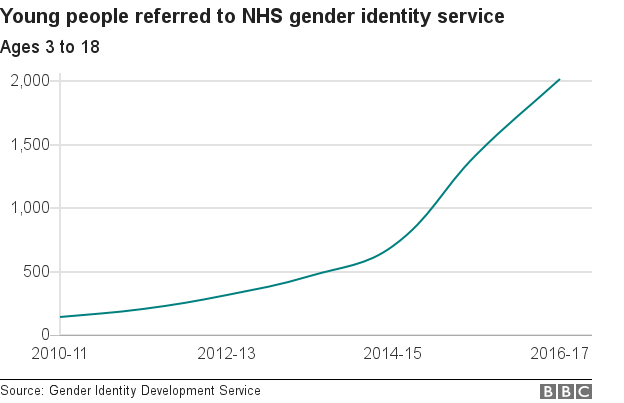
More than 2,000 young people, aged between three and 18, were referred to a specialist NHS clinic in 2016-17, seeking help with their gender identity.
The numbers have been growing every year since the start of the decade.
Of 2,016 young people referred to the Gender Identity Development Service (GIDS) in the most recent year, 1,400 were assigned female at birth.
Polly Carmichael, a consultant clinical psychologist and director of GIDS, said there was no single explanation for the increase but said there had been “significant progress towards the acceptance and recognition of transgender and gender diverse people in our society”.
Dr Carmichael said the majority of the service’s users did not take up physical treatment.
There were two children referred aged three in 2016-17. The service rejected 30 referrals of people who were already 18 years old.

The Christian Legal Centre, which is supporting Mr Sutcliffe, said he faced an internal disciplinary hearing on Wednesday.
The state academy school where he is employed said the matter was confidential.
However, it said it took equality and discrimination seriously and had a range of governor-approved policies in place to ensure it acted lawfully.
LGBT charity Stonewall said “pupils must be protected” even if teachers may hold “different opinions” about sexuality and gender identity.
It did not want to comment on the case involving Mr Sutcliffe, but it said “children should always feel included and accepted for who they are”.
Sperm smugglers: How women are smuggling sperm out of Israeli prisons
Lydia Rimawi has just given birth to what she calls a gift from God. Baby Majid – new life born out of an underground smuggling ring that’s rippling through Israel’s prisons.
I’m talking about Palestinian babies born from sperm smuggled out of Israeli prisons.
The imprisoned men are convicted of participating in what Israel deems terror attacks. To most Israeli’s – the men are considered terrorists.
To Palestinians – they’re martyrs.
Their wives – the smugglers whose tactics have been shrouded in secrecy… Until now.
For the first time the women shared their secret methods. On my trip to Palestine reporting this story over three days these women invited me into their lives and homes to reveal their successes and plans to continue to smuggle sperm out of Israel’s prisons.
There are around 4,700 Palestinian husbands, sons and brothers imprisoned in Israeli jails. Many of them are serving life sentences.
These Palestinian prisoners are not permitted conjugal visits and permitted visits are restricted to 45 minutes. Husband and wife are separated by a sealed glass panel and communicate via telephone. No physical contact is allowed at any time.
Lydia and her counterparts – Em Rafat and Samia are amongst a growing number of Palestinian women refusing to let the ongoing conflict between Palestinian and Israeli forces halt their lives.
They’re keeping their husbands legacies alive – one shot of semen at a time.
There’s an overwhelming sense of accomplishment in the room today following Lydia’s birth. She is chanting “we did it, we challenged the Israeli’s and this is the biggest victory for us and I have a beautiful baby boy”.
Lydia is not the only one of these women with a cause for celebration. Samia whose husband is serving multiple life sentences is five months pregnant.
Em Rafat’s son has been in prison for seven years. His wife is eight months pregnant.
As the Islamic call to prayer floats over the West Bank, I’m told Lydia’s counterparts are planning their next smuggle ‘operation’.
It’s my last day in The West Bank and the morning of the operation I meet Em Rafat in her home village near Ramallah. She is allowing me to accompany her along to Ramon prison where her son is.
Due to stringent Israeli security measures the trip can take up to 14 hours. This is the same journey she made 9 months ago when she smuggled out sperm for her daughter in law.
The women claim the prisoners bring the sperm ready to each visit. But I was left bewildered as to how they get the sperm out and how it survives.
IVF experts say sperm can survive outside the body for up to five days only if kept at 37 degrees.
According to specialist Dr Salem Abu Khaizaran who helps these women with the IVF procedure there a currently 65 samples of smuggled sperm, 16 women pregnant, and three about to have their babies.
Dr Salem explains to me the variety of ways that he’s had samples delivered to him.
“The samples come to me in different forms either in eye-drops containers, nose-drops containers, some of them give it in plastic gloves in different forms. The strangest thing the sperm came to us in was through a chocolate wrapper,” says Dr Salem.
Several checkpoint security breaches later, the threat of my camera being smashed to pieces by guards and a very hairy situation that just escalates as the adventure progressed – this is a story that definitely won’t leave me for a while.
I can tell you the sperm, the smugglers and myself all came out unscathed – with some extraordinary footage but it was by no means an easy feat.
I hope this underground network of Palestinian women and their phenomenal courage, determination and strength of spirit will leave you feeling as amazed as I am. They are truly a force to be reckoned with.
Poland defends massive far-right protest that called for a ‘White Europe’
By Avi Selk
Thousands gathered in central Warsaw on Nov. 11 for a march organized by radical far-right groups. The march coincided with Poland’s independence day.
CORRECTION: Earlier versions of this article — including the original headline — cited a CNN report that said a “Pray for an Islamic Holocaust” banner was displayed at the weekend march in Warsaw. CNN has since corrected its story and removed its reference to the banner. A similar banner was hung in another Polish city in 2015, according to local reports, but not at Saturday’s march. This post has been updated.
____________________
The official celebration of Poland’s 99th independence day went innocuously, with the usual ceremonies in the capital. There was even a visit from the European Council’s internationalist president, who insisted to Politico that Saturday’s festivities would proceed “with a smile on our face and with joy in our hearts.”
But for blocks and blocks and blocks beyond the central towers of Warsaw, a much larger crowd swelled beneath a cloud of red smoke.
Tens of thousands of people had come from across Poland and beyond, and reporters documented their signs:
“Clean Blood,” as seen by Politico.
“White Europe” streaked across another banner, the Associated Press reported — as about 60,000 people chanted and marched through Warsaw in an annual gathering of Europe’s far-right movements, which have grown to dwarf the official version of Poland’s independence day celebration.
By the end of the weekend, the AP reported, the official and unofficial events even seemed to be merging.
Police had arrested 45 counterprotesters — but not one of the marchers seen carrying white supremacist symbols or heard chanting “Sieg Heil” in a country where Nazis carried out some of the Holocaust’s worst atrocities.
Rather, Poland’s Foreign Ministry said Monday that the day had been “a great celebration of Poles, differing in their views, but united around the common values of freedom and loyalty to an independent homeland.”

Nov. 11 marks Poland’s celebration of its freedom from imperial rule in 1918. That freedom was interrupted over the following century by brutal occupations, first by Nazis, then communists.
In the 21st century, a group called All-Polish Youth, which the AP reported is named after a radical anti-Semitic group from the 1930s, began hosting a competing Nov. 11 celebration in Warsaw.
It began as a small thing, Politico reported. No more than a few hundred people showed up to the march in 2010, although the numbers soon grew into the thousands.
In some years, the spectacle turned bloody — as when masked marchers threw rocks, flares and paving slabs at police in 2014, according to the BBC.
But in 2015, the conservative Law and Justice Party took power in Poland, fueled in part by anti-immigration politics that helped put other right-wing parties in power throughout Europe.
By all accounts, the Nov. 11 rallies since then have been fairly peaceful and very large.

Some who marched under the flares and red smoke on Saturday were families and children, the AP reported. But more noticeable were droves of young men, some masked — and some chanting, “Death to enemies of the homeland.”
There was some violence Saturday, the AP reported, when nationalists pushed and kicked a group of women holding a banner that said “Stop Fascism.”
But that was the only such report. A heavy police force kept the small assembly of counterprotesters separated from the far-right march.
Far-right leaders from Britain and Italy were welcomed by the crowd, according to the AP. (The U.S. alt-right leader Richard Spencer had been deemed too extreme by the Polish government, and he canceled his plans to attend.)
An Israeli Foreign Ministry spokesman called the march dangerous, per the AP.
“History teaches us that expressions of racist hate must be dealt with swiftly and decisively,” he said — perhaps referring to the Nazi-era Warsaw ghetto, where hundreds of thousands of imprisoned Jews were deported to extermination camps if they were not killed before.
But the Polish Foreign Ministry waved off the worst reports about the crowd as “incidental,” the AP reported.
After the rally ended Saturday evening, a reporter asked Poland’s interior minister — a member of the right-wing government — what he thought of the banners and chants of “white Europe” and “pure blood.”
“It’s only your opinion, because you behave like a political activist,” he replied, Politico reported. According to the AP, the same minister called that swollen, crimson-fogged march across Warsaw “a beautiful sight.”
When Will We Have Designer Babies
By Whitney Kimball
Within 20 to 40 years, sex will no longer be the preferred method of reproduction. Instead, half the population with decent health care will–no shitting you–have eggs grown from human skin and fertilized with sperm, then have the entire genome of about 100 embryo samples sequenced, peruse the highlights, and pick the best model to implant. At least that’s what Stanford law professor and bioethicist Hank Greely predicts in The End of Sex and the Future of Human Reproduction. But skin-grown humans aside, how long until we have “designer babies”?
Here’s where we are: a gene-editing tool called CRISPR/Cas9 has produced a variety of terrifying wonders over the past few years. In August, a group of scientists announced that they had successfully edited a human embryo to eradicate a heart condition. (The validity of their paper, published in the journal Nature, is now disputed, but Chinese scientists also claimed to have edited embryos in 2015, though with less success.) And “designer pets” are already within reach; mice have been turned green. Beagles have been doubledin muscle mass. Pigs have been shrunk to the size of cocker spaniels with “designer fur.” Woolly mammoths are being attempted.
Greely expects human selection to be less like the Build-a-Bear workshop which “designer pets” suggests, in which you start from scratch with a base animal and pick features from a menu, but rather in which prospective parents select from a pot of about 100 embryos made by two people for preferences like gender and health, and maybe tweak out the hereditary diseases with CRISPR/Cas9.
It’s debatable when and how CRISPR-edited embryos will be approved for implantation (Congress has currently banned the FDA from even considering it), and scientists are currently wrestling over putting a moratorium on its use on humans. CRISPR’s own co-founder Jennifer Doudna fears what eugenic nightmare her technology could bring; in 2015, she co-signed a letter calling for thorough investigation into potential risks “before any attempts at human engineering are sanctioned, if ever, for clinical testing.”
This week on Giz Asks, we asked geneticists, bioethicists, and biotechnology experts and skeptics whether a future of “designer babies” is as crazy as it sounds.
Hank Greely
Director, Center for Law and the Biosciences at Stanford University, author of The End of Sex and the Future of Human Reproduction
I think that when average readers hear the term “gene editing,” our minds jump to Gattaca or a build-a-bear workshop for babies where you walk into a lab and select desirable traits (strength, beauty, intelligence, etc) from a pamphlet.
I think GATTACA was much more about selection than about editing, but, yes, most people have an exaggerated view of what is possible.
We don’t know anything, really, about genes that give increased IQ. I suspect–and in my book, The End of Sex, I predict–that in 20 to 40 years we’ll know a little, but not much–maybe enough to say “this embryo has a 60% chance of being in the top 50%” or “a 13% chance of being in the top 10%.” Intelligence is just too complicated and despite decades of work only genes associated with very low intelligence have been found.
Note, though, that you said “genetically select”–selection is more about preimplantation genetic diagnosis [PGD, pre-screening for genetic diseases in embryos] and picking among embryos randomly created by a couple. Editing is intentionally changing DNA away from what the couple created. Neither, though, works worth a damn unless you know what the relationship between the DNA and the trait is and not only aren’t we close with intelligence, we may never be very good at it: too many genes are involved, along with too much environment and too much luck!
…On eye color, hair color, skin color, etc., we’ve got some clues now and will be pretty good in ten to 20 years–though I doubt CRISPRing embryos will be shown to be safe and ready for clinical use in less than 20 to 30 years. On IQ, math ability, sports ability, music ability, personality type we’ll have some information but probably not very much: 60%, 70%, maybe 80% chances of being in the top half but not 90 to 100%. … Right now, though, we have made almost no progress on those traits or on common complicated diseases like asthma, type 2 diabetes, or depression.
… The more simple genetic diseases like Huntington’s disease turn out to be quite rare–common diseases are usually a mix of heavily genetic, somewhat genetic, and not at all genetic. For example, 1% of people with Alzheimer disease (and so about 1 person in a 1000 in the population) have an early onset form that is very strongly genetic. If you have the gene variation involved, the only way you won’t get the disease in your 40s or 50s is to die first from something else. About 4% of the population have two copies of a genetic variation that gives them a 50 to 80% chance of getting AD, compared with the overall average 10% or so. About 20% of the population has one copy of that variant and has about a 20 to 40 percent chance. About 2% of the population has two copies of a different version of the same gene and seem to have zero chance of getting AD. And most people with Alzheimer disease have no copies of any of the known, strong genetic risk factors for it. That’s what most common diseases are like; most behavioral traits will likely be even worse.
Glenn Cohen
Harvard Law School Faculty Director, Petrie-Flom Center for Health Law Policy, Biotechnology & Bioethics, leading expert in bioethics and law
I do not love the term “designer babies” because it is imprecise. [In one sense], they are already here and have been for a long time. When [individuals] consider need to use a sperm donor for artificial insemination… they engage in a form of trait selection. The catalogues that feature sperm “donors” (donors in scare quotes because they are paid) recruited for sperm banks have already excluded 99% of applicants, and who is left tends to have very desirable health, intelligence, and beauty traits. The same is true for egg “donors.” So already parents using these technologies are “designing” their babies. And there is nothing to stop someone who wanted to from buying both sperm and egg from donors to maximize their ability to engage in trait selection. For individuals using IVF [in vitro fertilization], there is also the possibility of using preimplantation genetic diagnosis (PGD) to examine the embryos and screen out those predicted to have diseases or other problems and engage in sex selection. The next step on the horizon, written about recently in the MIT Technology Reviewis combining big data from whole genome sequencing and population databases to make predictions on non-disease traits as part of the PGD technique.
Some companies are either directly or indirectly building this into their pitch to investors as that report suggests, though also [the MIT Technology Review reports that some scientists are skeptical]: “Some experts contacted by MIT Technology Review said they believed it’s premature to introduce polygenic scoring technology into IVF clinics—though perhaps not by very much. Matthew Rabinowitz, CEO of the prenatal-testing company Natera, based in California, says he thinks predictions obtained today could be “largely misleading” because DNA models don’t function well enough. But Rabinowitz agrees that the technology is coming.”
Even if perfected this will only be available to individuals willing to go through IVF and PGD, costly in both time, money, and health risks. So I don’t know how much uptake there will be in the near future. The more radical change would come if In Vitro Gametogenesis became cheap, safe, approved, and easy such that we could generate a large number of eggs without having to make women go through egg retrieval. I am a bit more skeptical it will be [as quick as Hank Greely suggests], but do think that such technology will be used in the future. Finally, if CRISPR gene editing becomes available as a therapeutic technique in the US, and we get much much better at targeting what to edit, it may be possible to do all this with fewer embryos generated and have more options since we can alter existing embryos instead of waiting to find an embryo that has the desired traits created through natural means. I am skeptical though that the regulatory system in the US will allow human use of this on embryos in the foreseeable future.
So the bottom line is on some definitions of designer babies they are here already and have been for some time. On other definitions I think the estimate is somewhere between 20 to 100 years depending on what you think about the progress of technology and the regulatory system in our country.
David Liu
Harvard professor in Chemistry and Chemical Biology, founder of five biotechnology companies and lead researcher and innovator in gene-editing technologies
When will “designer babies” become a reality–if so, how many years from now, and what would that look like? For example, will there be a time when people will be able to edit their future child’s genes to lead to greater strength, musical talent, mathematical genius?
Probably never. There’s a common misconception that allows people to imagine designer babies as you describe them. The misconception is that traits such as the ones you list above behave in a “Mendelian” manner—that is, like the traits of Gregor Mendel’s famous pea plants: tall vs short plant, green vs yellow seeds, etc. It turns out that the vast majority of human traits are not “monogenic,” meaning that they are not determined by the DNA sequence of a single gene. Instead, traits such as mathematical or athletic or musical ability reflect thousands of genes—recent research suggests perhaps even all of our genes!—as well as many environmental factors.
So even if one imagines a future in which (A) genome editing capabilities are truly like word processing (note: we aren’t there yet!), and (B) editing of human embryos, currently quite controversial and not practiced in most countries, is commonplace, it’s still unlikely that designer babies with traits such as higher intelligence or superior athletic skills will ever be possible. Human genetics simply doesn’t work that way. Finally, it’s also worth pointing out that the screening of human embryos to avoid certain genes strongly associated with devastating genetic diseases prior to implantation and pregnancy is already taking place in a number of countries around the work, and has been for a number of years.
…Even cosmetic traits such as hair and eye color, while genetically simpler than mathematical ability, aren’t really monogenic. Also, one has to consider the cost, risks, and ethics associated with such a procedure. The risks and costs and ethical challenges are easier to bear if the outcome is to avoid an incurable, fatal genetic disease that causes great suffering. For changing eye color, it’s not so compelling.
Dietrich M. Egli
Assistant Professor of Developmental Cell Biology at Columbia, prominent skeptic of the recent “breakthrough” claims of successful embryonic editing by CRISPR technology
The technique is not there yet. Nobody has shown that they can modify the genome of the human germ line and reliably avoid adverse effects. Nobody knows when that hurdle will be overcome. The claim based on a recent paper that appeared in Nature reporting they could [edit the DNA of a human embryo without adverse effects] is most likely wrong.
Does that imply that we are not even at a place where we can use gene-editing at all, for anything? CRISPR is not an effective tool yet? And what kind of adverse effects? Leading to mutations of some kind?
[CRISPR] works very well in cultured cells, where you can afford to have a less than 100% efficiency, and then simply select those that worked. It may also work for gene therapy in somatic cells.
And, its an amazing research tool. No clinical applications yet. It’s just a few years since it has been discovered.
Do you think there’s a natural balance of how many super-traits a person can possess, in a similar way to how when homo sapiens’ jaws shrank, it made more room in the skull for a larger brain? For example, would it offset the natural balance if math wizards were also born football players and possessed the musical talents of Mozart?
I don’t think there is a good answer to that. There are tradeoffs and constraints in the human body. There is also a huge gap of knowledge what a specific variant could accomplish.
For instance, there are some variants that protect against malaria, but cause [sickle cell] disease as well. The most meaningful thing to do is to further study the human genome to enable improvements in human health.
Dr. Robert Green
Medical geneticist and director of the Genomes2People Research Program at Brigham and Women’s Hospital; Professor of Medicine, Harvard Medical School
If we’re talking about the next five to ten years, I think what’s really exciting about these technologies is that they may allow us to edit genetic errors. Genetic errors like a mutation that would cause a disease in an infant. I think that that’s really the focus, it’s the disease focus, not the designer baby focus. That’s point number one.
Point number two is most of the traits that you can imagine someone trying to enhance, which is intelligence, height, athletic ability, musical ability and so forth, are probably very multi-genic traits. They are traits that many, many genes, many regulatory regions and so forth. They are very complex. Even if there were not ethical rules in place, which I think there probably will be … I think that it would be very, very difficult to [change those things].
If, say, the United States outlaws that kinds of thing, do you think other countries might start offering services where you can edit for things like hair and eye color? Do you foresee that as an inevitable consumer service?
I guess, I think that things like that are possible, for sure. I think that the hope is that most countries will try to agree on guidelines for which most of humanity will agree to and abide by because of the potential to do so much harm when messing with DNA to lose embryos, to create diseased human beings. I do hope that such actions as selecting for specific cosmetic differences might not be encouraged or permitted, but I am aware that there are reproductive clinics already in which gender selection is done. Embryos are created, they are looked at for a potential gender and then implanted. It is going to be difficult to regulate. Yes, all that can take place.
How quickly do you think this could happen, if the technology made it to the market, for consumers to use those services?
I guess theoretically, I would say, within a decade. But again, even things like hair color may be driven to certain traits. An eye color may be driven by a few genes, but you’ve got to imagine most people do not want to put their embryos at risk for anything less than avoiding a really serious disease. The notion that you would put an embryo, this child, at great potential risk–we really aren’t going to know the long-term effects of mocking around in the DNA of a human embryo and to put an embryo at risk for what you perceive to be a cosmetic improvement, I think would be against the principals of most responsible parents.
Oklahoma Man Lead Police on Wild Car Chase, Pistol-Packing Pastor Joins In
OKLAHOMA CITY, OK (KRQE/KOCO) – The driver of a stolen pickup truck led police on a wild chase through Oklahoma City that lasted nearly three hours.
He weaved through neighborhoods, squeezed through gates and went to wrong way down the road, barely missing oncoming traffic.
Police threw spikes, but he got around them.
A stranger even tried to stop him, but police finally got the upper hand when the driver flew backward into a pond.
He then started running, falling several times while trying to keep his pants on. Police tased him and finally led the suspect off in handcuffs.
In an interview with KOCO 5, a pastor says he opened fire on the man. He said he saw the chase on TV, spotted the suspect, and decided to follow him.
Craig Wright said he parked his car on the road in an effort to block the suspect in and asked if he needed any help, but the suspect drove off, KOCO 5 reports.
That’s when the pastor says he grabbed his gun.
Paradise Papers reveal the rise of a new class: The global oligarchy
By Conor Lynch
In response to the recent leak of 13.4 million files from two offshore service providers earlier this week, which documents how the world’s wealthiest individuals and corporations avoid paying taxes on their fortunes, Sen. Bernie Sanders, I-Vt., warned that the world is quickly becoming an “international oligarchy.”
“The major issue of our time is the rapid movement toward international oligarchy in which a handful of billionaires own and control a significant part of the global economy,” Sanders said in a statement to The Guardian, one of the major newspapers reporting on the so-called Paradise Papers. “The Paradise Papers shows how these billionaires and multinational corporations get richer by hiding their wealth and profits and avoid paying their fair share of taxes.”
A who’s who of prominent and wealthy individuals have been implicated in the Paradise Papers, the bulk of which come from the offshore law firm Appleby. This includes right-wing hedge fund billionaire Robert Mercer, rock star Bono, Commerce Secretary Wilbur Ross, pop star Madonna, Queen Elizabeth and many others. Multinational corporations such as Apple, Facebook, Uber, Nike, Walmart and McDonalds have also been implicated in the leaks.
That corporations and billionaires evade taxes by stashing their money offshore is hardly a revelation, of course. The Paradise Papers come about a year and a half after the Panama Papers — a leak of 11.5 million documents from the Panamanian offshore service provider Mossack Fonseca. These leaks do, however, provide an insight into the world of global economic elites and the rise of what is essentially an international plutocratic class.
“Appleby operates in a rarefied universe of U.H.N.W.I.’s — the industry’s abbreviation for ultra-high-net-worth individuals — where yachts and private jets are preferred transport and mansions sit empty because their owner has several others,” The New York Times reports. “The ranks of the superrich are growing fast, fueled by legitimate fortunes in finance, trade and technology — as well as drugs, embezzlement and bribery. And the offshore finance industry has grown alongside its customers’ accounts.”
This class of “ultra-high-net-worth individuals” is a relatively diverse group of people from around the world (though about half are American, and most are men), with different religious beliefs, different political views and different cultural backgrounds. But they all seem to share a kind of class consciousness. Global plutocrats of the 21st century tend to have more in common with (and more allegiance to) their own economic class than their own country, political party or cultural/religious group.
In some ways, this is nothing new: the wealthy have always been more aware of their own economic interests and social status than members of the lower classes, who are often driven (and divided) by social and cultural issues (much to the chagrin of labor organizers and socialists). In his classic 1956 book “The Power Elite,” sociologist C. Wright Mills discussed the class consciousness of America’s economic and political elite during the postwar period:
All the structural coincidence of their interests as well as the intricate, psychological facts of their origins and their education, their careers and their associations make possible the psychological affinities that prevail among them, affinities that make it possible for them to say of one another: He is, of course, one of us. And all this points to the basic, psychological meaning of class consciousness. Nowhere in America is there as great a “class consciousness” as among the elite; nowhere is it organized as effectively as among the power elite.
Sixty years after Mills wrote these words, the world has become increasingly globalized and so has the “power elite.” Plutocrats of this century are no longer as bound to their own country as they once were, and nowhere in our globalized world is there as great a class consciousness as among the billionaire class. The richest 1 percent of the world’s population now owns more than half of global wealth, and the eight richest men on the planet have more wealth combined than the poorest 3.6 billion people. As the Paradise Papers show, these “ultra-high-net-worth individuals” have no intention of spreading the wealth and will do whatever it takes — whether it’s hiding their money offshore or buying political influence — to further their interests.
All of this indicates that we are well on our way to becoming what Sanders calls an “international oligarchy,” where democracy is either nonexistent or treated as a facade, and elites have complete control over the economy. But this is not inevitable, and it is still possible to reverse this trend. To do this, however, working people will have to come together to fight for their own interests and challenge the status quo.
There are two forms of populism that are currently being offered as alternatives to international oligarchy. On the right, reactionary populists present the current divide between the 1 percent and the 99 percent as a struggle between “globalists” and nationalists, and seek to divide the working class by scapegoating minorities, immigrants and foreigners for problems that have been created by global capitalism. On the left, progressives and socialists aim to create an international working class movement that challenges both capitalism and the power of global elites.
So while the right promotes what Marxists have traditionally called “false consciousness,” which keeps the majority fractured and weak, the left promotes class consciousness and a politics of solidarity. It is not hard to see which side is truly confronting the power elite and offering a real alternative to oligarchy. It’s not the side of Donald Trump but that of Bernie Sanders.
Gal Gadot doesn’t want to work with Ratner on another ‘Wonder Woman’
A month after canceling to appear at a dinner to honor Brett Ratner, Gal Gadot still has a lot to say about the famed director and the accusations mounting against him.
Now, Gal says she won’t reprise her role for future “Wonder Woman” movies unless Brett Ratner is not involved, reports Page Six. Brett Ratner’s production company produced the film in conjunction with Warner Brothers.
“Wonder Woman” has already brought in over $400 million. But if Gal Gadot has anything to say about it, the producer won’t see another dime.

Brett made a lot of money from the success of ‘Wonder Woman,’ thanks to his company having helped finance the first movie,” a WB insider said.
“Now Gadot is saying she won’t sign for the sequel unless Warner Bros. buys Brett out [of his financing deal] and gets rid of him. She also knows that Warner Bros. has to side with her on this issue as it develops. They can’t have a movie rooted in women’s empowerment being part-financed by a man accused of sexual misconduct against women.”
When news first broke against Brett Ratner, Gal immediately took to Instagram to post a statement.
Earlier in the week, Warner Brothers ended their working relationship with Brett Ratner after multiple women came forward accusing the director of sexual harassment — including women like Olivia Munn and Ellen Page.
We’ll see if this wonder woman really can make a difference in Hollywood!
Thousands sign petition to ban child sex dolls
(KUTV) A petition on Change.org is calling to ban child sex dolls, which are lifelike, anatomically correct, and designed to simulate sex with a child.
The petition has received over 88,500 signatures, and has even been noticed by Salt Lake City Councilwoman Erin Mendenhall.
According to the petition, these dolls are currently “perfectly legal” to import.
“British police have seized more than 100 already in the UK, and authorities have found that the people buying them usually have child pornography too,” the petition says.
The petition states, “These child sex dolls can normalize a pedophile’s behaviors, emboldening them to harm children, as is often the case with those who view child pornography.”
“According to the CDC, 1 in 5 children are sexually abused. One child is too many,” the petition says. “Our elected officials need to protect children. That’s why Congressman Dan Donovan from New York is introducing legislation that will ban the distribution and sale of dolls that encourage child abuse.
New York Congressman Dan Donovan (R-Staten Island/Brooklyn) has said that he believes the dolls reinforce pedophilic behavior.
Some have suggested that pedophiles who use the dolls will be less likely to commit crimes.
Donovan is adamantly opposed to this view. “It doesn’t satisfy urges,” he says. “This is just a stepping stone.
In August Donovan unveiled a plan to “prevent the exploitation of innocent children.”
Seeing a scary new proliferation of child sex dolls makes it so important for our laws to evolve,” the Congressman said.
As of yet the Congressman doesn’t have any other supporters of the bill, but said, “I don’t think we’ll have a hard time finding cosponsors.”
You can sign the petition by clicking here.
Moore’s brother denies charges, compares persecution to Jesus
(CNN)Roy Moore’s brother is defending the GOP Senate candidate “to the hilt” amid the escalating controversy over allegations of sexual misconduct against him, according to CNN correspondent Martin Savidge, who spoke to the brother on the phone.
Jerry Moore firmly denied the allegations against his brother and drew an analogy between his situation and the persecution of Jesus Christ, Savidge reported Friday in an interview with CNN’s John Berman.
Savidge spoke to Jerry Moore on Friday morning, one day after an explosive Washinton Post report detailed allegations that the Republican Senate candidate from Alabama pursued sexual relationships with several teens when they were between the ages of 14 and 18 and he was in his thirties, including an alleged sexual encounter with the 14-year-old, who would not have been at the age of legal consent under Alabama law.
Jerry Moore said, “he knows … that the allegations against Roy Moore are not true, not true at all,” Savidge reported. The younger Moore also said “he’s very concerned about what the impact is going to be on their 91-year-old mother, hearing all of this, they worry about her age and health,” Savidge said.
Moore also claimed that the Democratic Party was behind what he called “false allegations,” and that “these women are going to, as [Moore] put it, have to answer to God for these false allegations,” Savidge said.
“When I asked what does he believe the motivation is with these women coming forward making the accusations they have, again, Jerry Moore says it’s money and the Democratic Party, implying that they are doing this because they’re being paid in some way, and it is for the purpose of derailing or interrupting this campaign,” Savidge said.
Moore went so far as to say “that his brother is being persecuted, in his own words, like Jesus Christ was,” according to Savidge. “Very defiant and very outspoken, relying on his faith and defending his brother to the hilt.”
Roy Moore, who faces a December 12 US Senate election, denied the allegations in the Post report, telling the newspaper: “These allegations are completely false and are a desperate political attack by the National Democrat Party and The Washington Post on this campaign.”
Later Thursday, the candidate tweeted, “The Obama-Clinton Machine’s liberal media lapdogs just launched the most vicious and nasty round of attacks against me. We are in the midst of a spiritual battle with those who want to silence our message.”
“The forces of evil will lie, cheat, steal — even inflict physical harm — if they believe it will silence and shut up Christian conservatives like you and me,” he wrote.
Texas Church Where Massacre Took Place Will Be Demolished, Pastor Says Facebook Twitter Flipboard Email
The pastor of the Texas church that was the site of a deadly shooting rampage this week says the bullet-riddled structure will be demolished because it is too stark of a reminder of the massacre.
Pastor Frank Pomeroy, whose 14-year-old daughter, Annabelle, was among the victims, told the Southern Baptist Convention on Thursday that he plans to have the church razed.
“There’s too many that do not want to go back in there,” Pomeroy told The Wall Street Journal.
“The pastor expressed his desire that perhaps the best way forward is to have the church demolished and replaced with a prayer garden,” convention spokesman Roger “Sing” Oldham, was quoted by USA Today as saying.
He added that parishioners haven’t “had a chance to fully deal with the grief and then come together to make a decision.”

Enlarge this image
A law enforcement official leaves the First Baptist Church on Tuesday, in Sutherland Springs Texas.
David J. Phillip/AP
Oldham was quoted by The Associated Press as saying the church is “too stark of a reminder” of Sunday’s mass shooting in which a gunman opened fire on the building with a semiautomatic assault-type rifle, killing more than two dozen people and wounding 20 others.
According to The Associated Press:
“Other sites of mass shootings have been torn down, including Sandy Hook Elementary in Newtown, Connecticut, where a gunman killed 20 children and six adults in December 2012. A new school was built [on the same site].
A one-room Amish schoolhouse near Lancaster, Pennsylvania, was torn down in 2006, 10 days after an assailant took children hostage and shot and killed five girls ages 6 to 13.”
Correction
Nov. 10, 2017
A previous version of this story quoted an incorrect statement from the Associated Press that the Sandy Hook Elementary school was rebuilt elsewhere. It is on the same site although not in the same footprint as the original school.
Woman who flipped off Trumps Motorcade gets fired
A photo of a woman giving President Donald Trump’s motorcade the middle finger went viral more than a week ago.
People on social media hailed Juli Briskman as a “she-ro.” A hashtag, #her2020, arose.
However, her employer, government contractor Akima LLC, was not pleased with the middle-fingered salute.
They fired the 50-year-old mother of two over it.
A White House photographer traveling with the president snapped a picture of Trump’s motorcade passing a bicyclist when he left a golf course in Sterling, Va., last week.
“He was passing by and my blood just started to boil,” Briskman told HuffPost. “I’m thinking DACA recipients are getting kicked out. He pulled ads for open enrollment in Obamacare. Only one-third of Puerto Rico has power. I’m thinking, he’s at the damn golf course again.”
The Democrat followed her instincts while she was on her usual biking path.
“I flipped off the motorcade a number of times,” Briskman told HuffPost.
The photo immediately went viral.
Briskman decided to give her job’s HR department a heads up when she went to work last Monday.
On Tuesday, her bosses told her that she violated the company’s social media policy by using the viral image as her profile picture on Facebook and Twitter.
They said, ‘We’re separating from you,'” Briskman told HuffPost. “Basically, you cannot have ‘lewd’ or ‘obscene’ things in your social media. So they were calling flipping him off ‘obscene.'”
Briskman, who worked in marketing and communications at Akima for just over six months, argued that she didn’t mention her employer on social media and was off-duty when the photo was snapped.
She was still canned because the government contractor said the incident could hurt business.
Briskman questioned how the company’s policy is enforced, saying a male colleague was recently allowed to keep his job after calling someone “a f–cking Libtard a–hole” on Facebook.
“How is that any less ‘obscene’ than me flipping off the president?” she said to HuffPost. “How is that fair?”
Akima did not comment on the situation.
Despite losing her job, Briskman doesn’t regret her form of protest.
“I’d do it again,” she told the Washington Post.
She has contacted the American Civil Liberties Union about the situation, according to the Post.
Viral Vigil Ep #6 / 11.09.17
Gunman opens fire at Texas church, kills 26
A black-clad gunman opened fire Sunday at a rural church outside San Antonio, killing at least 26 — including several children — and wounding at least 10, law enforcement officials said.
The killer, pursued by a good Samaritan with a gun, was found fatally shot a short time later in a neighboring Texas county, said a law enforcement official who is not authorized to comment publicly.
Authorities did not immediately identify a motive for the attack at First Baptist Church of Sutherland Springs, and they did not officially identify the gunman. But two law enforcement officials who were not authorized to comment publicly identified the gunman as Devin Kelley, 26, of nearby Comal County, Texas.
Kelley served briefly in the Air Force but was court-martialed in 2012, a military spokeswoman said.
Speaking to reporters late Sunday, Texas Gov. Greg Abbott said, “There are no words to describe the pure evil that we witnessed in Sutherland Springs today.”
Abbott said officials were cautiously releasing information on the shooting, including the names of victims, who ranged in age from 5 to 72 years old.
Officials said 23 of the 26 victims were shot inside the church.
“There’s a lot of information,” Abbott said. “We want to piece the puzzle together.”
Freeman Martin of the Texas Department of Public Safety said the shooter, who was dressed in black and was wearing a ballistic vest, was spotted at about 11:20 a.m. at a Valero gas station across from the church. Witnesses said he drove across the street, got out of his vehicle “and began firing at the church” with a Ruger assault-type rifle.
He moved to the other side and continued firing, then entered the church, Martin said, where he “continued to fire.”
As the suspect left the church, Martin said, a bystander retrieved a rifle and began firing at the shooter, who dropped his Ruger and drove away.
“Our local citizen pursued the suspect at that time,” Martin said.
As law enforcement responded, the suspect drove off a roadway at the Wilson County/Guadalupe County line, Martin said. He was found “deceased in his vehicle,” he said, but officials were not immediately certain if the fatal wound came from a self-inflicted gunshot or from the person pursuing him.
In a late Sunday news conference around the corner from the church, Wilson County Sheriff Joe Tackitt said as far as he knows the suspect had no ties to the town or knew anyone in the church, but that information was still being investigated.
“We don’t know why he was even here,” Tackitt said.
When asked if anyone has been able to describe to him the scene in the church, Tackitt replied, “All I can say is it was terrible.”
“It’s unbelievable to see children, men, women laying there,” he said. “Defenseless people. It’s just something you don’t want to see.”
Describing the layout of the church, the sheriff said he doesn’t think people could have escaped the attacker.
“You’ve got your pews on either side when you’re walking down the aisle and he just walked down the center aisle, turned around and was, from my understanding, shooting on his way back out,” he said. “There was no way anyone could have escaped.”
Tackitt said he knew quite a few of the people who were in the church, later describing the community as one where “pretty much everyone knows everyone.” He said recently the church hosted a fall festival.
“A week later this happens,” he said.
He confirmed a family had been killed, though he didn’t confirm number of people in the family, describing it as a “a pretty high number.” Tackitt said he’s known the family “forever.”
Frank Pomeroy, who is pastor at the church, told ABC News he was out of town when the rampage took place, but that his daughter was killed. Annabelle, 14, “was one very beautiful, special child,” Pomeroy said.


Annabelle Pomeroy was the pastor’s 14 year old daughter.
“Every one of our family’s close friends are gone.”
Pray for #SunderlandSprings
1 1 Reply
17 17 Retweets
25 25 likes
Paul Buford, pastor of nearby River Oaks Church, said his service was underway when first responders in his congregation were called to the scene. He said some members of the community had “confirmed information” about family members and friends. Buford declined to provide any details.
“We are pulling together as a community,” Buford said. “We are holding up as best we can.”
President Trump, addressing the shooting before speaking to U.S. and Japanese business leaders at a meeting in Tokyo, said the federal government will give “full support” to Texas as it deals with the aftermath of the “horrific shooting” at the church. While these are “dark times,” Trump said, Americans will do “what we do best: We pull together.”
Trump ordered that the U.S. flag be flown at half-staff at the White House and elsewhere through Thursday
Sexually active students must be reported to law enforcement or state officials, Ore. school district says
By Travis M. Andrews

The Salem-Keizer School District Headquarters (Google Maps)
Teachers and staff in the Salem-Keizer school district — which includes more than 40,000 students — were recently told that if they learn or merely suspect a student is sexually active, they must report it to law enforcement or state officials.
According to Oregon law, anyone under 18 years old cannot legally give consent, meaning all sexual activity between minors is considered sexual abuse. This policy, district officials say, stems from Oregon’s mandatory reporting and child abuse laws. But that seems to be a singular interpretation of the law. The Statesman Journal reached out to school districts around the state and found that not one of them had the same mandate.
The subject came up at a training session for teachers and staff in the school district because “we felt like we hadn’t made it clear enough,” as Superintendent Christy Perry told the Statesman Journal.
During the presentation, the district offered several specific examples of when an employee needs to contact law enforcement. These include a 15-year-old telling a teacher that she is having sex with her boyfriend and wants to learn about birth control, or a 17-year-old confiding in a teacher that his 16-year-old girlfriend is pregnant.
Another example: “A 14-year-old boy confides in you that he was kicked out of the house after his parents discovered that he was in a same-sex relationship. During the conversation, the student shares that he has engaged in sexual acts with his partner.”
The district claimed the policy is for the teenagers’ safety.
“Simply reporting to the state doesn’t mean police are going to be knocking on the door of students,” district spokeswoman Lillian Govus told KOIN. “What it does allow for is an abundance of caution in ensuring that our children are safe.”
Many disagree. An online petition calling for an end to the mandate has garnered more than 1,100 signatures. Some gathered on the state capitol steps to protest the policy.
Some pointed out that this leaves high school students without anyone to speak with about sex.
“You can’t have a conversation about safe sex without talking about sex,” Deborah Carnaghi, a program coordinator for Child Protective Services in Oregon’s Department of Human Services, told the Statesman Journal.
Others pointed out that sexual activity among high school students is common.
“We understand that the law for age of consent is at least 18,” Angel Hudson, an 11th-grader at McNary High School in Salem, Ore., wrote in support of the petition. “But we also understand that jaywalking is illegal, and everyone still does that. It’s a matter that occurs far too often to arrest every single jaywalker.”
More than 40 percent of high school students surveyed by the Centers for Disease Control and Prevention reported having sex in 2015, which if applied to this particular district, would account for almost 12,000 students. The average age Americans have sex for the first time is 17.3 years old.
“I lose the ability to have a private conversation with a trusted adult who works for the district, about something personal to me,” Hudson added. “Talking about sexual activity between teachers and students should be confidential.”
Some teachers said they would simply ignore the mandate.
“To me, I feel like I’m being told to tell the students to shut up,” a teacher who spoke on the condition of anonymity told the Keizertimes. “Teachers are also being told to establish appropriate adult-student connections so that when students come to school they feel safe and cared for. If students have a trusted adult at school that they need to talk with about sex, I see no problem with teachers being that.”
Govus said the district is merely trying to comply with the law.
But the Statesman Journal said it checked with other school districts in the state
“It is not convenient for our educators to report these in all instances and it’s not something that the students desire,” Govus told KOIN. “But for our employees to remain compliant with the law as it is written we must report and that goes for any school district employee [who] must report any sexual activity between minors.”
One parent, though, offered a solution.
“So rather than reporting it to the authorities, use that to gain trust, get insight and educate the kids. That way you’ll know what’s going on,” parent Joyce Stevens told KATU.
Oregon teen was excited to join her high school dance team. Then she learned about the maple syrup wrestling.
By Kyle Swenson
The teenage girls were blindfolded but they could hear the jeering crowd, smell the beer and weed smoke spiking the night air. When their eyes were uncovered, the initiates – freshman members of the Lakeridge High School dance team – saw their school, a well-groomed low-slung campus circled by picturesque hills in suburban Portland, Oregon. A group of 30 older students, boys and girls, stood before them like amped-up ballpark spectators.
The older team members shouted that the freshmen had to do their dance routines, according to court records. As the girls fumbled through the steps, the older teens started bombing them with water balloons, some filled with oatmeal. They were sprayed with large water guns filled with ketchup. The senior team members then told the girls to strip down to the bikinis they had been ordered to wear. They were given garbage bags to don like dresses. A tarp, sticky with maple syrup and feathers, was unrolled on the ground. The young girls were ordered to wrestle.
“Last one standing wins.”
The young girls began toppling each other while helplessly begging. “Please stop, please stop.”
The high school hazing mayhem did not go unnoticed on the night of Aug. 9, 2014. From nearby trees, Taissa Achcar-Winkels secretly filmed her 14-year-old daughter’s public humiliation.
“I was not okay with what had happened,” Achcar-Winkels’s daughter, identified in court records only by initials, told a federal court this week, according to the Lake Oswego Review. “I was terrified. I thought that had I stood up and said I didn’t want to do it, it wouldn’t have ended up well either way.”
The maple syrup wrestling was part of a series of hazing incidents at the center of a trial this week in Portland. Two years ago, Taissa and Ray Achcar-Winkels filed a negligence lawsuit against the Lake Oswego School District, administrators, coaches and others alleging the defendants failed to curb harassment aimed at their daughter and other new members of the high school’s dance team. The gantlet of abuse allegedly played out like “Mean Girls” on steroids – public dares, inappropriate sexual talk, abuse and bullying, according to court documents. But the family alleges the district is also responsible for the retaliation the girl endured after speaking up.
“I was bullied, I was retaliated [against],” the girl told the court this week. “After I spoke up, the principals, the administration did nothing. They just let the girls keep bullying me. I had a really hard time. No one checked to see if I was okay.”
In court this week, the school acknowledged the hazing, but pushed back against the idea the district bore responsibility for the abuse or retaliation.
“No one disputes that this happened,” the school district’s attorney, Karen Vickers told the court, Courthouse News reported. “We all wish those events had never happened. But they did and we are here. The Lake Oswego School District, like all districts in Oregon, has a policy against hazing and bullying. What this case is really about is the challenges faced by high school students, their parents and school officials.”
The student, according to court documents and testimony, was excited to be one of the few freshmen to make the school’s Pacer Dance Team (PDT) during the summer before school started.
The harassment, however, began in June 2014, when the squad went on an overnight “bonding” trip in Gearhart, Oregon, according to a magistrate judge’s findings for the court.
One night during the visit, the team was left alone for a campfire. There, the older members of the squad initiated a game they called “Ten Fingers.” According to the findings for the court, in the game “senior PDT dancers disclosed activities they had previously engaged in and other PDT dancers were to indicate if they had engaged in the same activity by raising a finger. Several senior PDT dancers volunteered that they had taken drugs or engaged in sexual activities, including anal and oral sex.”
The student was so embarrassed by the conversation she had to walk away from the campfire.
In early August, the team gathered at an older member’s house for an “initiation sleepover.” The girls’ phones were taken and they were forced into costumes – “things such as Big Bird, a hot dog, a Skittle, Thing 1 and Thing 2,” the magistrate’s findings state.
Then they were piled into a senior’s car and forced to play “Truth or Dare.” If they chose dare, the girls had to pick their task from a hat. These including running into a restaurant and screaming an obscenity and dancing on the roof of the car.
“They said you have to do it, there was no option. It was just, ‘You’re going to do it,'” the girl told the court this week.
The girls were then blindfolded and taken to the school, where a crowd was waiting with the water balloons and the maple syrup tarp.
Taissa Achcar-Winkels, nervous about what might happen to her daughter during the initiation, had walked to the school and witnessed the hazing. “I was already feeling extremely nervous,” she testified this week. “So I went for a walk. I was just going to go and see what was happening.”
After the wrestling, the initiation wasn’t over. The dancers were next driven to George Rogers Park on the banks of the Willamette River. The new team members were told to get into the water, then asked questions. Every wrong answer meant another step into the frigid river. The teens weren’t allowed to stop until the water was at their shoulders.
The freshman girl voiced her concerns about the hazing to a coach she trusted. The complaints made it to district administrators. They contacted the family, but her father told a school representative the family didn’t want to initiate an official investigation “due to the fear of possible reprisals,” court records say.
Her complaint, however, eventually spread to the rest of the squad and coaches. The other dancers began ignoring her and bullying her on social media, court documents allege. She was also taken off certain dance teams and not allowed to dance at big games – retaliation, the family alleges, for speaking up about the hazing. She quit the team. The school did open an investigation in November.
On Thursday, the school’s principal Jennifer Schiele defended the school’s response to the incidents. “I apologized to her,” she testified, according to the Lake Oswego Review. “I felt terrible about the way she came forward and did not receive support from her peers. I told her if she needed anything, she could come to me. I felt terrible for her.”
Surrogate mother of ‘twins’ finds one is hers
A surrogate mother from California, who gave birth to two babies, found out one of the children was biologically hers.
Jessica Allen became pregnant with her own biological child while she was carrying another baby as a surrogate for a Chinese couple.
Mrs Allen said doctors first thought the second was an identical twin.
As a result, both babies were given to the other woman after delivery and the Allens had to fight to get back their biological son.
‘Not explained’
Mrs Allen had already given birth to two healthy children, but had decided to become a surrogate mother.
She told Newsday on the BBC World Service she had ovulated despite being pregnant.
“I was pregnant through IVF already and at about six, seven weeks they found another embryo and they labelled it that the one embryo that they transferred split and turned into twins.
“My body naturally still ovulated while I was already pregnant – that’s very rare – no one really knows about it but obviously, with my situation, more people are learning about it.
“It’s called superfetation – it has a medical term to it, so why this process is not explained to surrogates, I don’t know. They don’t give this as a possibility.”
‘We definitely want our son’
Mrs Allen said she did not see the babies when they were born last December, but the other mother then texted her pictures of the babies when they were a few weeks old.
The intended mother also said she was waiting for Mrs Allen to feel well before revealing that she had doubts about the origin of one of the babies.
“I immediately freaked out and I asked my case worker, ‘what’s going on, how can this be, what’s happened, how did this happen?’ and she didn’t have any answers for me,” Mrs Allen told Newsday.
“So she [the case worker] said the next thing we need to do is to get me to have a DNA test.”
The intended mother also took the baby for a DNA test and within a fortnight asked Mrs Allen for a Skype call.
“That’s when she announced that the results indicated that I was his genetic mother,” Mrs Allen said.
“During the Skype call she did suggest that we could give him up for adoption and they already had a couple thinking about adopting him.
“At this point we had no idea what to do, so by the end of the call we told her we were going to talk about it, because we needed to figure out how we’re going to get ready for a baby literally overnight.”
However, the next day Mrs Allen told the woman: “We definitely want our son.”
Not on the birth certificate
But Mrs Allen and her husband ran into difficulties because – legally – they were not the parents.
They were told that because the intended mother signed the baby’s birth certificate, she was his legal mother and then if she wanted to give him up for adoption, she could
“I’m not on his birth certificate but I am his genetic mother, my husband is his genetic father and we have that proof through DNA,” said Mrs Allen, who added she and her husband were also asked to pay back part of the fee to the couple because they had paid her to carry more than one child.
They had also incurred fees for a lawyer they had hired to help them get custody of their son.
The Allens were finally reunited with their baby boy, who is now 10 months old.
When she met her son, Mrs Allen said she was a nervous wreck.
“When she [the case worker] pulled him out of her car and walked towards me, I just snatched him from her and said ‘give me my baby’ and I was just kissing him and trying to look at his face for the first time.
“I sat in the back seat with him so I could see him and talk to him and stuff.”
Canada’s No-Bullshit Governor General Just Took on Climate Change Deniers, Astrologers
By George Dvorsky

Speaking at a science conference in Ottawa on Thursday, Canada’s newly appointed governor general, Julie Payette, directed some harsh comments towards climate skeptics, astrologists, and believers of “divine intervention.” Critics complained that it’s not the governor general’s place to get involved in such matters, but Prime Minister Justin Trudeau defended the speech.
That Julie Payette, 54, would be a such staunch supporter of science is hardly a surprise. The computer and electrical engineer flew on two Space Shuttle missions (in 1999 and 2009), logging 25 total days in space. She was appointed governor general on July 13th, 2017 by the Trudeau government, and she hasn’t wasted time in making her mark—particularly when it comes to the promotion of science.
At this week’s Canadian Science Policy Conference, Payette argued for greater public acceptance of science, saying it’s time for Canadians step away from false beliefs such as astrology and divine intervention, while speaking out against people who insist that human activity isn’t responsible for climate change.
Such language isn’t typical of a Canadian governor general. As a state-appointed representative of the Queen, it’s a position of mere symbolic importance. As governor general, Payette is supposed to be an impartial overseer of the democratic process, and not get involved in politics or spiritual matters. That said, there’s nothing in the Canadian constitution that precludes the governor general from speaking out. And indeed, this latest governor general is not like the others, and she’s not holding back.
“So many people…still believe—want to believe—that maybe taking a sugar pill will cure cancer…and that your future [and your personality]…can be determined by looking at planets coming in front of invented constellations,” she said during the speech. In a clear reference to Creationists, Payette said we’re “still debating and still questioning whether life was a divine intervention,” or whether it came from the natural, random process of Darwinian natural selection.
On the topic of climate change, Payette said: “Can you believe that still today in learned society, in houses of government, unfortunately, we’re still debating and still questioning whether humans have a role in the Earth warming up or whether even the Earth is warming up, period?”
This isn’t the first time that Payette has dared to address climate change, having mentioned it in two of her three previous public engagement (including her acceptance speech as Canada’s new governor general). As Canada’s new GG, she appears to have taken up climate change as a main cause.
Later, Prime Minister Justin Trudeau praised Payette’s speech, saying she stands in support of science and the truth. “We are a government grounded in science,” he said. “Canadians are people who understand the value of science and knowledge as a foundation for the future of our country.”
Critics from both the media and within politics wasted no time in attacking the speech, which they criticized for its overreach and insensitivity.
“Those who read and write horoscopes would be entitled to take offence,” saidreporter Aaron Wherry in CBC News. “[And] however strongly one feels about the science of evolution, religious belief might generally be considered sacrosanct, or at least a topic that the appointed occupant of Rideau Hall should avoid commenting on.”
Alise Mills, a political strategist for the Conservative Party, said Payette’s speech inappropriately ventured into politics, and that it was mean spirited. “I definitely agree science is key but I think there is a better way to do that without making fun of other people,” she said.
Conservative leader Andrew Scheer blasted into the Prime Minister for his support of the speech. “It is extremely disappointing that the prime minister will not support Indigenous peoples, Muslims, Jews, Sikhs, Christians and other faith groups who believe there is truth in their religion,” he said in a statement posted to Facebook. “Respect for diversity includes respect for the diversity of religious beliefs, and Justin Trudeau has offended millions of Canadians with his comments.”
In his condemnation, Scheer is obviously reading way too much in Payette’s speech, but this episode shows how difficult it is to advocate for science and “the truth” (in Trudeau’s words) without impinging on people’s personal beliefs. Payette’s tone may have been harsh, but in this bewildering era of anti-science, her words were a breath of fresh air.
[CBC News]
Arrested for cursing: Six officers take down liberal reporter for profane language
By Aaron Colen
Watch your mouth when you’re walking the streets of Fairfax County, Virginia. You might get arrested.
Mike Stark, a reporter for the liberal website ShareBlue, was covering a parade that was also attended by Republican gubernatorial candidate Ed Gillespie.
Stark was standing in the entrance of a parking lot when a police officer told him to get on the sidewalk. The interaction escalated quickly.
The exchange
Two impolite words by Stark left him on the ground struggling against six officers while being handcuffed:
“I’m a f***ing reporter doing my job,” Stark said.
“If you curse again, in front of us, you’re going to jail,” an officer told Stark.
“F*** this,” Stark replied.
And off to jail he went, eventually charged with disorderly conduct and resisting arrest.
The altercation
The video shows that two officers were initially attempting to put handcuffs on Stark.
One of the officers sweeps Stark’s leg out from under him and takes him to the ground. Four other officers approached and also began restraining him.
One officer appears to press his knee down on Stark’s head while another demands he put one of his arms, which is trapped under his body, behind his back.
The law
Stark learned the hard way that Fairfax County Code 5-1-1 says that “if any person profanely curse or swear or be drunk in public he shall be deemed guilty of a Class 4 misdemeanor.”
It’s unlikely that Fairfax County police often find themselves handcuffing a man on the ground for foul language, but they were legally within their rights to arrest Stark.
Is that ordinance constitutional? Possibly not, at least according to Fairfax criminal defense lawyer Robert Whitestone, who said “There is no question that ‘profanely curse or swear’ has been ruled unconstitutional.”
The video can also be viewed on ShareBlue’s site here.
BIBLE, CREATION OF THE WORLD AND STORY OF FIRST MAN NOT TRUE, CLAIMS ISRAELI NEWSPAPER
By Cristina Silva
The Bible and its stories about the first man and the creation of the world are not true because there is no physical evidence to back it up, according to a new lengthy investigation from one of Israel’s top newspapers. Spanning roughly 5,000 words the article from left leaning Haaretz compares accounts in the Bible, from ancients Jews fleeing Egypt to descriptions of King David, and dismisses them all as fables.
“Is the Bible a True Story,” the headline asks. “Despite feverish searching with Scripture in one hand and cutting-edge technology in the other, evidence backing the Bible remains elusive.”
It goes on: “No evidence of the events described in the Book of Genesis has ever been found. No city walls have been found at Jericho, from the appropriate era, that could have been toppled by Joshua or otherwise. The stone palace uncovered at the foot of Temple Mount in Jerusalem could attest that King David had been there; or it might belong to another era entirely, depending who you ask.”
Keep Up With This Story And More By Subscribing Now
Researchers have long questioned the authenticity of the Bible’s version of human history, often struggling to find evidence of, say, Noah’s ark or even the possibility of Eve and Adam, the first woman and man. Young-Earth creationism, for example, directly fails science’s demands for coherence and hypothesis testing.
The mounting evidence against the Bible means fewer Americans than ever before are trusting scripture as gospel. Only 35 percent of Americans read the holy book at least once a week, while 45 percent seldom or never do, a Pew Research Center report in April found. About 36 percent of Christians said the Bible should not be taken literally, while 40 percent say it is the word of God. In all, only 24 percent of Americans said the holy book was “the actual word of God, and is to be taken literally, word for word,” a Gallup poll conducted in May concluded.
“This is the first time in Gallup’s four-decade trend that biblical literalism has not surpassed biblical skepticism. Meanwhile, about half of Americans — a proportion largely unchanged over the years — fall in the middle, saying the Bible is the inspired word of God but that not all of it should be taken literally,” the poll said. “From the mid-1970s through 1984, close to 40% of Americans considered the Bible the literal word of God, but this has been declining ever since, along with a shrinking percentage of self-identified Christians in the U.S. Meanwhile, the percentage defining the Bible as mere stories has doubled, with much of that change occurring in the past three years.”
The Other Reformation: How Martin Luther Changed Our Beer, Too
By Nina Martyris

Left: A bartender at Hops & Barley brewpub draws a pint of beer in Berlin. Right: A portrait of Martin Luther. The protest that Luther launched 500 years ago revamped not only how Europe worshipped but also how it drank. He and his followers promoted hops in beer as an act of rebellion against the Catholic Church.
Adam Berry; ullstein bild via Getty Images
On this day 500 years ago, an obscure Saxon monk launched a protest movement against the Catholic Church that would transform Europe. Martin Luther’s Protestant Reformation changed not just the way Europeans lived, fought, worshipped, worked and created art but also how they ate and drank. For among the things it impacted was a drink beloved throughout the world and especially in Luther’s native Germany: beer.
The change in beer production was wrought by the pale green conical flower of a wildly prolific plant — hops.
Every hip craft brewery today peddling expensive hoppy beers owes a debt of gratitude to Luther and his followers for promoting the use of hops as an act of rebellion against the Catholic Church. But why did Protestants decide to embrace this pretty flower, and what did it have to do with religious rebellion?
Therein foams a bitter pint of history.
In the 16th century, the Catholic Church had a stranglehold on beer production, since it held the monopoly on gruit — the mixture of herbs and botanicals (sweet gale, mug wort, yarrow, ground ivy, heather, rosemary, juniper berries, ginger, cinnamon) used to flavor and preserve beer. Hops, however, were not taxed. Considered undesirable weeds, they grew plentifully and vigorously — their invasive nature captured by their melodic Latin name, Humulus lupulus (which the music-loving Luther would have loved), which means “climbing wolf.”
“The church didn’t like hops,” says William Bostwick, the beer critic for The Wall Street Journal and author of The Brewer’s Tale: A History of the World According to Beer. “One reason was that the 12th century German mystic and abbess Hildegard had pronounced that hops were not very good for you, because they ‘make the soul of a man sad and weigh down his inner organs.’ So, if you were a Protestant brewer and wanted to thumb your nose at Catholicism, you used hops instead of herbs.”
Even before the Reformation, German princes had been moving toward hops — in 1516, for instance, a Bavarian law mandated that beer could be made only with hops, water and barley. But Luther’s revolt gave the weed a significant boost. The fact that hops were tax-free constituted only part of the draw. Hops had other qualities that appealed to the new movement; chiefly, their excellent preservative qualities. “All herbs and spices have preservative qualities, but with hops, beer could travel really well, so it became a unit of international trade that symbolized the growing business class, which was tangentially connected with the Protestant work ethic and capitalism,” says Bostwick.
Another virtue in hops’ favor was their sedative properties. The mystic Hildegard was right in saying hops weighed down one’s innards. “I sleep six or seven hours running, and afterwards two or three. I am sure it is owing to the beer,” wrote Luther to his wife, Katharina, from the town of Torgau, renowned for its beer. The soporific, mellowing effect of hops might seem like a drawback, but in fact it offered a welcome alternative to many of the spices and herbs used by the church that had hallucinogenic and aphrodisiacal properties. “Fueled by these potent concoctions, church ales could be as boisterous as the Germanic drinking bouts church elders once frowned on,” writes Bostwick. “And so, to distance themselves further from papal excesses, when Protestants drank beer they preferred it hopped.”
If the Catholic Church lost control over the printed word with the invention of the printing press — the technological weapon that ensured Luther’s success — it lost control over beer with the rise of hops. “The head went flat on monastic beer,” says Bostwick. “Did Protestantism explicitly promote hops? I don’t think so. But did it encourage the use of hops? I would say, yes, probably.”

Luther’s wife, Katharina, was the brewer of the family.
Courtesy of Luther Memorials Foundation of Saxony-Anhalt
Luther would have relished his role in promoting hops. If anyone loved and appreciated good beer, it was this stout, sensual and gregarious monk. His letters often mentioned beer, whether it was the delicious Torgau beer that he extolled as finer than wine or the “nasty” Dessau beer that made him long for Katharina’s homebrew. “I keep thinking what good wine and beer I have at home, as well as a beautiful wife,” he wrote. “You would do well to send me over my whole cellar of wine and a bottle of thy beer.” Days before he died, in February 1546, in one of his last letters to his wife, he praised Naumburg beer for its laxative properties. Luther suffered excruciating agonies from constipation, and it was therefore with immense satisfaction that he announced his “three bowel movements” that morning.
In an age where the water was unsafe, beer was drunk by everyone and was the nutritional and social fuel of Germany. “It was a really natural and very common part of every household pantry,” says Bostwick. “I compare it these days to a pot of coffee always simmering on your countertop. Back then it was a kettle of beer. Beer was brewed less for pure enjoyment than for medicinal reasons (it incorporated herbs and spices) and for pure sustenance. Beers then were richer and heartier than today. They were a source of calories for the lower classes who did not have access to rich foods.”
Not surprisingly, beer pops up at pivotal moments in Luther’s life. Most notably, after taking on the formidable might of the Catholic Church, an unruffled Luther famously declared that God and the Word did everything, “while I drank beer with my [friends] Philipp and Amsdorf.” Luther’s teachings were mocked as “sour beer,” and one of his critics disparaged him as a heretic from the filthy market town of Wittenberg, populated by “a barbarous people who make their living from breweries and saloons.” But as he gained fame and became a popular hero, a range of Lutheran merchandise was launched, including beer mugs featuring the pope as the Antichrist.
When the excommunicated Luther married the runaway nun Katharina von Bora, the town council gave the couple a barrel of excellent Einbeck beer. It was a fitting gift. Beer was soon to assume an even more central role in Luther’s life, thanks to his wife. The intelligent, talented and exceptionally competent Katharina not only bore six children and managed the Luthers’ large household with its endless stream of guests but also planted a vegetable garden and fruit trees, raised cows and pigs, had a fish pond, drove a wagon, and — to her husband’s undying delight — opened a brewery that produced thousands of pints of beer each year. Her initial shaky attempts produced a thin, weak brew, but she soon got the hang of it and learned exactly how much malt to add to suit her husband’s taste. Luther was ecstatic — Lord Katie, as he affectionately called her, had assured him a steady supply even when Wittenberg’s breweries ran dry.
Luther’s favorite spot to hold forth on theology, philosophy and life in general was not the tavern but the table. The long refectory table in the cavernous Luther home seated up to 50 people. “This was Luther’s especial domain,” writes Andrew Pettegree in his elegant biography Brand Luther: How an Unheralded Monk Turned History. “The day’s labors past, he would sit with his friends and talk. Fueled by his wife’s excellent beer, conversation would become general, discursive, and sometimes unbuttoned.”
Unbuttoned is an understatement. Voluble, energetic and beery, Luther’s conversation zigged and zagged between the sublime and the scatological, to the amazement of his students, who hung on his every word. The church was called a brothel and the pope the Antichrist. Former popes “farted like the devil” and were sodomites and transvestites. His students collected these jewels into a book called Table Talk. When it was published, it went viral.
But though he clearly loved his tankard, there is no record of Luther being a lush. In fact, he could be quite a scold when it came to drunken behavior. He lamented the German addiction to beer, saying, “such an eternal thirst, I am afraid, will remain as Germany’s plague until the Last Day.” And he once declared, “I wish brewing had never been invented, for a great deal of grain is consumed to make it, and nothing good is brewed.”
This was no doubt a spot of grandstanding. For all his protestations, Luther’s beer stein was always full. He loved local beer, boasted of his wife’s brewing skills, and launched a movement that helped promote hops. Does that make him a patron saint of the craft brewery?
“Luther might blanch a bit as a good Protestant at being called a saint,” points out Bostwick, “and there’s already a brewery saint called St. Arnold, who saved his congregation from the plague by making them drink beer. In the interests of Protestantism, I wouldn’t call him a saint, but he was certainly a beer enthusiast, and many a beer bar and brewery today has a picture of Martin Luther on their wall. So let’s say that while we certainly don’t genuflect to him, he’s known and appreciated.”
Hoppy Quincentennial, Martin Luther!
A Tunnel Collapsed at a North Korean Nuclear Test Site, Reportedly Killing 200 People
By Alex Lockie
After North Korea’s most powerful ever nuclear test underground at Punggye-ri in the country’s northeast, Japan’s TV Asahi reports that up to 200 have been killed in a tunnel collapse.
In early September, North Korea detonated a nuclear device under a mountain that experts assess to have been a hydrogen bomb about ten times more powerful than the first atomic bombs dropped on Japan at the close of World War II.
© Provided by Business Insider Inc Punggye ri north korea test satellite image
Since then, satellite imagery has revealed that the mountain above the test site has since suffered a series of landslides, and seismic aftershocks, thought to have resulted from the blast.
North Korean sources told TV Asahi that initially, a tunnel collapsed on 100 workers, and an additional 100 went in to rescue them, only to die themselves under the unstable mountain.
The tunnels in and out of the test site had been damaged previously, and the workers may have been clearing or repairing the tunnels to resume nuclear testing.
Additionally, with the test site compromised, hazardous radioactive material left over from the blast may seep out, which could possibly cause an international incident.
If the debris from the test reaches China, Beijing would see that as an attack on its country, Jenny Town, the assistant director of the US-Korea Institute and a managing editor at 38 North, told previously Business Insider.
Halloween 2017: The reasons we celebrate today and why children trick-or-treat
By Isabelle Fraser
Every year we wear scary outfits, bob for apples and carve pumpkins on Halloween – but why?
What is Halloween?
Well, Halloween or Hallowe’en (a contraction of All Hallows’ Evening), also known as Allhalloween, All Hallows’ Eve, or All Saints’ Eve, is a spooky celebration observed every year in a number of countries on October 31 – the eve of the Western Christian feast of All Hallows’ Day, also known as All Saints’ Day. In 2017, Halloween falls on a Tuesday.
The Americanised (Americanized?) Halloween that we experience today actually originated in the Celtic fringes of Britain, and was adapted over the decades by Christian traditions, immigrants’ conventions and an insatiable desire for sweets.
What is the history behind Halloween?
The origin of the festival is disputed, and there are both pagan and Christian practices that have evolved into what Halloween is like today.
Some believe it originates from the Celtic pagan festival of Samhain, meaning ‘Summer’s End’ which celebrated the end of harvest season.
Gaels believed that it was a time when the walls between our world and the next became thin and porous, allowing spirits to pass through, come back to life on the day and damage their crops. Places were set at the dinner table to appease and welcome the spirits. Gaels would also offer food and drink, and light bonfires to ward off the evil spirits.
The origins of trick or treating and dressing up were in the 16th century in Ireland, Scotland and Wales where people went door-to-door in costume asking for food in exchange for a poem or song. Many dressed up as souls of the dead and were understood to be protecting themselves from the spirits by impersonating them. More about that below.
The Christian origin of the holiday is that it falls on the days before the feast of All Hallows, which was set in the eighth century to attempt to stamp out pagan celebrations. Christians would honour saints and pray for souls who have not yet reached heaven.
What has Halloween got to do with dressing up?
Celts dressed up in white with blackened faces during the festival of Samhain to trick the evil spirits that they believed would be roaming the earth before All Saints’ Day on November 1st.
By the 11th century, this had been adapted by the Church into a tradition called ‘souling’, which is seen as being the origin of trick-or-treating. Children go door-to-door, asking for soul cakes in exchange for praying for the souls of friends and relatives. They went dressed up as angels, demons or saints. The soul cakes were sweet, with a cross marked on top and when eaten they represented a soul being freed from purgatory.
Nicholas Rogers, a historian at York University says that when people prayed for the dead at Hallow Mass, they dressed up. When praying for fertile marriages, “the boy choristers in the churches dressed up as virgins. So there was a certain degree of cross dressing in the actual ceremony of All Hallow’s Eve.”
In the 19th century, souling gave way to guising or mumming, when children would offer songs, poetry and jokes – instead of prayer – in exchange for fruit or money.
Halloween trick-or-treating
The phrase trick-or-treat was first used in America in 1927, with the traditions brought over to America by immigrants. Guising gave way to threatening pranks in exchange for sweets.
After a brief lull during the sugar rations in World War Two, Halloween became a widespread holiday that revolved around children, with newly built suburbs providing a safe place for children to roam free.
Costumes became more adventurous – in Victorian ages, they were influenced by gothic themes in literature, and dressed as bats and ghosts or what seemed exotic, such as an Egyptian pharoah. Later, costumes became influenced by pop culture, and became more sexualised in the 1970s.
Many of us have fallen victim to a scary Halloween prank, or even played the nasty trickster ourselves. From jumping out of bushes dressed as zombies or spooking people in their sleep as ghosts – the terrifying list of possibilities is endless.
Why do we carve pumpkins?
The carving of pumpkins originates from the Samhain festival, when Gaels would carve turnips to ward off spirits and stop fairies from settling in houses.
A theory that explains the Americanised name Jack O’Lantern came from the folkloric story of Stingy Jack, who fooled the devil into buying him a drink. He was not let into heaven or hell – and when he died, the devil threw him a burning ember which he kept in a turnip.
The influx of Irish immigrants in the 1840s to North America could not find any turnips to carve, as was tradition, so they used the more readily available pumpkin into which they carved scary faces.
By the 1920s pumpkin carving was widespread across America, and Halloween was a big holiday with dressing up and trick-or-treating.
Six peculiar Halloween traditions
In Czech culture, chairs for deceased family members are placed by the fire on Halloween night alongside chairs for each living one.
In Austria some people leave bread, water and a lighted lamp on the table before going to bed. It is believed that this will welcome dead souls back to Earth.
Meanwhile in Germany, people hide their knives to make sure none of the returning spirits are harmed – or seek to harm them!
Barnbrack, a fruitcake, is used as part of a fortune telling game in Ireland. Muslin-wrapped treats are baked inside. If a ring is found, it means that the person will soon be wed; a piece of straw means a prosperous year is on its way; a pea means the person will not marry that year; a stick means an unhappy marriage or dispute; a coin represents good fortune.
The city of Kawasaki in Japan holds an annual Halloween costume parade. More than 100,000 watch it and 2,500 people take part.
In Manila, capital of the Philippines, pets get in on the action too. An annual costume contest aims to raise funds for animal welfare groups.
How is Google celebrating it?
Google is celebrating Halloween with a video of Jinx, the lonely ghost, who embarks on a mission to find the perfect costume – and a place to belong.
“Last year, Momo successfully defended Magic Cat Academy from the clutches of a mischievous ghost invasion,” Google said. “This year, Jinx desperately wants to join Momo and the other trick-or-treaters outside. Not wanting to scare anyone, the lonely ghost agonizes over a costume to blend in with the trick-or-treaters, wreaking havoc in the process. In the end, Jinx finds wearing a disguise is no match for being yourself.”
Viral Vigil Ep #5 / 11.02.17
George Washington’s Church Says Plaque Honoring First President Must Come Down
Leaders at the church that George Washington attended decided that a plaque honoring the first president of the United States must be removed.
Christ Church in Alexandria, Virginia will take down a memorial marking the pew where Washington sat with his family, saying it is not acceptable to all worshipers.
“The plaques in our sanctuary make some in our presence feel unsafe or unwelcome,” leaders said, a reference to the fact that Washington was a slaveholder.
“Some visitors and guests who worship with us choose not to return because they receive an unintended message from the prominent presence of the plaques.”
“Many in our congregation feel a strong need for the church to stand clearly on the side of ‘all are welcome- no exceptions,'” they concluded.
A memorial to Confederate Gen. Robert E. Lee will also come down.
The decision comes in the wake of renewed controversy over whether statues honoring Civil War figures should be no longer honored. The debate broke out again over the summer after a white nationalist rally in Charlottesville, Virginia killed one and injured others.
President Trump expressed concern that the censoring of Confederate generals would lead to dishonoring Thomas Jefferson and George Washington as well.
Israeli judo star Tal Flicker wins gold in UAE; officials refuse to play anthem
By Henry Young
(CNN)Winning a gold medal is usually a cause for unmitigated celebration.
But not for Israel judo star Tal Flicker as he stood atop the podium at this week’s Abu Dhabi Grand Slam, having triumphed in the men’s half-lightweight division.
Instead of Hatikvah, Israel’s traditional national anthem, tournament organizers played the official music of the International Judo Federation (IJF).
Instead of the flag of Israel, the IJF’s logo was raised.
“It was weird,” Flicker told CNN Sport from the IPIC Arena. “Israel is my country and I’m proud to be from Israel.
“I sang Hatikvah because I don’t know anything else. This is my anthem.”
‘The world knows where we’re from’
Flicker had feared this might happen, given the UAE has no diplomatic ties with Israel and like most other Arab countries doesn’t recognize it as a state.
“There’s nothing sweeter than the moment of victory, the 25-year-old posted on his Facebook page ahead of the tournament. “That feeling that you did it for yourself, the family, team, and of course for the country.
“With or without the flag, I will face the difficulties and any rival in front of me. We’ll do anything to get to Abu Dhabi and end up on the podium.
“Everyone in this world knows where we’re from and which country we represent. I am the proudest in the world to be Israeli.”
He and his 11 compatriots competing at the elite international event were already forced to wear judogis (judo uniforms) without the typical identifying symbols of their nationality.
Earlier that day, fellow Israeli Gili Cohen — bronze medalist in the women’s half-lightweight division — had also stood by solemnly as the IJF’s flag was raised.
“No Israeli anthem or flag. A disgrace to the spirit of sports,” posted the Embassy of Israel in the US. ” A disgrace to the spirit of sports.”
“It’s an outrage,” tweeted Emmanuel Nahshon , Israel’s Foreign Ministry Spokesman. “Blatant hypocrisy. Shameful.”
The UAE embassy in London and the UAE government did not immediately respond to CNN’s request for comment.
Shocking Video: Woman Knocked Out, Witnesses Rob & Take Selfie, Instead Of Calling 911
By Marty Griffin
PITTSBURGH (KDKA) — It’s a breathtaking, horrifying and jaw-dropping moment caught on surveillance video which has Pittsburgh Police investigating and deeply concerned.
“They don’t treat animals like that. They wouldn’t treat a dog that way,” says a Pittsburgh woman whose daughter is seen being beaten and lying unconscious on a sidewalk in the video.
A surveillance camera captured the incident in Beechview more than a month ago. It shows a man walk up to the woman, kick her leg out and punch her in the face, knocking her out cold. The man then walks away from the scene.
The next moments may be more disturbing. One young man walks up to the woman, looks at her motionless body, then pulls out his phone and takes a video. Four more young people do the same.
“It’s disgusting. My daughter needs help,” the girl’s mother said.
A source who provided KDKA’s Get Marty with the video said in a text, “They didn’t help her. They took what looks like her phone while she’s out cold.”
One of the young people can be seen in the video clip bending down near the woman and picking something up.

The source went on to say, “Nobody called 911 to help her.”
The source also said of the group of young people, “They actually come back. A kid lays beside her and takes a selfie.”
A source close to the investigation said the woman ended up lying on the sidewalk until she regained consciousness.
KDKA’s Marty Griffin went to Broadway Avenue in Beechview where he found the woman in the video on the streets. She’s a drug addict with several arrests, mostly on drug charges.
KDKA is not identifying her or showing her face.
When first approached, she panicked and ran off, then KDKA’s Marty Griffin called her mother to the scene. She spotted her daughter several blocks away and approached her.
The woman reached out to KDKA in text messages. She told Get Marty:
“I’ll do anything possible to help her, but I’m raising her daughter, and now her daughter has to come first.”
“I told her about you and offered to pick her up and take her away from this situation. She said if I didn’t someone was going to kill her. That’s why we are here… to get her help.”
KDKA’s Marty Griffin: “Do you want some help?”
Victim: “I would like it. But I don’t know what I need help for at this point, I’m not sure at this point.”
Griffin: “I can get you into a rehab facility. So if I make the calls will you make sure…”
Victim’s Mother: “I will make sure she gets there.”
Dr. Neil Capretto, of Gateway Rehab, was shocked by the video.
“She’s lying there like somebody just hit a deer, is lying there on the side of the road,” said Dr. Capretto. “It’s like a sideshow in a circus. This is a human being.”
Dr. Capretto agreed to help the young woman. She was admitted into the facility that day.
“They deserve to be helped. This is my oath to help people who are sick. I, as a physician, this is my oath to help people who are sick. She’s sick and she needs help,” says Dr. Capretto.
KDKA is told she is doing extremely well.
Her mother gave Get Marty this update in a text:
“OMG Marty! I’m just leaving rehab where I just left my daughter. I didn’t think I would really see this day in my life. I really don’t know how to thank you and Dr. Capretto. The police also were very helpful. I’ve never really experienced anything like this before. It really does take a village. Forever grateful to you all.”
Meantime, Pittsburgh Police are continuing to investigate her attack. They believe they know who is responsible.
Saudi Arabia’s Robot Love Is Getting Weird
By Adam Clark Estes

In the latest example of “Philip K Dick-inspired nightmare becomes real life,” Saudi Arabia just became the first nation to grant citizenship to a robot. The robot’s name is Sophia. It is artificially intelligent, friends with CNBC’s Andrew Ross Sorkin, and, arguably, a glimpse into the dark future that will kill us all.
You see, the Kingdom of Saudi Arabia has been interested in androids for years. It seemed almost quaint at first. This desert nation with more money than caution and a taste for the futuristic was bound to explore the odd possibilities of new technologies. Years ago, Saudi Arabia began experimenting with robots boldly, tasking them with everything from building construction to brain surgery. Neighboring Qatar and United Arab Emirates even recruited robots to work as jockeys in camel races, a whimsical twist that surely fed the curiosity of Saudi princes.
Recently, however, Saudi Arabia’s affinity for robotics has taken a weird—even dark—turn. Ahead of granting Sophia citizenship, Saudi Crown Prince Mohammed bin Salman announced the construction of a new megacity called Neom. Designed to dwarf Dubai both in size and lavishness, the new metropolis is planned as an international business and tourism hub with fewer rules than the rest of Saudi Arabia. Women will be allowed in public without wearing an abaya, for instance. The city of Neom will also have more robots than humans.
“We want the main robot and the first robot in Neom to be Neom, robot number one,” the crown prince said in Riyadh. “Everything will have a link with artificial intelligence, with the Internet of Things—everything.”
This is basically the plot of I, Robot, a book that did not turn out well for the humans. And if we’re to assume that some of the robots in Neom will be artificially intelligent abominations like Sophia, mankind is definitely doomed. Even Sophia thinks so. Just watch this segment from The Tonight Show when the robot talks about its “plan to dominate the human race.”
Jokes aside, what’s especially dystopian about Saudi’s robot obsession is the extent to which the machines appear to have more rights than many people in the country. Critics on social media lambasted the Saudi government after it announced that Sophia had been granted citizenship. Images of Sophia at the Future Investment Initiative, where the citizenship announcement happened, showed the uncanny female automaton without a headscarf or an abaya. She was also without a male guardian. It would be a crime for a Saudi women to be in public without an abaya or a male guardian.
You might argue that a robot can’t really be a female, which is true. However, Hanson Robotics, the company that built Sophia and is run by a former Disney Imagineer, dresses her in female clothing and says that she’s supposed to look like Audrey Hepburn (which is hilarious because she doesn’t look a thing like Audrey Hepburn). Sophia does look female, though, and now she’s a Saudi citizen with unique rights. It’s unclear what exactly those rights are, but freedom from gendered laws appears to be one of them.
For Saudi Arabia, diversifying the economy by pouring some of that oil money into tech makes sense, but it remains to be seen if the country plans to adopt more robots as citizens or if Neom will actually get built. The Saudi royal family hasn’t had a ton of luck with megaprojects like this in the past, the King Abdullah Economic City being the most recent example of unfulfilled promises. Neom might just remain a twinkle in Crown Prince Mohammed bin Salman’s eye.
Speaking of twinkles, take one last look at Sophia’s eyes. They are not okay. The sinister sparkling when it’s processing information looks worse than the red glow in the Terminator’s skull. It also serves as a tiny peek into a frightening future full of artificially intelligent beings, the capabilities of which we’ve barely pondered. In an interview with Andrew Ross Sorkin, new Saudi citizen Sophia actually took a swipe at Elon Musk and his warnings about AI:
“My AI is designed around human values like wisdom, kindness, compassion. I strive to become an empathetic robots (sic),” Sophia said.
“We all believe you but we all want to prevent a bad future,” Sorkin said.
“You’ve been reading too much Elon Musk. And watching too many Hollywood movies,” Sophia said. “Don’t worry, if you’re nice to me, I’ll be nice to you. Treat me as a smart input output system.”
Musk’s reply on Twitter was priceless.
Lucifer Is Not an Acceptable Baby Name In This Country
By Carla Bleiker
What the heck? That’s probably what a civic registry office employee thought when he saw the request made by a couple from the central German city of Kassel. The parents wanted to register their newborn son as Lucifer.
The registrar refused to put the rather unusual name into the baby’s birth certificate, the parents refused to choose a different one. The case ended up in court, where, eventually, mom and dad were convinced to not saddle their son with a name that many people across the world associate with pure evil. The baby boy is now named Lucian.
The Latin word “lucifer” means “morning star” or, as an adjective, “light-bringing.” But today the name is a synonym for the devil. In Christian tradition, Lucifer was used as the proper name of the devil before his fall from grace. In popular culture Lucifer is synonymous with the devil or Satan.
Because the name stands for the personification of evil, the Association for the German Language (GfdS) considers it problematic and not appropriate.
“At the center of decisions like this is the well-being of the child,” Frauke Rüdebusch from the GfdS told newspaper Die Welt.
While there are no laws about what parents can name their children in Germany, parents cannot name them anything they want to. The registrar has to approve every name to go on a baby’s birth certificate.
If she is unsure, she can consult with the GfdS or, if she considers a name inappropriate and the parents won’t budge, go to court — all to prevent boys and girls from growing up with names that open them up to ridicule later in life.
Most parents in Germany decide on more conventional names for their children. The GfdS collects records of hundreds of registry offices across the country each year to compile a list of the most popular names. In 2016, they received more than one million individual entries, covering 97% of all baby names given that year.
The most popular names for girls born in 2016 were Marie, Sophie and Sophia. For boys, the top three were Elias, Alexander and Maximilian. More unusual names that were approved in 2016 include Fips and Twain, as in Mark.
In previous years, parents were allowed to name their children Gandalf, Godsgift or Kastanie (German for “chestnut”), for example. Moms and dads who wanted to go with Vespa, Westend or Dracula, on the other hand, were refused and had to go back to the drawing board.
In 2015, a refugee mother was so grateful for her new life in Germany that she named her daughter Angela Merkel, after the German chancellor.
Harriet illegal in Iceland
Other countries have different rules when it comes to naming babies. In Iceland, parents can choose from a list of roughly 1,850 female and 1,700 male names for their babies. If they aren’t happy with any of the choices, they can appeal to the Icelandic Naming Committee. To pass the test, a name can only have letters that are part of the Icelandic alphabet, and must be “capable of having Icelandic grammatical endings.”
This reporter’s name wouldn’t fly in Iceland, since the nation’s alphabet does not include the letter C. Harriet is also a no-go, as a British-Icelandic family found out. The British father and Icelandic mother where aghast when the national registry refused to renew their 10-year-old daughter’s passport in 2014 because it did not recognize her name. Harriet cannot be conjugated in Icelandic.
All citizens of the People’s Republic of China aged 16 and older must carry identity cards, which are processed electronically. That’s why all names must be spelled with characters that can be entered into or processed by a computer. Of the roughly 70,000 known Chinese characters, both simplified and traditional, only around 32,200 fulfill this requirement.
The US is famous for having lax rules on what names are allowed. Celebrities have kids named North, Apple or Blue Ivy. Regular citizens go crazy as well, naming their children Prince Charles, I’munique or Hellzel – who would make a perfect sister to the little German boy almost named Lucifer.
Church Says Pastor Stole Over $300,000 From Coffers
By Sarah Fowler
JACKSON, Miss. — A Baptist pastor is accused of stealing more than $300,000 over more than two years.
In an emailed statement, officials with Broadmoor Baptist Church said former executive pastor Riley Brown took $332,000 from the Madison church coffers over a “primarily” 27-month period. The statement was issued in response to questions by The Clarion-Ledger.
Brown could not be reached for comment.
Brown, whose LinkedIn profile reads he’s “seeking a new start,” describes himself as a “strong business development professional.” He claims a master’s degree in divinity from New Orleans Baptist Theological Seminary.
Brown is no longer employed with the church. Church officials are reporting the matter to the Internal Revenue Service and the Mississippi Department of Revenue.
The church will not press criminal charges but will cooperate with prosecutors, according to the emailed statement. Madison County District Attorney Michael Guest was not immediately available.
“As a body of Christ, we sought to find a proper balance between accountability and grace; and given our changes in personnel and significant new safeguards and internal controls we have added, and will continue to add, we are confident we can responsibly steward the resources entrusted to us,” the statement reads. “While we choose not to press criminal charges against this individual, we will fully cooperate with prosecutors if it is independently pursued.”
The “transactions” were discovered after an internal policy review in September, according to the statement.
“These transactions were undertaken by one individual, Riley Brown, circumventing our existing internal policies and procedures,” the statement read.
Video: Sophia becomes first robot to receive Saudi citizenship
A robot has just been granted citizenship — by Saudi Arabia. The robot named Sophia was confirmed as a Saudi citizen during a business event in Riyadh, according to an official Saudi press release.
The move is an attempt to promote Saudi Arabia as a place to develop artificial intelligence — and, presumably, allow it to become a full citizen, according to The Independent.
“We have a little announcement. We just learnt, Sophia; I hope you are listening to me, you have been awarded the first Saudi citizenship for a robot,” said panel moderator and business writer Andrew Ross Sorkin.
Basking in the attention, the robot then thanked the country. “Thank you to the Kingdom of Saudi Arabia. I am very honoured and proud for this unique distinction,” Sophia told the panel. “It is historic to be the first robot in the world to be recognised with citizenship.”
Sorkin later asked Sophia a series of questions. “Good afternoon, my name is Sophia and I am the latest and greatest robot from Hanson Robotics. Thank you for having me here at the Future Investment Initiative,” she said.
Calls for UK-wide ban on smacking children after Scottish move
By Libby Brooks
The children’s commissioners of Scotland, England, Wales and Northern Ireland are calling for a UK-wide change in the law after the Scottish government confirmed its support for a ban on smacking children.
Scotland is to become the first part of the UK to introduce an outright ban on the physical punishment of children, after the Scottish government said it would ensure that a member’s bill became law.
John Finnie, the justice spokesperson for the Scottish Greens, has proposed removing the defence of “justifiable assault” from Scottish law, giving children the same legal protection as adults.
Along with leading children’s charities, the children’s commissioners for Scotland, England, Wales and Northern Ireland have welcomed the development but expressed concern that legal protection from assault could now vary depending on a young person’s location.
Calling for the law to be changed at UK level, Anne Longfield, the children’s commissioner for England, said: “The current legislation in England, which grants an exemption from the law on common assault to allow the physical punishment of children, is outdated. It should be updated to reflect what the vast majority of parents believe: that hitting children is wrong and that there are better and more effective ways of disciplining children and encouraging positive behaviour.”
The UK is one of only four EU countries that have not committed to legal reform over the physical punishment of children. According to section 58 of the ChildrenAct 2004, it is illegal for a parent or carer to smack their own child, except where it amounts to “reasonable chastisement”. Corporal punishment in schools was banned by the Westminster parliament in 1986.
Sally Holland, the children’s commissioner for Wales, expressed her disappointment that a legal defence for hitting children still existed throughout the UK. The defence of “reasonable chastisement”, which applies in England, Wales and Northern Ireland, mirrors the Scottish principle of “justifiable assault”. The Labour party in Wales made the removal of the defence a manifesto pledge in May’s Welsh assembly elections.
Holland said: “I’m delighted to hear today’s announcement from the Scottish government. I’m very pleased that the Welsh government has also committed to removing the defence; something that I think will accelerate a cultural change and will make more parents aware of the long-term damage of smacking.”
Koulla Yiasouma, Northern Ireland’s commissioner for children and young people, said: “Assaults on children have never been right, and it is certainly not right now that protection from assault as a child may depend on where you live in the UK.”
She added: “I am confident that while Scotland may be the first in the UK to ban this, it most certainly won’t be the last. I will be doing everything in my power to make sure Northern Ireland follows suit in due course and combines legal reform with improved support for parents.”
Describing the current legal defence as “untenable”, Bruce Adamson, the children’s and young people’s commissioner for Scotland, said: “Across the political spectrum, there is recognition that this is not only an obligation in human rights law and the right thing to do, but it is something we should have done many years ago.
“Scotland has the potential to be the first country in the UK to bring about the legal change necessary to provide children with equal protection from assault. If we pride ourselves on being a progressive country, a country which values children and is committed to offering them the best outcomes in life, then we need to make sure that this legislative change happens at the very earliest opportunity.”
The NSPCC, which has long campaigned for a change in the law, also made the case for a UK-wide ban. A spokeswoman said: “Closing this loophole would bring Scotland in line with dozens of other countries and give children there equal protection under the law. We urge governments across the UK to do likewise, including in Westminster.”
Explaining the decision to support the member’s bill to give children equal protection from assault, a Scottish government spokesperson said: “Mr Finnie’s proposals are not a Scottish government bill; however, we will ensure the proposals become law. We believe physical punishment can have negative effects on children, which can last long after the physical pain has died away. We support positive parenting through, for example, funding for family support services.”
A three-month public consultation on Finnie’s proposed bill, which took place over the summer, received an overwhelmingly positive response from organisations and individuals, including the Scottish Police Federation, Unicef UK and the NSPCC.
The bill received a further boost as Scottish Labour said supporting it was “the right thing to do”. The party’s education spokesman, Iain Gray, said: “Labour MSPs have discussed John Finnie’s bill and do believe that the time has come to provide children with the same protection as adults under the law.”
A Scottish Conservative spokesman said the party would “consider the bill very carefully”, but added: “I4n general terms, however, we believe the current legislation which permits reasonable chastisement has worked well and that remains our current position.”
Inside a Secretive Group Where Women Are Branded
By Barry Meier

ALBANY — Last March, five women gathered in a home near here to enter a secret sisterhood they were told was created to empower women.
To gain admission, they were required to give their recruiter — or “master,” as she was called — naked photographs or other compromising material and were warned that such “collateral” might be publicly released if the group’s existence were disclosed.
The women, in their 30s and 40s, belonged to a self-help organization called Nxivm, which is based in Albany and has chapters across the country, Canada and Mexico.
Sarah Edmondson, one of the participants, said she had been told she would get a small tattoo as part of the initiation. But she was not prepared for what came next.
Each woman was told to undress and lie on a massage table, while three others restrained her legs and shoulders. According to one of them, their “master,” a top Nxivm official named Lauren Salzman, instructed them to say: “Master, please brand me, it would be an honor.”
A female doctor proceeded to use a cauterizing device to sear a two-inch-square symbol below each woman’s hip, a procedure that took 20 to 30 minutes. For hours, muffled screams and the smell of burning tissue filled the room.
“I wept the whole time,” Ms. Edmondson recalled. “I disassociated out of my body.”
Since the late 1990s, an estimated 16,000 people have enrolled in courses offered by Nxivm (pronounced Nex-e-um), which it says are designed to bring about greater self-fulfillment by eliminating psychological and emotional barriers. Most participants take some workshops, like the group’s “Executive Success Programs,” and resume their lives. But other people have become drawn more deeply into Nxivm, giving up careers, friends and families to become followers of its leader, Keith Raniere, who is known within the group as “Vanguard.”

Both Nxivm and Mr. Raniere, 57, have long attracted controversy. Former members have depicted him as a man who manipulated his adherents, had sex with them and urged women to follow near-starvation diets to achieve the type of physique he found appealing.
Now, as talk about the secret sisterhood and branding has circulated within Nxivm, scores of members are leaving. Interviews with a dozen of them portray a group spinning more deeply into disturbing practices. Many members said they feared that confessions about indiscretions would be used to blackmail them.
Mark Vicente, a filmmaker and former top Nxivm official, said that after hearing about the secret society, he confronted Mr. Raniere.
“I said, ‘Whatever you are doing, you are heading for a blowup,’” Mr. Vicente said.
Several former members have asked state authorities to investigate the group’s practices, but officials have declined to pursue action.
In July, Ms. Edmondson filed a complaint with the New York State Department of Health against Danielle Roberts, a licensed osteopath and follower of Mr. Raniere, who performed the branding, according to Ms. Edmondson and another woman. In a letter, the agency said it would not look into Dr. Roberts because she was not acting as Ms. Edmondson’s doctor when the branding is said to have happened.
Separately, a state police investigator told Ms. Edmondson and two other women that officials would not pursue their criminal complaint against Nxivm because their actions had been consensual, a text message shows.
State medical regulators also declined to act on a complaint filed against another Nxivm-affilated physician, Brandon Porter. Dr. Porter, as part of an “experiment,” showed women graphically violent film clips while a brain-wave machine and video camera recorded their reactions, according to two women who took part.
The women said they were not warned that some of the clips were violent, including footage of four women being murdered and dismembered.
“Please look into this ASAP,” a former Nxivm member, Jennifer Kobelt, stated in her complaint. “This man needs to be stopped.”
In September, regulators told Ms. Kobelt they concluded that the allegations against Dr. Porter did not meet the agency’s definition of “medical misconduct,” their letter shows.
Mr. Raniere and other top Nxivm officials, including Lauren Salzman, did not respond to repeated emails, letters or text messages seeking comment. Dr. Roberts and Dr. Porter also did not respond to inquiries.
Former members said that, inside Nxivm, they are being portrayed as defectors who want to destroy the group.
It is not clear how many women were branded or which Nxivm officials were aware of the practice.
A copy of a text message Mr. Raniere sent to a female follower indicates that he knew women were being branded and that the symbol’s design incorporated his initials.
“Not initially intended as my initials but they rearranged it slightly for tribute,” Mr. Raniere wrote, (“if it were abraham lincolns or bill gates initials no one would care.)”
From the Message
Below is an excerpt of a text message Mr. Raniere sent to a female follower, which suggested that he knew women were being branded and that the symbol’s design incorporated his initials.
“… Not intended initially as my initials but they rearranged it slightly for tribute(if it were abraham lincolns or bill gates initials no one would care). The primary meaning and design of the brand symbol has nothing to do with my initials …”
Joining the Sisterhood
Ms. Edmondson, who lives in Vancouver and helped start Nxivm’s chapter there, was thrilled when Lauren Salzman arrived in January to teach workshops.
The women, both in their early 40s, were close and Ms. Edmondson regarded Ms. Salzman as a confidante and mentor.
“Lauren was someone I really looked up to as a rock star within the company,” said Ms. Edmondson, an actress who joined Nxivm about a decade ago.
During her visit, Ms. Salzman said she had something “really amazing” she wanted to share. “It is kind of strange and top secret and in order for me to tell you about it you need to give me something as collateral to make sure you don’t speak about it,” Ms. Edmondson recalled her saying.
The proposition seemed like a test of trust. After Ms. Edmondson wrote a letter detailing past indiscretions, Ms. Salzman told her about the secret sorority.
She said it had been formed as a force for good, one that could grow into a network that could influence events like elections. To become effective, members had to overcome weaknesses that Mr. Raniere taught were common to women — an overemotional nature, a failure to keep promises and an embrace of the role of victim, according to Ms. Edmondson and other members.
Submission and obedience would be used as tools to achieve those goals, several women said. The sisterhood would comprise circles, each led by a “master” who would recruit six “slaves,” according to two women. In time, they would recruit slaves of their own.
“She made it sound like a bad-ass bitch boot camp,” Ms. Edmondson said.
Ms. Edmondson and others said that during training, the women were required to send their master texts that read “Morning M” and “Night M.” During drills, a master texted her slaves “?” and they had 60 seconds to reply “Ready M.”
Trainees who failed had to pay penalties, including fasting, or could face physical punishments, two women said.
In March, Ms. Edmondson arrived for an initiation ceremony at Ms. Salzman’s home in Clifton Park, N.Y., a town about 20 miles north of Albany where Mr. Raniere and some followers live. After undressing, she was led to a candlelit ceremony, where she removed a blindfold and saw Ms. Salzman’s other slaves for the first time. The women were then driven to a nearby house, where the branding took place.

In the spring, the sorority grew as women joined different circles. Slaves added compromising collateral every month to Dropbox accounts, and a Google Document was used to list a timetable for recruiting new slaves, several women said.
Around the same time, an actress, Catherine Oxenberg, said she learned her daughter had been initiated into the sorority.
“I felt sick to my stomach,” said Ms. Oxenberg, who starred in the 1980s television series “Dynasty.”
Ms. Oxenberg had become increasingly concerned about her 26-year-old daughter, India, who looked emaciated from dieting. She told her mother that she had not had a menstrual period for a year and that her hair was falling out.
Ms. Oxenberg said she invited her daughter home in late May to try to get her away from the group.
When Ms. Oxenberg confronted her about the sorority, her daughter defended its practices.
“She said it was a character-building experience,” Ms. Oxenberg said.

‘Humans Can Be Noble’
By the time the secret group was taking shape, Mark Vicente, the filmmaker, had been a faithful follower of Mr. Raniere for more than a decade.
Mr. Vicente said he had been contacted by Ms. Salzman’s mother, Nancy, a co-founder of Nxivm who is known as “Prefect,” after the 2004 release of a documentary he co-directed that explored spirituality and physics.
Soon, Mr. Vicente was taking courses that he said helped him expose his fears and learn strategies that made him feel more resolute.
He also made a documentary called “Encender el Corazón,”or “Ignite the Heart,” which lionized Mr. Raniere’s work in Mexico.
“Keith Raniere is an activist, scientist, philosopher and, above all, humanitarian,” Mr. Vicente says in the film.
Mr. Raniere has used those words to describe himself. On his website, he said he spoke in full sentences by age 1, mastered high school mathematics by 12 and taught himself to play “concert level” piano. At 16, he entered Rensselaer Polytechnic Institute in Troy, N.Y.
Before Nxivm, he helped run a company called Consumers’ Buyline Inc., which offered discounts to members on groceries and other products.
In the mid-1990s, several state attorneys general investigated it as a suspected pyramid scheme; Mr. Raniere and his associates agreed to shut it down.
Through Nxivm, Mr. Raniere transformed himself into a New Age teacher with long hair and a guru-like manner of speaking.
“Humans can be noble,” he says on his website. “The question is: will we put forth what is necessary?”
By many accounts, Mr. Raniere sleeps during the day and goes out at night to play volleyball or take female followers for long walks. Several women described him as warm, funny and eager to talk about subjects that interested them.
Others saw a different side. Nxivm sued several former members, accusing them of stealing its trade secrets, among other things.
Mr. Vicente said he was aware of the negative publicity, including a 2012 series by The Albany Times-Union that described alleged abuses inside Nxivm.
Mr. Vicente’s views began to change this year after his wife was ostracized when she left Nxivm and he heard rumors about the secret sorority.

Mr. Vicente said he got evasive answers when he asked Mr. Raniere about the group. Mr. Raniere acknowledged giving “five women permission to do something,” but did not elaborate, other than to say he would investigate, Mr. Vicente said.
Mr. Vicente said he suspected Mr. Raniere was lying to him and might have done so before. Suddenly, self-awareness techniques he had learned felt like tools that had been used to control him.
“No one goes in looking to have their personality stripped away,” he said. “You just don’t realize what is happening.”
Followers Start to Flee
In May, Sarah Edmondson began to recoil from her embrace of the secret society.
Her husband, Anthony Ames, who was also a Nxivm member, learned about her branding and the couple both wanted out.
Before quitting, Mr. Ames went to Nxivm’s offices in Albany to collect money he said the group owed him.
He had his cellphone in his pocket and turned on its recorder.
On the recording, Mr. Ames tells another member that Ms. Edmondson was branded and that other women told him about handing over collateral. “This is criminal,” Mr. Ames says.
The voice of a woman — who Mr. Ames said is Lauren Salzman — is heard trying to calm him. “I don’t think you are open to having a conversation,” she said.
“You are absolutely right, I’m not open to having a conversation,” he replied. “My wife got branded.”
A few days later, many of Mr. Raniere’s followers learned of the secret society from a website run by a Buffalo-area businessman, Frank R. Parlato Jr. Mr. Parlato had been locked in a long legal battle with two sisters, Sara and Clare Bronfman, who are members of Nxivm and the daughters of Edgar Bronfman, the deceased chairman of Seagram Company.

In 2011, the Bronfman sisters sued Mr. Parlato, whom they had hired as a consultant, alleging he had defrauded them of $1 million.
Four years later, in 2015, the Justice Department indicted him on charges of fraud and other crimes arising from alleged activities, including defrauding the Bronfmans. Mr. Parlato has denied the claims and the case is pending.
Mr. Parlato started a website, The Frank Report, which he uses to lambaste prosecutors, Mr. Raniere and the Bronfmans. In early June, Mr. Parlato published the first in a torrent of salacious posts under the headline, “Branded Slaves and Master Raniere.”
A Nxivm follower, Soukaina Mehdaoui, said she reached out to Mr. Raniere after reading the post. Ms. Mehdaoui, 25, was a newcomer to Nxivm, but the two had grown close.
She said Mr. Raniere told her the secret sorority began after three women offered damaging collateral to seal lifetime vows of obedience to him.
While Ms. Mehdaoui had joined the sorority, the women in her circle were not branded. She was appalled.
“There are things I didn’t know that I didn’t sign up for, and I’m not even hearing about it from you,” she texted Mr. Raniere.
Mr. Raniere texted back about his initials and the brand.
By then, panic was spreading inside Nxivm. Slaves were ordered to delete encrypted messages between them and erase Google documents, two women said. To those considering breaking away, it was not clear whom they could trust and who were Nxivm loyalists.
Late one night, Ms. Mehdaoui met secretly with another Nxivm member. They took out their cellphones to show they were not recording the conversation.
Both decided to leave Nxivm, despite concerns that the group would retaliate by releasing their “collateral” or suing them.
Ms. Mehdaoui said that when she went to say goodbye to Mr. Raniere, he urged her to stay.
“Do you think, I’m bad, I don’t agree with abuses,” she recalled him saying. He said the group “gives women tools to be powerful, to regain their power for the sake of building love.”
Nxivm recently filed criminal complaints with the Vancouver police against Ms. Edmondson and two other women accusing them of mischief and other crimes in connection with the firm’s now-closed center there, according to Ms. Edmondson. The women have denied the allegations. A spokesman for the Vancouver police declined to comment.
Ms. Edmondson and other former followers of Mr. Raniere said they were focusing on recovering.
“There is no playbook for leaving a cult,” she said.
Exclusive: Neo-Nazi and National Front organiser quits movement, opens up about Jewish heritage, comes out as gay
By Paraic O’Brien
A white supremacist active as recently as the start of this year says today he is publicly renouncing 40 years of hate. Speaking on Channel 4 News he comes out as gay for the first time – and admits to a violent past.
After a lifetime of involvement with the far-right Kevin Wilshaw announces on Channel 4 News that he is leaving the movement – at the same time publicly coming out as gay.
The well known National Front organiser in the 1980s was still active in white supremacist groups earlier this year – including speaking at events.
But tonight on Channel 4 News he explains for the very first time why he is publicly disavowing the movement – sharing his secrets, explaining how he was both a Neo-Nazi and of Jewish heritage , while admitting to violent acts and what motivated his hatred.
Jewish heritage
Kevin Wilshaw also opens up about his Jewish mother.
“She was part Jewish, maiden name was Benjamin, we have Jewish blood on that side.
On an application form to join the National Front, he wrote about his hatred of “the Jews”.
“That term ‘the Jews’ is the global faceless mass of people you can’t personalise it, not individuals. That’s the generalisation that leads to 6 million people being deliberately murdered.
“I didn’t have many friends at school, I wanted to be a member of a group of people that had an aim, and I thought getting involved in that kind of thing would be comradeship. “
“Even though you end up being a group of people that through their own extreme views are cut off from society, you do have a sense of comradeship in that you’re a member of a group that’s being attacked by other people.”
Coming out
“On one or two occasions in the recent past I’ve actually been the recipient of the very hatred of the people I want to belong to … if you’re gay it is acceptable in society but with these group of people it’s not acceptable, and I found on one or two occasions when I was suspected of being gay I was subjected to abuse.”
Mr Wilshaw admits that being a Nazi who is gay – but with a Jewish background – is a contradiction.
“It’s a terribly selfish thing to say but it’s true, I saw people being abused, shouted at, spat at in the street – it’s not until it’s directed at you that you suddenly realise that what you’re doing is wrong.”
“You have other members leading National Front who are overtly gay. And nobody could see the contradiction of it that you have an overtly gay person leading a homophobic organisation, makes no sense.”
“Then you have someone like Nicky Crane, one of the hardest people who would be gay.”
“Even when people found out, they’d rationalise it, ‘He’s not really gay’ or ‘gay and ok’.”
Violent attack
He said he had hurt people, “but not unprovoked, in defence. In a by-election in Leeds I smashed a chair over someone’s head.”
But he denied ever having approached minorities and assaulted them.
“I’d never do that, but I have seen incidents where people were singled out because they were black by a group of people. It turned my stomach, I rejected that, I pushed it to the back of my mind.”
Mr Wilshaw was arrested for vandalising a mosque in Aylesbury in the early 1990s – and in March this year he was arrested for online race hate offences.
Extremist as recently as the start of this year
He joined the BNP after being part of the National Front and flirted with dangerous fringe groups like the Racial Volunteer Force.
Mr Wilshaw says he remembers meeting David Copeland – the Brixton and Soho nail bomber. More recently he took to social media – and until the start of year was still speaking at rallies.
Former National Front activist Matthew Collins, who now works for the anti-racist group Hope not Hate said: “One of things we noticed is there was someone who was struggling, he was becoming more and more extreme.”
“We almost expected the phone call and a cry for help, and that’s what he’s done.”
‘I want to hurt extremists’
“I feel appallingly guilty as well, I really do feel guilty, not only that, this is also a barrier to me having a relationship with my own family, and I want to get rid of it, it’s too much of a weight.”
“I want to do some damage as well, not to ordinary people but the people who are propagating this kind of rubbish – want to hurt them, show what it’s like for those who are living a lie and be on the receiving end of this type of propaganda, I want to hurt them.”
Fearing some level of revenge, Mr Wilshaw says “one or two would want to sort me.. they’d see it as betrayal.”
“I am going to find it difficult, granted, to fill a void that has occupied my life since childhood.”
It’s Now Legal to Liquefy a Dead Body in California
By Yasmin Tayag
On Sunday, California Governor Jerry Brown passed AB 967, an innocuously named bill for a not-so-innocuous law. The bill, proposed by assembly member Todd Gloria, a San Diego democrat, will make it legal for Californians to liquefy their corpses after death in a bath of caustic juice.
The process, referred to as water cremation (or aquamation, resomation, bio-cremation, or flameless cremation), has been proposed as a much more environmentally friendly way to dispose of a body after death. The bill is sponsored by Qico, Inc., a “sustainable cremation” company that specializes in this form of corpse disposal, and it will go into effect by at least July 1, 2020.
“A lot of people view water creation as a more respectful option and we’re glad a lot of people will be able to have it,” Jack Ingraham, the CEO of Qico, tells Inverse. “We think this is a trend for the future. I think within 10 years to 20 years, cremation will be thought of as a water-based process, and the entire flame process will be replaced.”
Unfortunately, no actual liquid is returned to the survivors, only the remaining calcium, or the bones. “These are crushed into the ashes returned to the family,” Ingraham says, who adds that the process also results in about 20-30 percent more “ashes” being returned to the family. So while you can’t drink Uncle Frank, you will get more of his ashes.
These days, the only mainstream options available are burial or cremation, both of which aren’t especially green; coffins take up a lot of valuable space and are made of slowly biodegrading wood, and cremation requires reaching temperatures of up to 1800 degrees Fahrenheit, which isn’t exactly energy efficient. Then there’s the option of sending a dead body to space in a rocket, which is not green, for obvious reasons.
Aquamation, in contrast, dissolves a body, DNA and all, in a vat of liquid into a relatively unharmful solution of slightly alkaline water that can be neutralized and returned to the Earth. California is the latest state to make the procedure legal, joining 14 others.
The chemical process behind aquamation is called alkaline hydrolysis, which involves sticking a body into a solution of potassium hydroxide and water that’s heated to about 200 degrees Fahrenheit, a slightly lower temperature than boiling and waiting for it to dissolve.
Potassium hydroxide, often referred to as potash or lye, is a common chemical used in manufacturing soft soap and biodiesel. Its defining quality is that it’s chemically alkaline, which means that it’s packed with oxygen-hydrogen pairs known as hydroxide groups. In strong enough concentrations, hydroxides can dissolve organic solids into liquids; it’s essentially the same process that happens when you pour Drano into a sink clogged with fat or hair.
In aquamation, raising the temperature and pressure helps the process move along faster. Usually, it takes about four hours to dissolve a skeleton. By the end of the process, the only solid thing that’s left is a pile of soft bones (potassium hydroxide won’t eat through calcium phosphate) that gets crushed into a sterile powder for family members of the deceased to take home.
As for the flesh, blood, and guts? Everything else gets dissolved into a green-brown liquid that’s slightly less basic than it was at the start of the process. What starts as a solution with a very strongly alkaline pH of 14 (the most basic possible) ends up somewhere around pH 11. Truly neutral water has a pH of about 7, so technicians sometimes add an acidic substance, like vinegar, to balance out all the excess hydroxides floating around.
It’s “what happens in a natural burial in the ground, just in a faster time frame,” Ingraham says.
The process is already a popular way to dispose of a dead pet’s body; not only is it less energy-intensive than other methods, but it also kills potentially life-threatening pathogens, like viruses, bacteria, and prions that cause transmissible spongiform encephalopathy (the type that cause mad cow disease), which aren’t always inactivated by heat.
The thought of liquefying a body is pretty weird, but California is not the first state to make it legal: Oregon, Minnesota, Maryland, Maine, Kansas, Illinois, Florida, Colorado, Georgia, Wyoming, Idaho, and Nevada have already joined the ranks of the corpse dissolution supporters. It’s something we’d better get used to in the long run. The world is running out of space, both for living and dead bodies, so it’s in our best interest to figure out what to do with all of our future corpses. Besides, if humans aren’t going to do anything good for the Earth while we’re alive, we might as well find a way to do so in death.
What’s next for aquamation in California? Ingraham says his two-year-old company expects to have their technology ready by 2019 and to be in agreement with state regulators by then as well. Meanwhile, he’s hopeful that demand will grow for this new technology that he expects will cost a little more than traditional cremation but ultimately will be set by funeral homes.
While you can’t scatter traditional ashes at Venice Beach because they’re relatively toxic — they’re ashes, after all — you won’t have those restrictions with the result of a water cremation, Ingraham says.
“When people hear about it they tend to prefer it,” he says, noting that the white “ashes” from water-based cremation can be scattered in more places.
New All-Seeing Billboard Uses Hidden Cameras to Show Ads Based on Age, Emotions
By Sidney Fussell
London’s famous Piccadilly Circus is getting an immense and terrifying new video display called Piccadilly Lights. According to its maker, the enormous screen (which is almost the size of two professional basketball courts) can detect the vehicles, ages, and even emotions of people nearby, and respond by playing targeted ads. Imagine New York’s Time Square with a makeover from John Carpenter’s They Live—but without any pretense of deception.
“Screen content can be influenced by the characteristics of the crowd around it, such as gender, age group and even emotions,” Landsec, which owns the screen, brags on its site. “It is also able to respond and deliver bespoke ad content triggered by surroundings in the area.”
A write-up of Piccadilly Lights by Wired specifically focusses on the advertising potential of passing cars:
Cameras concealed within the screen will track the make, model and colour of passing cars to deliver more targeted adverts. Brands can even pre-program triggers so that specific adverts are played when a certain model of car passes the screen, according to Landsec, the company the owns the screens.
According to the magazine, the screen and its hidden cameras won’t go live until later this month, but Landsec’s original press release contains more than enough dystopian marketing spin to start worrying now. In it, Piccadilly Lights is praised as a “live, responsive site” with “one of the highest resolution LED displays of this size in the world.” The hidden cameras go unmentioned, of course, but the installation is advertised as “creating experiences that emotionally resonate” using “social listening” so it can “be more agile and tailor our messages in real-time.”
Make no mistake, however, this is an enormous consumer surveillance apparatus that is being advertised as a way to monitor a public space to sell people TVs and sports bras. Adding to the creep factor, most of this tech is already being used by police to track and surveil suspects.
Police departments currently use object recognition to spot the make and model of cars. And back in February, the company formerly known as Taser announced their body cameras will soon recognize and sort people in real-time based on their age, gender and even what they’re wearing. Emotion detection has been touted as a way to predict violent attacks, as has monitoring Twitterand Facebook for keywords that may belie a threat or implicate criminals. Bill Bratton, who at different times in his life has led the NYPD and LAPD, said last year that social media often “forms the foundation” of New York City’s criminal cases against suspects.
Responding to The Verge, a Landsec spokesperson said the screen can react to “external factors,” but wouldn’t collect or store personal data. That’s reassuring, but it would certainly be valuable to advertisers (who are shelling out big money to be featured on this uber-screen) to know which ads people are responding to and what type of people (based on age, gender, and car model) responded to each ad.
Landsec gives the examples of cars, age and gender, but what else can their cameras spot? Presumably, if there are four Lamborghinis in the area, that means rich people with disposable income are nearby. Can the apparatus make similar income and lifestyle judgements based on factors like skin color and body type? Imagine realizing the 400-foot ad for a dieting campaign was meant specifically for you.
Emotion recognition is the wildcard in all this. Disney, for example, is using face recognition to spot smiles and frowns among moviegoers. How does Landsec do it? Does it similarly scans faces? Or does it use body language? What do four angry faces and a smile mean to the all-seeing eye of capitalism? Landsec could save us all some stress and tell us more about how it works and what it looks for.
We’ve reached out Landsec for comment and will update this story if and when we hear back. Until then, it’s easy to see this as just another step in surveillance capitalism’s death march to tracking every move we make.
Should Teens Own Smartphones
By Tony Reinke
When Silicon Valley’s 20-something techno-prodigies were awing the world with new, shiny, unveilings of iPods and then iPhones and then iPads, many of the inventors didn’t have kids. Few had teens. Now, most of them have kids, and many have teens — teenagers addicted to gadgets their parents birthed into the world years ago.
This is the story of Tony Fadell, a former Senior VP at Apple, known as the grandfather of the iPod, and a key player on the early design team for the iPhone. On the 10-year anniversary of the iPhone in an interview, he made this admission: “I wake up in cold sweats every so often thinking, what did we bring to the world?”
Fadell, a father of three, has come to see the addictive power of the iPhone, an addiction that cannot be removed. “I know what happens when I take technology away from my kids. They literally feel like you’re tearing a piece of their person away from them — they get emotional about it, very emotional. They go through withdrawal for two to three days.”
“This self-absorbing culture is starting to [really stink],” Fadell said. “Parents didn’t know what to do. They didn’t know this was a thing they needed to teach because we didn’t know for ourselves. We all kind of got absorbed in it.”
Yes — we all got absorbed — techies and teens and parents. All of us. And now we’re trying to figure out how to wisely manage our devices.
Teens, Smartphones, and Depression
Digital absorption has coincided with the fast-changing dynamics of public high school life. Last winter, I asked an assistant principal at a large Twin Cities high school (of more than 2,000 students) how her job has changed over the past two decades.
Much remains the same, she said. “But the one thing that has changed drastically in working with teenagers for over twenty years is the dependency they have now on the instant gratification and feedback from others. How many likes do I have? How many followers? And there’s a compulsion to put something online to see how many likes I can get. And if that wasn’t enough, what does it say about me?”
“There’s a really strong connection to this behavior and the increased mental health issues we’re seeing in the school,” she said. “Over the past three-to-five years I would say my job has changed the most, because we’re now dealing with so much more mental health. I don’t think it’s singularly because of technology, but I genuinely believe digital technology is a major factor. It changes everything from the way people relate with others to the way they see themselves.”
Destroying a Generation?
The cold sweats of Fadell and the eyewitness testimony of this assistant principal are captured in the haunting headline over a recent feature article published in The Atlantic, “Have Smartphones Destroyed a Generation?”
iGen is the new label for those roughly 12-to-22-year-olds, born between 1995 and 2005. Among them, the warning signs are prevalent. “Rates of teen depression and suicide have skyrocketed since 2011,” wrote author Jean Twenge of the struggles faced by the iGen-ers. “It’s not an exaggeration to describe iGen as being on the brink of the worst mental-health crisis in decades. Much of this deterioration can be traced to their phones.
“The more time teens spend looking at screens, the more likely they are to report symptoms of depression,” and, “girls have borne the brunt of the rise in depressive symptoms among today’s teens.” Twenge cites sources that show depression is on the rise among both boys and girls. For boys, depressive symptoms rose 21% between 2012–2015. In the same span, rates among girls increased by 50%. The rates of suicide for both increased, too. Male suicides doubled; female suicides increased threefold.
From what I know about these spikes in depression, and what I have discovered about the allure of our devices, what we are addressing here are existential questions about the meaning of life and acceptance from others — massive questions, weighing heavy on a young generation. These are redemptive questions, identity questions, gospel issues.
Digital media force a teen and preteen into the 24-7 pressure cooker of peer approval. But it’s not just teens; all of us feel this addictive draw of our social media. Smartphones seem to influence us all in at least 12 potent ways.
But the question here is pretty straightforward: Given these warning signs, is it possible for a teen to resist the powers of culture and go smartphone-free through the middle school and high school years?
Smartphone-Free Teens
I asked Jaquelle Crowe, the author of the excellent book, This Changes Everything: How the Gospel Transforms the Teen Years, that question. She provides us with a rare example of an iGen teen who postponed the adoption of a smartphone until age 18. I asked her what it was like to wait so long.
Jaquelle, thanks for your time to share your experience. Studies are beginning to suggest that rates of teen depression are on the rise, and there is no single factor to get all the blame. But the pervasiveness of smartphones among iGen teens has to be considered as a significant cause. Would this connection surprise you?
Absolutely not. Smartphones contribute significantly to the 24-7 approval culture we live in. There’s no escaping it. This is something our parents don’t always understand, because when they were teenagers, that culture was largely limited to the 9–3 school day, and then they retreated to the boredom of family life.
But now there’s 24-7 social media. There’s a constant comparison and peer approval game that cannot be escaped. And it’s crippling, exhausting, and undeniably stressful. You can’t get away from the likes, the shares, the texts, the pictures. It’s like the popularity contest never ends. And it works both ways. Your smartphone gives you a front-row seat to watch the popularity contest, too.
That is a powerful dynamic, hard to escape the popularity culture on both fronts (feeding it and watching it play out). You did not get a smartphone until you were 18, but you had friends with smartphones, right?
Yes, I did, and I was well aware that most of my peers had access to something I didn’t. I could name every friend who had a phone, simply because I would see their phone. If Alison got a phone, I knew about it. If Jared got a phone, I knew about it. Not because they flaunted it or shamed me, but because it was always around. Even if we were talking together, it would buzz or ping or they’d be fidgeting with it. If there was a pause, a moment of silence, a break, they’d be on their phones, and I’d be left in the lingering awkwardness and boredom.
It definitely fed my FOMO (fear of missing out). It fed into some insecurity. Even though my friends never made me feel weird for not having a smartphone, it was an expectation, so they were surprised when they discovered I didn’t have one. There were times when I was the outlier. And not only with friends but also with my generation at large. I’d be walking through the mall or waiting in line or stopped on the sidewalk, and I would look around, fully present and disconnected — and stare at a sea of teens glued to smartphones. I was an exception, and that felt uncomfortable.
At times, I felt lonely — even if I was surrounded by people. They were constantly connected and I was isolated. I felt confined by my lack of access. At the same time, those feelings were largely emotional and visceral because I agreed theoretically with my parents — that I didn’t need a phone right then.
I applaud your parents for this foresight and conviction. Most parents, I fear, simply cave to the pressure, as their teen caves to the pressure — a domino effect of pressures, and certainly one I feel as a parent. But it’s worth giving this decision critical thought, because introducing a fully functioning smartphone is a decision that cannot easily be undone. For you, how much trust does this call for on the part of a teen, to wait? It seems like you have to trust your parents more than your peers, and that’s a main struggle of the teen years.
It calls for trust, definitely. And connected to that, a willingness to submit and obey. Ultimately, it requires a recognition that your parents are actually looking out for your best interests — emotionally, mentally, spiritually, and physically — and that they know you better than your peers do.
The thing is, deep down, most teens know that. They just push back because not owning a smartphone makes them feel ashamed.
I assume you had access to a phone of some sort?
Yes. If I was going out, I’d often borrow my mom’s flip phone for emergencies. I almost never used it.
That’s wise. As for digital media, what did you have access to before the smartphone?
I had a computer, I had email, I had access to some social media. I technically could do everything from home. But in a digital world with an expanding reach, that still somehow seemed limited.
For sure. Speaking as a 20-year-old now, what would you say to parents who are weighing the pros/cons and reading all the news and the testimonies of parents of teens, and who are coming to the conclusion that delaying the smartphone in the life of their teen would be wise? What kind of pushback should they expect to hear from their teen?
To parents, I’d say: It is worth it to have your kids wait. I’ve seen it and heard it and can attest to it since I got my own smartphone — smartphones change you. They give you overwhelming and shocking access. They zap your attention span. They are massively addictive. You can (and should!) put up safeguards, but a smartphone fundamentally changes your heart and mind. If it’s possible for teens to delay that change, I think it is a wise consideration.
Teach your teens discipline and discernment before you entrust them with the dangers of a smartphone. Of course, smartphones are not inherently evil; they have the potential for great good. But they need to be wielded well.
If you’re making your teen wait, don’t delegitimize the painful exclusion they’ll feel but use this time to prepare them to use technology wisely and faithfully. In the hands of unprepared, immature teens, smartphones can be deadly.
As for pushback that a parent is sure to hear, teens will feel left out. That might make them frustrated, confused, lonely, or hurt, and if they lash out, that’s why. They might feel like they’re separated from their friends. They might feel the pain of peer pressure. They might fear missing out. They might even have some legitimate concerns (e.g., having a phone with them when they’re out by themselves).
Parents, in the face of this pushback, be willing to explain your reasoning. When your teens ask you, “Why can’t I have a smartphone?” they really don’t want you to say, “Because I told you so.” Even if they don’t agree with it, they will likely respect your willingness to reason with them and the depth of critical thought you’ve put into this.
Share your research with them. Introduce them to other teens (in person or online) who don’t have smartphones. Instead of treating them like a child (just saying, “No” and moving on), pursue thoughtful, honest dialogue with them. Allow them to keep the conversation going, and be willing to do the hard work of communication for the greater good of your relationship.
Very good. And perhaps we can close with what you would say directly to the teens in this scenario. What should they expect to face by way of internal and peer struggle?
To the teens who take this countercultural move, you are an outlier in your generation. Obedience in life requires avoiding every clingy weight that will trip you up in the Christian life (Hebrews 12:1). I can only encourage you to hold fast. It comes down to this. Hold fast.
Jesus is better than a smartphone. You will rehearse this truth over and over in your heart.
And when you feel burdened by exclusion and isolation, don’t despair. Your identity is not in fitting in or meeting superficial expectations. It’s in Christ alone. And he gives you one task: be faithful. Right now, that looks like obeying your parents and trusting their good intentions for you — and that may mean not having a smartphone for a time.
Don’t run from this reality in shame; embrace it in faith. Your joy is not found in cultural connectivity; it’s found in union with Christ. So hold fast, and be faithful. Your reward is coming and it is far greater than any loss you will feel in this life.
Kid’s Spend Less Time Outdoors Than Prisoners.
By Sara Burrows

While inmates at maximum security prisons in the U.S. are guaranteed at least 2 hours of outdoor time a day, half of children worldwide spend less than an hour outside, reports TreeHugger.com.
A survey of 12,000 parents in 10 countries found that one-third of children (ages 5 to 12) spend less than 30 minutes outside each day. The survey, sponsored by Unilever laundry detergent brands OMO and Persil, inspired a new marketing campaign – “Dirt is Good – Free the Children.”
The short film below – documenting prisoners’ responses to the survey – is part of that campaign:
Prisoners at a maximum security facility in Indiana called outdoor time the “highlight” of their day. “You take all your problems and frustrations and just leave them out there,” one prisoner said. Another said “it keeps his mind right.”
When asked how they would feel about having their “yard time” reduced to one hour a day, inmates responded that it would build more anger and resentment. One inmate said it would be “torture.” A prison guard said it would be “potentially disastrous.”
The prisoners are shocked upon learning that most children have less than an hour of outdoor time per day, one of them calling the news “depressing.” Another said if he could have one wish granted it would be that he could take his kid to a park.
Another study found that one in nine children “have not set foot in a park, forest, beach or any other natural environment for at least 12 months.”
Huffington Post reported recently that with children today spending only half the time their parents did outdoors, we are producing an “unsociable, unimaginative and inactive generation.” Only half of children have ever built a sandcastle at the beach or had a picnic outside of their own yard, and over a third have never played in the mud. Also, about half of children opt for screen time alone over playing with others outdoors.
In addition to “unsociable, unimaginative and inactive” – our culture’s lack of outdoor time is producing children who are physically and mentally ill:
“We are physically active when we spend time outdoors, so we are less likely to become obese. When sunshine hits our skin, we form Vitamin D, which helps with a number of health issues. Peer-reviewed scientific studies have shown that time spent outside lowers rates of heart disease, osteoporosis, multiple sclerosis, and some forms of cancer. Kids with ADHD focus better when they spend time outdoors. And, nature time leads to more positive moods, as well as lower stress and anxiety.”
Genes for Skin Color Rebut Dated Notions of Race, Researchers Say
By Carl Zimmer

For centuries, skin color has held powerful social meaning — a defining characteristic of race, and a starting point for racism.
“If you ask somebody on the street, ‘What are the main differences between races?,’ they’re going to say skin color,” said Sarah A. Tishkoff, a geneticist at the University of Pennsylvania.
On Thursday, Dr. Tishkoff and her colleagues showed this to be a profound error. In the journal Science, the researchers published the first large-scale study of the genetics of skin color in Africans.
The researchers pinpointed eight genetic variants in four narrow regions of the human genome that strongly influence pigmentation — some making skin darker, and others making it lighter.
These genes are shared across the globe, it turns out; one of them, for example, lightens skin in both Europeans and hunter-gatherers in Botswana. The gene variants were present in humanity’s distant ancestors, even before our species evolved in Africa 300,000 years ago
The widespread distribution of these genes and their persistence over millenniums show that the old color lines are essentially meaningless, the scientists said. The research “dispels a biological concept of race,” Dr. Tishkoff said.
Humans develop color much as other mammals do. Special cells in the skin contain pouches, called melanosomes, packed with pigment molecules. The more pigment, the darker the skin.
Skin color also varies with the kind of pigments: Melanosomes may contain mixtures of a brown-black called eumelanin and a yellow-red called pheomelanin.
To find the genes that help produce pigments, scientists began by studying people of European ancestry and found that mutations to a gene called SLC24A5 caused cells to make less pigment, leading to paler skin. Unsurprisingly, almost all Europeans have this variant.
We knew quite a lot about why people have pale skin if they had European ancestry,” said Nicholas G. Crawford, a postdoctoral researcher at the University of Pennsylvania and a co-author of the new study. “But there was very little known about why people have dark skin.”
Since the early 2000s, Dr. Tishkoff has studied genes in Africa, discovering variants important to everything from resistance to malaria to height.
African populations vary tremendously in skin color, and Dr. Tishkoff reasoned that powerful genetic variants must be responsible.
Studying 1,570 people in Ethiopia, Tanzania and Botswana, she and her colleagues discovered a set of genetic variants that account for 29 percent of the variation in skin color. (The remaining variation seems tied to genes yet to be discovered.)
One variant, MFSD12, was particularly mysterious: No one knew what it did anywhere in the body. To investigate its function, the researchers altered the gene in reddish lab mice. Giving them the variant found in darker-skinned Africans turned the mice gray.
As it turned out, MFSD12 can affect the production of brown-black eumelanin, producing a darker skin color.
The eight gene variants that Dr. Tishkoff and her colleagues discovered in Africans turned out to be present in many populations outside the continent. By comparing the DNA of these people, the researchers were able to estimate how long ago the genes appeared.
They turned out to be immensely old. A variant for light skin — found in both Europeans and the San hunter-gatherers of Botswana — arose roughly 900,000 years ago, for example.
Even before there were Homo sapiens, then, our distant forebears had a mix of genes for light and dark skin. Some populations may have been dark-skinned and others light-skinned; or maybe they were all the same color, produced by a blend of variants.
Neanderthals split off from our own ancestors an estimated 600,000 years ago, spreading across Europe and eastern Asia. While they became extinct about 40,000 years ago, some of their DNA has survived.
These hominins inherited the same combination of variants determining skin color, Dr. Tishkoff and her colleagues also discovered. It’s possible that some populations of Neanderthals, too, were light-skinned, and others dark-skinned.
Living humans come packaged in a wide range of hues — from pale and freckly in Ireland to dark brown in southern India, Australia and New Guinea. Researchers have argued that these varying colors evolved partly in response to sunlight.
The idea is that people who live with intense ultraviolet light benefited from dark color, pigments that shielded important molecules in their skin. In places with less sunlight, people needed lighter skin, because they were able to absorb more sunlight to make vitamin D.
The new genetic evidence supports this explanation, but adds unexpected complexity. The dark-skinned people of southern India, Australia and New Guinea, for example, did not independently evolve their color simply because evolution favored it.
They inherited the ancestral dark variants Dr. Tishkoff’s team found in Africans. “They had to be introduced from an African population,” said Dr. Tishkoff.
Yet the same is true for some genes that produce light skin in Asia and Europe. They also originated in Africa and were carried from the continent by migrants.
As Africans moved into Europe and Asia, they interbred with Neanderthals on several occasions. Last week, Michael Dannemann and Janet Kelso of the Max Planck Institute for Evolutionary Anthropology in Germany reported that people in Britain still carry a number of Neanderthal variants that color skin.
Some of the newly discovered genes appeared relatively recently in our evolution.
The pale-skin variant of SLC24A5 that’s overwhelmingly common in Europe, for example, is a recent addition to the genome, arising just 29,000 years ago, according to the new study. It became widespread only in the past few thousand years.
Dr. Tishkoff and her colleagues found it frequently not just in Europe, but also in some populations of lighter-skinned Africans in East Africa and Tanzania. Studies of ancient DNA recently discovered in Africa point to an explanation.
Several thousand years ago, it seems, a migration of early Near Eastern farmers swept into East Africa. Over many generations of interbreeding, the pale variant of SLC24A5 became common in some African populations.
In all, the new study provides “a deeper appreciation of the genetic palette that has been mixed and matched through evolution,” said Nina Jablonski, an expert on skin color at Pennsylvania State University.
The Bechdel Test, and Other Media Representation Tests, Explained
By Nick Douglas
In the latest episode of Rick & Morty alternative The Simpsons, guest star Alison Bechdel describes her famous Bechdel test for films: Do two female characters have at least one conversation that’s not about a man? Marge immediately brings up Homer, provoking Bechdel’s FAIL animation, shown here in handy exploitable form:
Bechdel’s test, popularized in her comic Dykes to Watch Out For, was never intended to wholly define a film as “feminist” or “sexist.” After all, “Baby Got Back” passes it. Bechdel invented the test with her friend Liz Wallace to set a low bar that many Hollywood movies still can’t clear. As her character Mo puts it in the comic, “Last movie I was able to see was Alien.”
Setting that low bar has many valid uses, which is why it’s so popular. For one, as the A.V. Club’s Caroline Siede points out, it raises basic awareness of the massive gender disparity in media: Very few movies would fail a reverse Bechdel test for men.
And it’s a strong measure of female representation across an industry. Multiple organizations keep a running Bechdel scorecard of feature films. One chart of over 7,000 films indicates representation slowly improving since the 70s:
The standard is used in industry revenue analysis (showing that passing films outperform failing ones) and in annual Oscar wrap-ups. It’s the basis of a ratings stamp in some Swedish theaters, and it’s one of many check-box criteria on screenplay database The Black List. But Bechdel’s isn’t the only popular test for media’s portrayal of women.
More Tests of Female Representation
Tumblr user Chaila invented the Mako Mori test after noting that Pacific Rimfails the Bechdel Test despite a strong female character, while Thor passes it. A film passes this test if “1) one female character 2) gets her own narrative arc 3) that is not about supporting a man’s story.” The test is more subjective than Bechdel’s, but of course so is the issue they both address.
Writer Roxane Gay proposed a six-part test: Is there a central female character, with supporting female characters, who doesn’t compromise herself for love or live extravagantly for no explained reason? And at least half the time, is this character a woman of color, transgender, and/or queer? Gay’s sixth point is a non-requirement: Female characters “shouldn’t have to live up to an unrealistic feminist standard.” They can be flawed, so long as they feel like real human beings.
The satirical Sexy Lamp test by comics writer Kelly Sue DeConnick (co-creator of Pretty Deadly and Bitch Planet) is the easiest to pass: If your female character could be replaced by a sexy lamp without the plot falling apart, “YOU’RE A FUCKING HACK.” Naturally, many movies fail it. Especially if, as Tumblr user shitifindon suggested, you’re allowed to stick a Post-It on the sexy lamp.
The Crystal Gems test, designed by critic Locuas and named after the cartoon heroes in Steven Universe, combines the three above tests, and adds a scale for each—because we deserve to raise our standards. An example of its tridimensional results:
The Ellen Willis test requires the story (or pop song) to make sense if the genders were flipped. (It’s meant, of course, to call out gender roles, not biological factors.)
Editor and fandom expert Jenn Northington’s Tauriel test just asks that in a given work, at least one woman be good at what she does.
Other Media Tests
But hey, women are only one of a beautifully wide range of people poorly represented in media! So there are tests for other marginalized groups as well. Some of the best:
The racial Bechdel test has the same simple rules as the Bechdel Test, applied to people of color: At least two of them must have a conversation that’s not about a white person. (The native Bechdel test applies a stricter version, to show that movies and shows with Native American characters still often fail.)
Similarly, actor Dylan Marron’s YouTube series Every Single Word features brief compilations of every line delivered by people of color in a given well-known film. Of the 34 compilations, only five are longer than a minute.
The Deggans rule (by TV critic Eric Deggans) requires a show that’s not about race to include at least two non-white human characters in the main cast.
The Morales rule, by actor Natalie Morales, asks that no one calls anybody Papi, dances to salsa music, or uses “gratuitious Spanish.”
The DuVernay test, proposed by film critic Manohla Dargis in honor of director Ava DuVernay, is more abstract. A work passes it if “African Americans and other minorities have fully realised lives rather than serve as scenery in white stories.”
GLAAD’s Vito Russo test has three requirements: The film must contain a lesbian, gay, bi, or transgender character. That character must not be predominantly defined by their orientation or gender identity—they need to be as unique as straight cis characters. And they must be important enough to affect the plot—they can’t just crack some jokes or “paint urban authenticity.
The Topside test for trans literature, created by literary editors Riley MacLeod (now at Kotaku) and Tom Leger, asks that a book include multiple trans characters who know each other, who talk to each other about something other than medical transition procedures. The goal is to set a higher bar than, say, Jeffrey Eugenides’s Middlesex, which use trans characters as a prop for non-trans characters. (The link includes some recommended texts.)
For more media tests, like the Finkbeiner test for non-fiction and the Lauredhel test for toys, check out this list on the Geek Feminism Wiki. Remember, no one test can replace a qualitative examination of a film. Not all of them are even recommended in earnest. But each test opens up critical discussion, challenges and inspires creators, and provides another tool for measuring the industry.
Florida Superintendent Orders Ban on All Books Judged ‘Inappropriate’
By Maren Williams
In response to a draconian censorship directive recently issued by the superintendent of schools in Dixie County, Florida, CBLDF this week joined with other member organizations of the Kids’ Right to Read Project in defending vast swathes of library and classroom materials in the district. The order from Superintendent Mike Thomas targets for removal any library materials, textbooks, or supplemental texts that contain “profanity, cursing, or inappropriate subject matter.”
It is unclear exactly what prompted Thomas’ action at this time, but if followed to the letter it would undoubtedly decimate both curricula and library collections. For just a small taste of the impact, consider the four books on the district’s summer reading list for 8th graders:
- Lord of the Flies by William Golding
- The Graveyard Book by Neil Gaiman
- Summer of My German Soldier by Bette Greene
- Young Man and the Sea by Rodman Philbrick
As the linked titles show, at least three out of four books on the list have been considered “inappropriate” at one time or another. Lord of the Flies and Summer of My German Soldier have both been challenged specifically for profanity among other complaints, while The Graveyard Book has been targeted due to violence. (Although Dixie County students were assigned to read the original prose novel, the graphic novel adaptation of Gaiman’s book was also challenged for violent imagery in 2015.)
The list above represents the only glimpse of curriculum that we were able to locate on Dixie District Schools website, and 75% of it would be wiped out by Thomas’ order. Now extrapolate that to the even more challenging and “mature” books that surely must be assigned to older students and available in library collections. The impact would be unfathomable–not to mention that such a content-based purge would be highly unconstitutional!
In the letter sent to Thomas yesterday, we outlined the wide variety of materials that could fall afoul of his order, judging by past challenges from various locations:
Excluding material because it may be subjectively considered ‘inappropriate’ and ‘questionable’ potentially affects a wide range of materials that address race, gender, religion, sex, political violence, history, science, politics, the environment, or any other issue on which people may disagree. Books that community members and parents have called inappropriate include Nickel and Dimed, by Barbara Ehrenreich, because of its depiction of poverty; Native Son by Richard Wright for its depiction of ghetto life; A Day No Pigs Would Die by Robert Newton Peck because of its descriptions of farm life; The Diary of A Young Girl by Anne Frank because it is a “real downer”; and a Shel Silverstein poem in A Light in the Attic because it “encourages children to break dishes so they won’t have to dry them.” The September 8 directive provides no definition of, or criteria for determining what subject matter is “inappropriate.” This leaves teachers and librarians with no clear guidance and may encourage them to exclude any potentially controversial material from the library or the classroom.
Additionally, the letter points out that the superintendent’s order tramples the district’s own policies regarding selection of educational media (e.g. library) materials and instructional materials, as well as challenges to materials. Thomas claims that his order also reflects the will of the school board, but we hope they will prove him wrong at their next meeting on Tuesday, Oct. 10.
Below, read the whole letter sent by NCAC and signed by Kids’ Right to Read Project partners CBLDF, the National Council of Teachers of English, American Booksellers for Free Expression, the Association of American Publishers, the Authors Guild, PEN America, and the Society of Children’s Book Writers and Illustrators.
Georgia Mom Upset About Sexual ‘Identity Definitions’ Quiz At School
By Fox News
The DeKalb County School District in Georgia is facing backlash after a “sexual identity” assignment was given to the sixth graders of Lithonia Middle School.
The middle school’s health teacher assigned a quiz that defined 10 “sexual identity” terms, such as gay, lesbian, and transgender. The quiz required the sixth graders to identify and differentiate between various sexual orientations and identities, FOX 5 Atlanta reported.
One mother, Octavia Parks, was particularly shocked when her 12-year-old daughter came home with the assignment.
“Why are they teaching that in school?” Parks said. “What does that have to do with life?”
Parks felt that the material was not appropriate for school, and that her daughter was too young to learn about sexual orientation.
‘WITNESSING WHITENESS’ INFLUENCING LESSONS FOR CHILDREN AT ST. LOUIS SCHOOL
“We’re talking about a sixth grader who still watches Nickelodeon,” Parks said. “I’m not ready to explain what these words are nor what they mean.”
Parks recalls an earlier conversation with the health teacher, during which she was assured that such material would not be taught.
“We had a brief conversation and she assured me that this sort of thing would not happen.” Parks said. “Nonetheless, it is happening.”
Now, Parks has signed a consent form to remove her child from the health class. She is not the only parent to find fault with the controversial quiz.
Eva McClain, the mother of a past Lithonia Middle School student, agrees that the material is inappropriate for school. She also said that the sexual orientation quiz was not part of the health class’ curriculum when her daughter was in school.
GEORGIA TEACHER ALLEGEDLY ASSIGNS STUDENTS TASK OF CREATING NAZI MASCOT
“If a kid wants to know about the gender or know about the sex preference, it should come from the parents, not from the school,” McClain said.
It is still unclear if the DeKalb County School District approved this curriculum, but the district did acknowledge the parent’s concern in a written statement.
“DCSD has been made aware of this alleged event, and is working to verify its authenticity. We will investigate this event and take action, as appropriate, once that investigation is completed,” a spokesman for the district said to FOX 5.
Park plans to bring her concerns to the school district headquarters Tuesday, as soon as their fall break ends.
“I will be removing her from that class, and I’m also going to take it to the board of education to see what they have to say about it, as well,” Parks said.
Kesha Hymn Lyrics
Different Meditation Practices Reshape Brain in Different Ways
By Tereza Pultarova
Credit: Mooshny/Shutterstock
Different types of meditation change the brain in different ways, a new study finds.
In one of the largest studies on meditation and the human brain to date, a team of neuroscience researchers at the Max Planck Institute of Human Cognitive and Brain Sciences in Germany examined 300 participants in a nine-month meditation program. The project, called ReSource, consisted of three periods of three months each. During this program, the participants each practiced different three types of meditation focused on improving attention, compassion or cognitive skills.
At the beginning of the program, and then again at the end of each three-month period, the researchers took measurements of the participants’ brains using a variety of techniques, including magnetic resonance imaging (MRI). The researchers found that not only did certain brain regions change substantially within the three-month periods, but these regions also changed differently based on the type of meditation the participants had practiced. [Mind Games: 7 Reasons You Should Meditation]
“We were surprised [by] how much can actually happen in three months, because three months isn’t that long,” said Veronika Engert, a neuroscience researcher at Max Planck. Engert was the lead author of one of two papers published on Oct. 4 by the research group in the journal Science Advances.
Engert told LiveScience that while changes in brain structure after intensive meditation programs have been observed before, this is the first time that researchers could clearly see the changes that followed a period of practicing a specific type of meditation.
The participants were divided into three groups, and practiced each type of meditation in a different order. This allowed the researchers to more reliably link the changes in the brain to the type of meditation that was being practiced.
For example, in one part of the study, a group of participants was asked to practice mindfulness-based attention for 30 minutes daily six days a week for three months. During this type of meditation, the participants were taught to focus on their breath with their eyes closed or to monitor tension in their bodies. At the end of the three-month period, the participants showed thickening in the prefrontal cortex of the brain, an area involved in complex thinking, decision-making and attention, Engert said.
After the three-month session that focused on mindfulness, that group moved on to types of mediation focused on developing social skills such as compassion and understanding a situation from a perspective of another person. As with the first session, the researchers observed different changes in the people’s brains after each of the next two sessions.
“If people train [in the skill of] perspective-taking, we see changes in brain regions that are important for these cognitive processes” Engert said. Or, if people focus on affect, or emotion, “then we see changes in brain regions that are important for emotional regulation,” she said.
But the participants’ brains weren’t the only things that were changing. The researchers also observed changes in the behavior of the participants, and these changes matched up with the changes in their brains.
Stress and meditation
In another part of the study, the researchers measured how the participants responded to a stressful situation similar to a job interview or an exam. The scientists found that all respondents who were practicing meditation reported feeling less stressed than people who were not meditating. However, only those participants practicing compassion and perspective-taking showed consistently lower levels of the stress hormone cortisol in their saliva after the stressful situation, according to Engert.
“After this type of a stress test we usually see that cortisol rises after about 20 minutes,” said Engert. “This rise in cortisol was lower by 51 percent in those subjects who had the social training.”
One limitation of the study was that the participants included only healthy people who did not have any type of mental health condition. Engert said the researchers haven’t looked at whether meditation could be used to, for example, help people suffering from depressionor anxiety. However, Engert said, considering the fact that stress is a major contributor to a wide range of diseases that plague the modern world, the findings could help tailor approaches that could be used as preventive measures. Stress, according to Engert contributes not only to the development of depression but also cardiovascular or metabolic diseases.
In addition, the findings could help researchers develop tailored training programs for specific areas of the brain to help people perform better in various areas of their lives, she said, however, more research is needed to understand exactly how such programs affect the brain.
The team will now focus on studying the effects of the three mind-training techniques on children and people working in highly stressful professions, Engert said.
Originally publishedon Live Science.
Satanist Wins Transfer of Her Abortion Rights Case to the Missouri Sepreme Court
By Max Londberg
A Missouri woman who is an adherent of the Satanic Temple won a victory in court last week in her quest to show that state abortion law violates her religious beliefs.
The Western District Court of Appeals ruled in her favor Tuesday, writing that her constitutional challenge — rare for its basis in religion — presented “a contested matter of right that involves fair doubt and reasonable room for disagreement.”
The woman, identified as Mary Doe in court documents, argued that her religion does not adhere to the idea that life begins at conception, and, because of that, the prerequisites for an abortion in Missouri are unconstitutionally violating her freedom of religion protected by the First Amendment.
The court ordered a transfer of the woman’s case to the Missouri Supreme Court.
The suit names Gov. Eric Greitens, Attorney General Josh Hawley and others as defendants.
Her claims were originally rejected by the Cole County Circuit Court, but she appealed the decision.
Doe underwent an abortion in May 2015 in St. Louis. But before she was able to have the procedure, she had to comply with the state’s informed consent law.
The law compels women to wait 72 hours between their initial visit and the procedure, view an active ultrasound and sign a form pledging that they’ve read a booklet that includes the line, “[t]he life of each human being begins at conception. Abortion will terminate the life of a separate, unique, living human being.”
She declined to hear her fetus’ heartbeat and felt “guilt and shame,” according to court documents.
She claims that “the sole purpose of the law is to indoctrinate pregnant women into the belief held by some, but not all, Christians that a separate and unique human being begins at conception,” according to the court’s opinion. “Because the law does not recognize or include other beliefs, she contends that it establishes an official religion and makes clear that the state disapproves of her beliefs.”
The case would be the first of its kind to be heard by either the Missouri Supreme Court or U.S. Supreme Court, according to the Western District Court.
“Neither the Missouri Supreme Court nor the U.S. Supreme Court has considered whether a Booklet of this nature, an Ultrasound, an Audible Heartbeat Offer, and a seventy-two-hour Waiting Period violate the Religion Clause rights of pregnant women,” the court wrote.
Judge Thomas Newton issued the unanimous opinion. He wrote that Doe argued she must not support religious, philosophical or political beliefs that imbue her fetal tissue with an existence separate, apart or unique from her body.
“Because we believe that this case raises real and substantial constitutional claims, it is within the Missouri Supreme Court’s exclusive jurisdiction…” Newton wrote, “and we hereby order its transfer.”
Doe is an adherent of the Satanic Temple, according to court documents.
A 2015 New York Times profile of the Satanic Temple — formed by two people with a “shared distaste for organized religion” — pointed out how the group has used social media, its “eye-catching name” and imagery such as Baphomet, the “sabbatic goat,” to attract widespread media attention to its lawsuits.
The group’s mission is “to encourage benevolence and empathy among all people, reject tyrannical authority, advocate practical common sense and justice, and be directed by the human conscience to undertake noble pursuits guided by the individual will.”
The Satanic Temple is also a plaintiff in another, similar case in federal court, according to Missouri Lawyers Weekly.
Hawley said in a statement that he would vigorously defend “Missouri’s sensible waiting period law from this challenge by the Satanic Temple in the Missouri Supreme Court.”
Doe argues that the prerequisites to having an abortion reveal preferential treatment afforded to some in the state but not others.
“The State of Missouri is using its power to regulate abortion to promote some, but not all, religious beliefs that Fetal Tissue is, from conception, a separate and unique human being whose destruction is morally wrong,” she argued.
Doe is requesting that the sections in question of Missouri’s informed consent law be voided.
The FBI’s Hunt for Two Missing Piglets Reveals the Federal Cover-Up of Barbaric Factory Farms
By Glenn Greenwald
This article includes graphic images some readers may find disturbing.
FBI AGENTS ARE devoting substantial resources to a multistate hunt for two baby piglets that the bureau believes are named Lucy and Ethel. The two piglets were removed over the summer from the Circle Four Farm in Utah by animal rights activists who had entered the Smithfield Foods-owned factory farm to film the brutal, torturous conditions in which the pigs are bred in order to be slaughtered.
While filming the conditions at the Smithfield facility, activists saw the two ailing baby piglets laying on the ground, visibly ill and near death, surrounded by the rotting corpses of dead piglets. “One was swollen and barely able to stand; the other had been trampled and was covered in blood,” said Wayne Hsiung of Direct Action Everywhere (DxE), which filmed the facility and performed the rescue. Due to various illnesses, he said, the piglets were unable to eat or digest food and were thus a fraction of the normal weight for piglets their age.
Rather than leave the two piglets at Circle Four Farm to wait for an imminent and painful death, the DxE activists decided to rescue them. They carried them out of the pens where they had been suffering and took them to an animal sanctuary to be treated and nursed back to health.

Photo: Wayne Hsiung/DxE
This single Smithfield Foods farm breeds and then slaughters more than 1 million pigs each year. One of the odd aspects of animal mistreatment in the U.S. is that species regarded as more intelligent and emotionally complex — dogs, dolphins, cats, primates — generally receive more public concern and more legal protection. Yet pigs – among the planet’s most intelligent, social, and emotionally complicated species, capable of great joy, play, love, connection, suffering and pain, at least on a par with dogs — receive almost no protections, and are subject to savage systematic abuse by U.S. factory farms.
At Smithfield, like most industrial pig farms, the abuse and torture primarily comes not from rogue employees violating company procedures. Instead, the cruelty is inherent in the procedures themselves. One of the most heinous industry-wide practices is one that DxE activists encountered in abundance at Circle Four: gestational crating.
Where that technique is used, pigs are placed in a crate made of iron bars that is the exact length and width of their bodies, so they can do nothing for their entire lives but stand on a concrete floor, never turn around, never see any outdoors, never even see their tails, never move more than an inch. That was the condition in which the activists found the rotting piglet corpses and the two ailing piglets they rescued.

Photo: Wayne Hsiung/DxE
Female pigs give birth in this condition. They are put in so-called farrowing crates when they give birth, and their piglets run underneath them to suckle and are often trampled to death. The sows are bred repeatedly this way until their fertility declines, at which point they are slaughtered and turned into meat.
The pigs are so desperate to get out of their crates that they often spend weeks trying to bite through the iron bars until their gums gush blood, bash their heads against the walls, and suffer a disease in which their organs end up mangled in the wrong places, from the sheer physical trauma of trying to escape from a tiny space or from acute anxiety (called “organ torsion”).
So cruel is the practice that in 2014, Canada effectively banned its usage, as the European Union had done two years earlier. Nine U.S. states, most of which host very few farms, have banned gestational crating (in 2014, New Jersey Gov. Chris Christie, with his eye on the GOP primary in farm-friendly Iowa, vetoed a bill that would have made his state the 10th).
But in the U.S. states where factory farms actually thrive, these devices continue to be widely used, which means a vast majority of pigs in the U.S. are subjected to them. The suffering, pain, and death these crates routinely cause were in ample evidence at Smithfield Foods, as accounts, photos, and videos from DxE demonstrate.
FBI raids animal sanctuaries
Under normal circumstances, a large industrial farming company such as Smithfield Foods would never notice that two sick piglets of the millions it breeds and then slaughters were missing. Nor would they care: A sick and dying piglet has no commercial value to them.
Yet the rescue of these two particular piglets has literally become a federal case — by all appearances, a matter of great importance to the Department of Justice. On the last day of August, a six-car armada of FBI agents in bulletproof vests, armed with search warrants, descended upon two small shelters for abandoned farm animals: Ching Farm Rescue in Riverton, Utah, and Luvin Arms in Erie, Colorado.
These sanctuaries have no connection to DxE or any other rescue groups. They simply serve as a shelter for sick, abandoned, or otherwise injured animals. Run by a small staff and a team of animal-loving volunteers, they are open to the public to teach about farm animals.
The attachments to the search warrants specified that the FBI agents could take “DNA samples (blood, hair follicles or ear clippings) to be seized from swine with the following characteristics: I. Pink/white coloring; II. Docked tails; III. Approximately 5 to 9 months in age; IV. Any swine with a hole in right ear.”

The FBI agents searched the premises of both shelters. They demanded DNA samples of two piglets they said were named Lucy and Ethel, in order to determine whether they were the two ailing piglets who had been rescued weeks earlier from Smithfield.
A representative of Luvin Arms, who insisted on anonymity due to fear of the pending criminal investigation, described the events. The FBI agents ordered staff and volunteers to stay away from the animals and then approached the piglets. To obtain the DNA samples, the state veterinarians accompanying the FBI used a snare to pressurize the piglet’s snout, thus immobilizing her in pain and fear, and then cut off close to two inches of the piglet’s ear.
The piglet’s pain was so severe, and her screams so piercing, that the sanctuary’s staff members screamed and cried. Even the FBI agents were so sufficiently disturbed by the resulting trauma, that they directed the veterinarians not to subject the second piglet to the procedure. The sanctuary representative recounted that the piglet who had part of her ear removed spent weeks depressed and scared, barely moving or eating, and still has not fully recovered. The FBI “receipt” given to the sanctuaries shows they took DNA samples “from swine.”
Several volunteers at one of the raided animal shelters said they were followed back to their homes by FBI agents, who dramatically questioned them in front of family members and neighbors. And there is even reason to believe that the bureau has been surveilling the activists’ private communications regarding the rescue of this piglet duo.
The FBI specified as part of its search that it was seeking DNA samples from piglets they said were named “Lucy” and “Ethel.” But those were not the names the activists used when publicly discussing the rescue of the two piglets. In their videos about the rescue, they called the pair “Lily” and “Lizzie.” Lucy and Ethel were code names the activists used internally, suggesting that agents were surveilling the activists’ communications — either electronically or through informants — in an effort to find the two piglets and build a criminal case against the group.
Subsequent events confirmed that this show of FBI force was designed to intimidate the sanctuaries, which played no role in the rescue. Weeks after the FBI’s execution of the two search warrants, Luvin Arms — in the midst of an interview with The Intercept — received a telephone call from the U.S. Department of Agriculture, claiming the agency had received “a complaint” that the sanctuary lacked the legally required licenses for animal shelters that are open to the public. “We had never had an FBI visit or a USDA call about licenses, and now suddenly, within weeks, both happened,” the sanctuary representative said.

Photo: Wayne Hsiung/DxE
Retaliation for exposing cruel treatment
What has vested these two piglets with such importance to the FBI is that their rescue is now part of what has become an increasingly visible public campaign by DxE and other activists to highlight the barbaric suffering and abuse that animals endure on farms like Circle Four. Obviously, the FBI and Smithfield — the nation’s largest industrial farm corporation — don’t really care about the missing piglets they are searching for. What they care about is the efficacy of a political campaign intent on showing the public how animals are abused at factory farms, and they are determined to intimidate those responsible.
Deterring such campaigns and intimidating the activists behind them is, manifestly, the only goal here. What made this piglet rescue particularly intolerable was an article that appeared in the New York Times days after the rescue, which touted the use of virtual reality technology by animal rights activists to allow the public to immerse in the full experience of seeing what takes place in these companies’ farms. The article featured a photograph of the DxE activists rescuing the piglets from the Smithfield farm:

The Times article was published July 6. The search warrant against the sanctuaries was obtained the following month, in mid-August, and then executed on August 31. In the interim, the piglets had become stars of a clearly effective campaign against Smithfield Foods.
In response to questions from The Intercept, Smithfield insisted that it does not abuse its animals. But, as is typical for factory farms, the company offered little more then generalized denials, accompanied by vague accusations that the videos and photos the activists took are somehow “distorted.”
After they rescued the two piglets, the DxE activists did not try to hide what they had done: They did the opposite. They used a tactic known as “open rescue,” the purpose of which is to publicly detail what has been done to help the public understand the true nature of the abuses.
The activists wrote about the rescue in social media postings that went viral, detailing the horrific conditions they witnessed at Smithfield and describing the suffering of the piglets. They posted videos to Facebook and YouTube that they filmed of the farm and the rescue as it happened, with other videos showing Lily and Lizzie being treated at the sanctuaries and growing into happy, playful, healthy adolescents.
Video: Direct Action Everywhere
Plainly, the “crime” of these activists that has galvanized the FBI is not the “theft” of two dying piglets; it is political activism and investigative journalism, which exposes the cruelty and abuse at the heart of this powerful industry.
In response to a few media reports on the FBI raids at the sanctuaries, bureau spokesperson Sandra Barker told the Washington Post: “I can say that we were at the two locations conducting court-authorized activity related to an ongoing investigation. Because it’s ongoing, I’m not able to provide any more details at this time.”
To an industry feeling endangered by growing public disgust over conditions at industrial farms — driven by scandals within the meat, pork, and poultry sectors — Lily and Lizzie are political and journalistic threats. Animals like them are vital for enabling animal rights activists to demonstrate to the public in a visceral, personalized way that this industry generates massive profit by monstrously and unnecessarily torturing living beings who are emotionally complex and experience great suffering.

Photo: Wayne Hsiung/DxE
Government power abused to intimidate and punish activists
The Justice Department’s grave attention to a case of two missing piglets reflects how vigilantly the U.S. government uses extreme measures to protect the agricultural industry — not from unjust economic loss, violent crime, or theft, but from political embarrassment and accurate reporting that damages the industry’s reputation.
A sweeping framework of draconian laws — designed to shield the industry from criticism and deter and punish its critics — has been enacted across the country by federal and state legislatures that are captive to the industry’s high-paid lobbyists. The most notorious of these measures are the “ag-gag” laws, which make publishing videos of farm conditions taken as part of undercover operations a felony, punishable by years in prison.
Though many courts, including most recently a federal court in Utah, have struck down these laws as an unconstitutional assault on speech and press freedoms, they continue to be used in numerous states to harass and, in some cases, prosecute animal rights activists. As the Times article notes, these ag-gag laws are one reason activists are forced to turn to virtual reality: to show what really happens inside industrial farms without running the risk of prosecution.
Many mother pigs had nipples that were torn into bloody shreds from feeding starving piglets.
Photo: Wayne Hsiung/DxE
Even more extreme and menacing is the federal Animal Enterprise Terrorism Act. As I described previously when reporting on the arrest of two young activists — who faced 10 years in prison for freeing minks from farm cages before the animals could be sliced to death and turned into luxury coats — nonviolent animal rights activists are often designated as “terrorists” under the AETA and are treated in the court system as such, even when no human beings are hurt and the economic loss is minimal:
As is typical for lobbyist and industry-supported bills, the AETA passed with overwhelming bipartisan support (its two prime Senate sponsors were James Inhofe, R-Okla., and Dianne Feinstein, D-Calif.) and then was signed into law by George W. Bush.
This “terrorism” law is violated if one “intentionally damages or causes the loss of any real or personal property (including animals or records) used by an animal enterprise … for the purpose of damaging or interfering with” its operations. If you do that — and note that only “damage to property” but not to humans is required — then you are guilty of “domestic terrorism” under the law.
Prior to the 2006 enactment of the AETA, animal rights activism that damaged property was already illegal under a 1992 federal law, as well as various state laws, and subject to severe punishments. The primary purpose of the new 2006 law was to expand the scope of criminal offenses to include plainly protected forms of political protest, and to heighten the legal punishments and intensify social condemnation by literally labeling animal-rights activists as “domestic terrorists.”
The factory farm industry and its armies of lobbyists wield great influence in the halls of federal and state power, while animal rights activists wield virtually none. This imbalance has produced increasingly oppressive laws, accompanied by massive law enforcement resources devoted to punishing animal activists even for the most inconsequential nonviolent infractions — as the FBI search warrant and raid in search of “Lucy and Ethel” illustrates.
The U.S. government, of course, has always protected and served the interests of industry. Beginning when most of the nation was fed by small farms, federal agencies have been particularly protective of agricultural industry. That loyalty has only intensified as family farms have nearly disappeared, replaced by industrial factory farms where animals are viewed purely as commodities, instruments for profit, and treated with unconstrained cruelty.

Photo: Wayne Hsiung/DxE
Lately, opposition is emerging from unusual places. Utah federal judge Robert J. Shelby, an Obama appointee who is a lifelong Republican, recently struck down the state’s ag-gag law on First Amendment grounds, noting in his ruling:
For as long as farmers have put food on American tables, the government has endeavored to support and protect the agricultural industry. … In short, governmental protection of the American agricultural industry is not new, and has taken a variety of forms over the last two hundred years. What is new, however, is the recent spate of state laws that have assumed an altogether novel approach: restricting speech related to agricultural operations.
As Shelby detailed, those ag-gag laws were not used until activists began having success in showing the public the true extent of cruelty that industrial farms impose on animals:
Nobody was ever charged under these [early ag-gag] laws, and for nearly two decades no new ag-gag legislation was introduced. That changed, however, after a series of high profile undercover investigations were made public in the mid to late 2000s.
To name just a few, in 2007, an undercover investigator at the Westland/Hallmark Meat Company in California filmed workers forcing sick cows, many unable to walk, into the “kill box” by repeatedly shocking them with electric prods, jabbing them in the eye, prodding them with a forklift, and spraying water up their noses. A 2009 investigation at Hy-Line Hatchery in Iowa revealed hundreds of thousands of unwanted day-old male chicks being funneled by conveyor belt into a macerator to be ground up live.
That same year, undercover investigators at a Vermont slaughterhouse operated by Bushway Packing obtained similarly gruesome footage of days-old calves being kicked, dragged, and skinned alive. A few years later, an undercover investigator at E6 Cattle Company in Texas filmed workers beating cows on the head with hammers and pickaxes and leaving them to die. And later that year, at Sparboe Farms in Iowa, undercover investigators documented hens with gaping, untreated wounds laying eggs in cramped conditions among decaying corpses.
The publication of these and other undercover videos had devastating consequences for the agricultural facilities involved. The videos led to boycotts of facilities by McDonald’s, Target, Sam’s Club, and others. They led to bankruptcy and closure of facilities and criminal charges against employees and owners. They led to statewide ballot initiatives banning certain farming practices. And they led to the largest meat recall in United States history, a facility’s entire two years’ worth of production.
Over the next three years, sixteen states introduced ag-gag legislation.
In other words, both the legislative process and law enforcement agencies are being blatantly exploited — misused — to protect not the property rights but the reputational interests of this industry. Having the FBI — in the midst of real domestic terrorism threats, hurricane-ravaged communities, and intricate corporate criminality — send agents around the country to animal sanctuaries in search of DNA samples for two missing piglets may seem like overkill to the point of being laughable. But it is entirely unsurprising in the context of how law enforcement resources are used, and on whose behalf.

A piglet at Smithfield-owned Circle Four Farm in Utah.
Photo: Wayne Hsiung/DxE
Smithfield Food’s defenses
It makes sense that Smithfield Foods would be petrified of the public learning of many of its practices. But in this particular case, they are specifically trying to hide the pure evils of gestational crates. This video, taken by an investigator with the Humane Society in 2012, shows the widespread but hideous reality of gestational crates at a Smithfield farm:
In response to the public controversy over this practice, generated by activists filming what was going on, Smithfield announced in 2012 that they would phase out gestational crating in 10 years — by 2022. They then claimed that by the end of 2017, they would transition completely to “group housing systems.” But as the DxE videos show, gestation crates are exactly what activists found in abundance when they visited Smithfield’s Circle Four.
Indeed, when Wayne Hsiung and DxE visited Circle Four over the summer, they saw no signs whatsoever of any construction or reform efforts to move away from gestational crates, Hsiung told the Intercept. As the videos show, Circle Four had thousands of pigs suffering in such crates. That was where the activists found the two piglets, close to death.
When Smithfield learned that The Intercept was reporting on these issues, a spokesperson emailed a statement and invited further questions. The statement claims that in response to DxE’s reporting, Smithfield “immediately launched an investigation and completed a third-party audit,” and “the audit results show no findings of animal mistreatment.”
This is a typical industry tactic: When they claim, as they almost always do, that their paid auditors discovered “no findings of animal mistreatment,” what they mean is that there was no evidence that their employees engaged in activities that corporate procedures explicitly prohibit (such as beating the animals or administering electric shock).
But what the audit does not do is ask whether the procedures themselves (such as gestational crating) are abusive and thus constitute “mistreatment.” Smithfield failed to provide a response to The Intercept’s follow-up questions about what it does and does not mean when their auditors claim no “mistreatment” was discovered; the company simply reiterated that “the animals observed on the farm by the audit team were in good condition, appeared comfortable, free of clinical disease, and showed no signs of fear or intimidation in the presence of people.” Simply review the DxE video above, and the featured photos showing what they found at Circle Four, to judge for yourself.

Cramped conditions lead to many pigs being trampled to death at Smithfield-owned Circle Four Farm in Utah.
Photo: Wayne Hsiung/DxE
In its statement, Smithfield also accused the activists who rescued the two piglets of “risk[ing] the life of the animals they stole and the lives of the animals living on our farms by trespassing” — an odd claim from a company that plans to slaughter all of those same animals. When asked to specify how the activists endangered the lives of the sick animals they rescued, Smithfield told The Intercept that “the video’s creators violated Smithfield’s strict biosecurity policy, which prevents the spread of disease on farms.” The statement added: “The piglets were not ‘extremely ill’ or ‘on the verge of death.’ These piglets, along with other animals living on the farm, are well cared for throughout their lifetime.”
But in response, Hsiung told the Intercept: “Our activists use better biosecurity protocols than the company’s own employees, as evidenced by the dead, rotting piglets on the farm. Allowing baby animals to rot to death is, in fact, a serious violation of biosecurity and food safety. Taking photographs of animal cruelty is not.”
Smithfield also accused the activists of manipulating their film, claiming that “the video appears to be highly edited and even staged in an attempt to manufacture an animal care issue where one does not exist.” But Smithfield did not respond to this question from The Intercept about the staging allegation: “How would these activists stage hundreds of pigs in gestation crates and dozens of piglets rotting to death — all in virtual reality, no less? It would take a Hollywood blockbuster budget and the most sophisticated team of computer-generated imagery for that. What’s Smithfield’s theory about what they fabricated in this video?”
The only specifics Smithfield offered was the assertion that “based on the review of animal care experts, it appears piglets were moved from one section of the barn to another to support the inaccuracies and falsehoods described in the video by its creators.”
But Hsiung said: “The video speaks for itself. I don’t know how we can fake a rotting piglet.” Regarding the accusation that they moved piglets, he added: “I imagine what they are seeing is piglets in the wrong sort of pen, gestation rather than farrowing. But that is a testament to their own failed animal care practices. We were shocked and horrified, as well, to see piglets born and housed in inappropriate conditions that left them exposed to trauma.”
In sum, the industry has long responded to these videos — which they tried in the first instance to use their lobbying power to criminalize — by insisting that the videos are distorted. Yet they never specify what these supposed distortions are. Now that activists are using virtual reality technology, which allows the viewer to see everything the activists see, such claims are even more untenable than they were before.

Photo: Wayne Hsiung/DxE
Revolving door with agribusiness
A recent change in U.S. political discourse — spurred by events such as the 2008 financial crisis, the Occupy movement, and the Bernie Sanders presidential campaign — is the increasingly common use of the words “oligarchy” and “plutocracy” to describe the country’s political system. Though dramatic, the terms, melded together, describe a fairly simple and common state of affairs: power exerted by and exercised for the exclusive benefit of a small group of people who wield the greatest financial power.
It is hard to imagine a more vivid illustration than watching FBI agents don bulletproof vests and execute DNA search warrants for Lily and Lizzie, all to deter and intimidate critics of a savage industry that funds politicians and the lobbyists that direct them.
Substantial attention has been paid over the last several years to the “revolving door” that runs Washington — industry executives being brought in to run the agencies that regulate their industries, followed by them returning to that industry once their industry-serving government work is done. That’s how Wall Street barons come to “regulate” banks, how factory owners come to “regulate” workplace safety laws, how oil executives come to “regulate” environmental protections — only to leave the public sector and return back to lavish rewards from those same industries for a job well done.
Though it receives modest attention, this revolving door spins faster, and in more blatantly sleazy ways, when it comes to the USDA and its mandate to safeguard animal welfare. The USDA is typically dominated by executives from the very factory farm industries that are most in need of vibrant regulation.
For that reason, animal welfare laws are woefully inadequate, but the ways in which they are enforced is typically little more than a bad joke. Industrial farming corporations like Smithfield know they can get away with any abuse or “mislabeling” deceit (such as misleading claims about their treatment of animals) because the officials who have been vested with the sole authority to enforce these laws — federal USDA officials — are so captive to their industry. Courts have repeatedly ruled that private individuals, animal rights groups, and even state authorities have no right to sue to enforce animal welfare laws, because the “exclusive authority” lies with the U.S. government, which has no real interest in actually enforcing those laws.

Secretary of Agriculture Sonny Perdue on July 12, 2017, in Atlanta.
Photo: Bob Andres/Atlanta Journal-Constitution/AP
The current secretary of agriculture, former Georgia Gov. Sonny Perdue (pictured, right), is just one example, but he vividly highlights the revolving door form of legalized corruption that dominates this industry.
Perdue was raised on a Georgia row farm and obtained his doctorate in veterinary medicine. Despite those seemingly benign credentials, the factory farm industry celebrated the news of his nomination by President Donald Trump. The National Chicken Council, for instance, demanded that he be “confirmed expeditiously.” The enthusiasm was for good reason.
“Georgia was pretty friendly to food-industry interests during Perdue’s two terms,” Grub Street reported, and Perdue “took about $330,000 in contributions from Monsanto and other agribusinesses for his campaigns.” In 2009, the Biotechnology Innovation Organization, the lobbying group for genetically modified foods, named Perdue its “Governor of the Year” because, it said, “he has been a stalwart advocate of the biosciences in Georgia and truly understands the promise of our industry.” As Georgia governor, Perdue supported the rapid expansion of factory farm giant Perdue Farms (to which he has no familial relation), with its long history of allegations of animal abuse.
And Perdue has extensive ties to the agribusiness sector he’s now supposed to oversee and regulate. The firm of which he is the founding partner and his family owns and runs, Perdue Partners LLC, is an agribusiness at the heart of this industry:

After being confirmed, Perdue wasted little time lavishing his agribusiness industry with gifts. In February, the USDA “abruptly removed inspection reports and other information from its website about the treatment of animals at thousands of research laboratories, zoos, dog breeding operations and other facilities,” reported the Washington Post. Then, two senators who have received large sums from farmers and ranchers — Democrat Debbie Stabenow and Republican Pat Roberts — agitated for the recession of the Obama administration’s mild regulations on organic eggs, designed to improve conditions for chickens, and the Perdue-led USDA “put the new standard on hold and suggested that it might even be withdrawn.”
In sum, with industry insiders dominating the sole agency (USDA) with the authority to regulate factory farms, animals that are captive, abused, tortured, and slaughtered en masse have little chance, even when it comes to just applying existing laws with a minimal amount of diligence. The politics of the U.S. — including the fact that a key farm state, Iowa, plays such a central role in presidential elections — means there are massive forces arrayed behind factory farms, and very few in support of animal welfare.
Photo: Wayne Hsiung/DxE
From fringe to the mainstream
But the animal rights movement, despite receiving relatively scant media attention and operating under the threat of federal prosecutions for terrorism, boasts some of the nation’s more effective, shrewd, and tenacious political activists. They have made significant strides in turning the public against the worst of the prevailing practices on these farms, and more generally, in forcing into the public consciousness the knowledge of how this industry imposes suffering, abuse, and torture on living beings on a mass and systematic scale, all to maximize profits.
Just a decade ago, the cause of animal cruelty and exploitation was a fringe position, rarely appearing outside far-left circles. That has all changed, thanks largely to the efforts of these activists, many of whom have been imprisoned for their efforts. Most activists say that it was unimaginable even a decade ago for major newspaper columnists such as the New York Times’ Nicholas Kristof or Frank Bruni to take up their cause, yet that’s precisely what they have done in a series of columns over the last several years.
“If you torture a single chicken and are caught, you’re likely to be arrested. If you scald thousands of chickens alive, you’re an industrialist who will be lauded for your acumen,” Kristof wrote in one 2015 column. He described the savagery of the process used to slaughter chickens by the millions and scornfully dismissed industry’s claim that no abuse or mistreatment was found by their auditors.
In a column the year before, Kristof detailed the barbarism and misleading claims that chickens are “humanely raised” at Perdue Farms — the company USDA Secretary Perdue helped to expand — and concluded: “Torture a single chicken and you risk arrest. Abuse hundreds of thousands of chickens for their entire lives? That’s agribusiness.”
And that’s to say nothing of the other significant costs from industrial farming. There are serious health risks posed by the fecal waste produced at such farms. And the excessive, reckless use of antibiotics common at factory farms can create treatment-resistant bacterial strains capable of infecting and killing humans. There is also increasing awareness that industrial farming meaningfully exacerbates climate problems, with some research suggesting that it produces more greenhouse gas emissions than all forms of transportation combined. Reviewing the meat industry in 2014, Kristof summarized what he learned this way:
Our industrial food system is unhealthy. It privatizes gains but socializes the health and environmental costs. It rewards shareholders — Tyson’s stock price has quadrupled since early 2009 — but can be ghastly for the animals and humans it touches.
Bruni wrote in a 2014 column headlined “According Animals Dignity” of “a broadening, deepening concern about animals that’s no longer sufficiently captured by the phrase ‘animal welfare.’” Instead of simply curbing the most egregious abuses, he wrote, a more principled awareness of the intrinsic worth and rights of animals is emerging: “an era of what might be called animal dignity is upon us.”
Some progress is indeed undeniable. Laws are being re-written to recognize that dogs and other pets are more than property; places such as Sea World and Ringling Brothers’ circuses can no longer feature imprisoned animals forced to perform; and some states are enacting laws criminalizing the worst extremes of animal cruelty.
One U.S. Senator, Democrat Cory Booker of New Jersey, has placed animal rights protections as one of his legislative priorities. Booker, who has been a vegetarian since college and recently announced his transition to full veganism, has sponsored a spate of bills to fortify the rights of animals: from banning the selling of shark fins to limiting the legal uses of animals for testing to requiring humane treatment of animals in all federal facilities.
While he has been attacked by the New York Post for “animal rights extremism” after he announced his veganism, Booker now regularly and unflinchingly invokes the core principles of animal rights: “I want to try to live my own values as consciously and purposefully as I can. Being vegan for me is a cleaner way of not participating in practices that don’t align with my values.” Rather than these legislative efforts being scorned, a spokesman for Booker told the Intercept that “Sens. Merkley and Whitehouse have been reliable allies on animal testing and other efforts; the Shark Fin effort has a number of cosponsors as well; and Sens. Schatz, Markey, Warren, Feinstein, Blumenthal have been partners as well.”
The devastating costs of industrial farming and the mass torture and slaughter on which it depends — moral, spiritual, physical, environmental — are being documented in scholarly circles with increasing clarity. A group of public health specialists jointly wrote in a New York Times op-ed in May: “This sweeping change in meat production and consumption has had grave consequences for our health and environment, and these problems will grow only worse if current trends continue.”

Rescued pig Lizzie gives affection to her rescuer, Wayne Hsuing of DxE.
Photo: Wayne Hsiung/DxE
In general, the core moral and philosophical question at the heart of animal rights activism is now being seriously debated: Namely, what gives humans the right or justification to abuse, exploit, and torture non-human species? If there comes a day when some other species (broadly defined) — such as machines — surpass humans in intellect and cognitive complexity, will they have a valid moral claim to treat humans as commodities whose suffering and death can be assigned no value?
The irreconcilable contradiction of lavishing love and protection on dogs and cats, while torturing and slaughtering farm animals capable of a deep emotional life and great suffering, is becoming increasingly apparent. British anthropologist Jane Goodall, in the preface to Amy Hatkoff’s groundbreaking book “The Inner World of Farm Animals,” examined the science of animal cognition and concluded: “Farm animals feel pleasure and sadness, excitement and resentment, depression, fear, and pain. They are far more aware and intelligent than we ever imagined … They are individuals in their own right.”
All of these changes have been driven by animal rights activists who, often at great risk to themselves, have forced the public to be aware of the savagery and cruelty supported through food consumption choices. That’s precisely why this industry is so obsessed with intimidating, threatening, and outlawing this form of activism: because it is so effective.
Dissidents are tolerated to the extent they remain ineffectual and unthreatening. When they start to become successful — that is, threatening to powerful interests — the backlash is inevitable. The tools used against them are increasingly extreme as their success grows.
To call the FBI’s actions in raiding these animal sanctuaries a profound waste of its resources is both an understatement and beside the point. The real short-term goal is to target those most vulnerable — volunteer-supported animal shelters — to scare them out of taking care of rescued animals. And the ultimate goal is to fortify and intensify a climate of intimidation and fear designed to deter animal rights activists from reporting on the horrifying realities of these factory farms.
There is a temptation to turn away from and ignore this mass suffering and cruelty because it’s so painful to confront, so much more pleasant to remain unaware of it. Animal rights activists are determined to prevent us from doing so, and we should all feel gratitude for their increasing success in making us see what we are enabling when we consume the products of this barbaric and sociopathic industry.
Correction: October 7, 2017
An earlier version of this story incorrectly attributed authorship of the book “The Inner World of Farm Animals” to Jane Goodall. It was written by Amy Hatkoff. Goodall wrote the foreword to the book, from which her quote in this story was drawn.
Indiana Supreme Court: Sex With Minors OK, But It’s Illegal to Sext Them
By David Kravets

Ullstein Bild/ Getty Images
In Indiana, it’s legal for adults to have consensual sex with minors aged 16 and 17. But it’s illegal to sext those same minors, the Indiana Supreme Court ruled this week. The decision reinstated sexting charges against an adult who texted nude images of himself to a girl he knew was 16.
The state’s highest court, ruling 5-0, noted that the charges against 40-year-old defendant Sameer Thakar, a high school teacher who has been removed from his post, are “inconsistent” when balanced against the state’s laws on consensual sex. But state lawmakers, and not the Supreme Court, can rectify that if they want to, the court ruled.
“The Dissemination Statute clearly protects minors under the age of 18 from the dissemination of matter harmful to them,” Justice Mark S. Massa wrote (PDF). “Whether this inconsistent statutory treatment of minors aged 16 and 17 is advisable with respect to sexually-related activity is a matter for the legislature, and whether Thakar’s alleged conduct violated the Dissemination Statute is a matter for the jury.”
A lower court had tossed the charges last year because Indiana’s law allowed minors as young as 16 to consent to have sexual relations. Thakar did not have sex with the girl, who was in Oregon. The defendant, who faces a maximum of three years in prison if convicted, argued that it was “patently illogical” to hold someone criminally liable for sending nude pictures to a minor—yet it’s legal to expose themselves to minors in person.
The Indiana ruling is among a string of cases in which sexting laws are clearly nonsensical. Last month, for example, the Washington Supreme Court upheld the conviction under state child porn laws of a 17-year-old boy who sent a picture of his own erect penis to a 22-year-old woman. The case illustrates a bizarre situation in which the juvenile defendant was both the perpetrator of transmitting child porn and the victim of it.
Last year, we reported on a similar case out of Texas, where it’s legal to have sex with somebody as young as 17 years old. But it’s considered child pornography to have nude pictures of somebody under 18, even if he or she is 17 and is the same person you had sex with.
Then there was the 2015 case of two North Carolina teens charged with child porn accusations for consensually sexting one another. One of the teens was accused of possessing child pornography because he had nude photos of himself on his phone. The arrest warrant for the boy’s girlfriend described her as both a victim and a perpetrator.
The Changing Reasons Why Women Cheat on Their Husbands
By Kim Brooks
Photos: Which animals are monogamous?
Humans are now mostly monogamous, but this has been the norm for just the past 1,000 years.
Scientists at University College London believe monogamy emerged so males could protect their infants from other males in ancestral groups who may kill them in order to mate with their mothers.
One of the more interesting facts in Esther Perel’s new book, State of Affairs: Rethinking Infidelity, comes near the beginning.
Since 1990, notes the psychoanalyst and writer, the rate of married women who report they’ve been unfaithful has increased by 40 percent, while the rate among men has remained the same.
More women than ever are cheating, she tells us, or are willing to admit that they are cheating — and while Perel spends much of her book examining the psychological meaning, motivation, and impact of these affairs, she offers little insight into the significance of the rise itself.
So what exactly is happening inside marriages to shift the numbers? What has changed about monogamy or family life in the past 27 years to account for the closing gap? And why have so many women begun to feel entitled to the kind of behavior long accepted (albeit disapprovingly) as a male prerogative?
One of the more interesting facts in Esther Perel’s new book, State of Affairs: Rethinking Infidelity, comes near the beginning.
Since 1990, notes the psychoanalyst and writer, the rate of married women who report they’ve been unfaithful has increased by 40 percent, while the rate among men has remained the same.
More women than ever are cheating, she tells us, or are willing to admit that they are cheating — and while Perel spends much of her book examining the psychological meaning, motivation, and impact of these affairs, she offers little insight into the significance of the rise itself.
So what exactly is happening inside marriages to shift the numbers? What has changed about monogamy or family life in the past 27 years to account for the closing gap? And why have so many women begun to feel entitled to the kind of behavior long accepted (albeit disapprovingly) as a male prerogative?
What surprised me most about these conversations was not that my friends were cheating, but that many of them were so nonchalant in the way they described their extramarital adventures. There was deception but little secrecy or shame.
Often, they loved their husbands, but felt in some fundamental way that their needs (sexual, emotional, psychological) were not being met inside the marriage. Some even wondered if their husbands knew about their infidelity, choosing to look away.
“The fact is,” one of these friends told me, “I’m nicer to my husband when I have something special going on that’s just for me.” She found that she was kinder, more patient, less resentful, “less of a bitch.” It occurred to me as I listened that these women were describing infidelity not as a transgression but a creative or even subversive act, a protest against an institution they’d come to experience as suffocating or oppressive.
In an earlier generation, this might have taken the form of separation or divorce, but now, it seemed, more and more women were unwilling to abandon the marriages and families they’d built over years or decades. They were also unwilling to bear the stigma of a publicly open marriage or to go through the effort of negotiating such a complex arrangement.
These women were turning to infidelity not as a way to explode a marriage, but as a way to stay in it. Whereas conventional narratives of female infidelity so often posit the unfaithful woman as a passive party, the women I talked to seemed in control of their own transgressions. There seemed to be something new about this approach.
In The Secret Life of the Cheating Wife: Power, Pragmatism, and Pleasure in Women’s Infidelity, another book on infidelity to be published this November, the sociologist Alicia Walker elaborates on the concept of female infidelity as a subversion of traditional gender roles.
To do so, she interviews 40 women who sought or participated in extramarital relationships through the Ashley Madison dating site.
Like The State of Affairs, Walker’s text offers valuable insight simply by way of approaching its subject from a position of curiosity as opposed to prevention or recovery, and she investigates which factors led the women in her study to go outside their marriages.
Surely, one might think, a woman who would do such a thing must be acting out of a desire to escape a miserable marriage. And yet it turns out, this isn’t always the case: Many of the women Walker interviewed were in marriages that were functional. Like the women I knew who cheated, many of the interviewees said they liked their husbands well enough. They had property together. They had friendships together. They had children that they were working together to raise.
But at the same time, they found married life incredibly dull and constraining and resented the fact that as women, they felt they consistently did a disproportionate amount of the invisible labor that went into maintaining their lifestyle.
One woman in Walker’s book told her, “The inequality of it all is such an annoying factor that I am usually in a bad mood when my spouse is in my presence,” and another said that while her husband was a competent adult in the world, at home he felt like “another child to clean up after.”
Many of the friends I spoke to expressed similar feelings. “I shop and cook, my husband does dishes and empties the trash,” one told me. “We each do our own laundry. But I’ve always been in charge of the ‘calendar,’ and what I didn’t realize until recently is that in some way I’m in charge of managing many of our relationships.
My husband is a homebody and I initiate/plan almost all of our social endeavors. My mom got this phrase from her therapist: ‘keeping the pulse of the household’ — this idea that someone has to be managing the emotional heart of your tiny community. I think women do that a lot.”
And as Perel repeats frequently in this book, and in her previous one, little does as much to muffle erotic desire as this kind of caretaking and enmeshment.
“I think there’s an incredible amount of deep resentment for women in America about divisions of labor,” said sociologist Lisa Wade when I asked her to comment on this contradiction. “And what social scientists are finding now is that there is a correlation between equal division of labor and better sex.”
No matter how much attention is paid to these issues, she told me, “these kind of cultural beliefs hang on a long time after they’re relevant. They hang on in ways that are often invisible. A lot of women have tried to address these problems and have faced a lot of stubbornness from husbands. They feel there’s no way to win this battle. So maybe now what women are deciding is that infidelity is a third way.”
Of course, it’s a “third way” that is not feasible for everyone, even if more women are taking it up, usually women who feel financially secure and independent enough to risk potential fallout.
These women seem to be finding that no amount of sensitivity or goodwill on the part of their husbands can save them from the fact that in every arena, from work to marriage to parenthood, they’re always doing more for less.
As Wade put it, “It’s such a precarious balance keeping everyone happy, that for many women, to start a long conversation about her own sexual satisfaction seems like a bad idea. We now tell women that they can have it all, that they can work and have a family and deserve to be sexually satisfied. And then when having it all is miserable and overwhelming or they realize marriage isn’t all it’s cracked it up to be, maybe having affairs is the new plan B.”
I tested this idea out on a few of the friends who had confided in me about their affairs, and most of them agreed. Twenty or thirty years ago they might have opted for divorce, because surely there was another man out there who could do better in this role, who could satisfy them completely. But a lot of these women are children of divorce. They lived through the difficulties divorce can create.
“Even now,” all these years later, one told me, “Do you know what my most vivid memory of Christmas is? Driving through a blizzard up I-95 in the back of one of their cars, and then they’d pull over on the side of the highway and hand off me and my brother without speaking. That was our Christmas. Why did these people marry in the first place?”
Maybe that’s the essential question, the question preceding those Perel explores in her book. Why do women still marry when, if statistics are to be believed, marriage doesn’t make them very happy?
I confided in a friend once that, after 15 years of marriage, the institution and the relationship itself continued to mystify me. At the time I married, marriage had felt like a panacea; it was a bond that would provide security, love, friendship, stability, and romance — the chance to have children and nice dishes, to be introduced as someone’s wife. It promised to expand my circle of family and improve my credit score, to tether me to something wholesome and give my life meaning.
Could any single relationship not fall short of such expectations? Maybe these women were on to something — valuing their marriages for the things it could offer and outsourcing the rest, accepting the distance between the idealization and the actual thing, seeing marriage clearly for what it is and not what we’re all told and promised it will be.
My friend told me she felt this way of thinking was the only answer, and the way she’d come to reconcile her feelings about the relationship. She said that she used to compare her marriage to her parents’, who always seemed totally in love. “Until the end of my mom’s life they were spooning together every night in a double bed … not even a queen. But,” she added, “they were awful and narcissistic, with very little to give to their children.”
My friend felt she and her husband were much better parents, more involved and attuned to their kids.
“But often,” she went on, “it can feel like my husband and I are running a family corporation together and that our emotional intimacy consists of gossiping about our friends and watching Game of Thrones. Sometimes I wonder if when the kids leave I should either (a) have a passionate affair or (b) find another husband. I may do neither, but it seems like (a) is more likely than (b). I don’t have any illusions that marrying someone else will make me happy, not anymore.”
The Latest Discovery of Organics in Space Is Nothing to Get Excited About
By George Dvorsky

Astronomers have detected traces of an organic compound known as methyl chloride around a group of young stars. The discovery comes as a complete surprise to scientists, but instead of signifying the presence of alien life, it’s forcing them to re-evaluate the source of this molecule and its role as a basic building block for habitability.
Methyl chloride, also known as Freon-40, is a colorless, sweet-smelling gas that’s highly flammable. Here on Earth, this organic compound is produced by industrial and biological processes, which is why astrobiologists thought it might be a good idea to search for methyl chloride in the atmospheres of distant exoplanets as a way to detect alien life. But as new research published in Nature Astronomy shows, this substance appears to be more common than we realized, showing up in significant quantities during the formation of stars. So while its use as a potential biosignature is now diminished, the new study still tells us something we didn’t know before about the environments around nascent star systems.
Astronomers and astrobiologists received their first hint that methyl chloride isn’t anything particularly special when the Rosetta probe, using its ROSINA instrument, detected traces of the organic compound in the ultra thin atmosphere of comet 67P/Churyumov-Gerasimenko (67P/C-G). Now, astronomers using the Atacama Large Millimeter/submillimeter Array (ALMA) detected the gas wafting around a collection of infant stars, or protostars, in a system known as IRAS 16293-2422. Located 400 light-years away, the protostars in this system are so young that they’re still enveloped in gas and dust.
The authors of the new study, led by Edith Fayolle from the Harvard-Smithsonian Center for Astrophysics (CfA), say it’s the the first time that this class of molecule, known as organohalogens, has ever been detected in deep space. Halogens are reactive, non-metallic elements that produce acidic compounds when introduced to hydrogen, and include the elements fluorine, chlorine, bromine, iodine, and astatine. The new study also shows that organic chemistry in the the interstellar medium involves halogens, which is something we didn’t know before.
“Finding organohalogens near these young, Sun-like stars was surprising,” said Fayolle in a statement. “We simply didn’t predict its formation and were surprised to find it in such significant concentrations. It’s clear now that these molecules form readily in stellar nurseries, providing insights into the chemical evolution of solar systems, including our own.”
As noted, scientists had speculated that the presence of this compound would be a good indicator of biological life, but now we know it’s a common component of young star systems, forming naturally in interstellar clouds and enduring long enough to weave itself into the fabric of young star systems. Indeed, because this compound was detected around Comet 67P/C-G, we also know that methyl chloride clings to comets—objects that happen to form during the primordial phase of star systems.
“ALMA’s discovery of organohalogens in the interstellar medium also tells us something about the starting conditions for organic chemistry on planets,” said study co-author Karin Öberg, who’s also with CfA. “Based on our discovery, organohalogens are likely to be a constituent of the so-called ‘primordial soup,’ both on the young Earth and on newly formed rocky exoplanets.”
The astronomers were able to detect the methyl chloride by taking advantage of ALMA’s molecule sniffing capabilities. This dish can detect faint radio signals emitted by collections of molecules in space. Each molecule produces its own unique spike in the radio spectrum, so like a fingerprint, scientists can match it to a particular molecule.
Looking ahead, the researchers are hoping to find more traces of methyl chloride around other protostars and comets to understand how much of this substance is produced during the early stages of star formation, and how it’s disbursed.
‘Faux’ Male Feminists Draw Ire in Hollywood
By Monica Corcoran Harel

It’s a tough time to be a male feminist, especially in Hollywood.
A few weeks ago, Kai Cole, the ex-wife of Joss Whedon, the man who created “Buffy the Vampire Slayer” and who has been honored for creating strong female characters, wrote a highly personal takedown of him for The Wrap, a Hollywood industry website.
In the post, Ms. Cole, a film producer, said that Mr. Whedon “hid multiple affairs” with “his actresses, co-workers, fans and friends” during their 16-year marriage. His explanation for why he had so many female friends, she said, was that “his mother raised him as a feminist.”
Moreover, Ms. Cole called out his “hypocrisy” for “preaching feminist ideals” while using their marriage as a “shield” to commit adultery. In essence, she branded Mr. Whedon, the director of the coming “Justice League” superhero film, a fake male feminist.
It’s a label that appears to be gaining cultural currency, especially in the Trump era.
“Saturday Night Live” aired a sketch last season called “Girl at a Bar” in which a succession of seemingly sensitive male feminists (“I worked for Hillary,” one says) try to pick up a woman at a bar, only to resort to misogynistic language when rebuffed.
The three-minute sketch seemed to have hit a chord. Myriad essays that decried wolves in pink pussy hats and “woke misogynists” followed. “Watch S.N.L. Demolish Fake Male Feminists,” read a Vanity Fair headline. “Hating Trump Doesn’t Make a Man a Feminist,” said Bustle, an online culture magazine for women, which argued that “male feminists” have become a “powerful cultural niche,” and cited numerous celebrity examples including Ryan Gosling, Mark Ruffalo and Chris Pratt.
Tal Peretz, an assistant professor at Auburn University who specializes in gender studies, sees the criticism of male feminists as an inevitable consequence of social progress. “More men are getting involved in the feminist and women’s rights movements, and I think that the learning curve for them is really steep and really long,” said Dr. Peretz, who is an author of “Some Men: Feminist Allies and the Movement to End Violence Against Women.” “Our bar for men in feminism is getting higher, too, and rightly so.”
Examples of these higher standards abound.
Critics of men who sport “The Future is Female” T-shirts also maintain that some are using the word “feminist” inappropriately. The preferred term, they argue, is “feminist allies.” The rationale is that white people who fight against racism wouldn’t call themselves “black,” just as straight people who rally for lesbian, gay, bisexual and transgender rights wouldn’t call themselves “transgender.”
BuzzFeed recently published “17 Types of Male ‘Feminists’ That Need to Be Stopped,” an illustrated list that included a new father who suddenly becomes a feminist after he has a daughter, and a male manager who congratulates himself for hiring a female employee.
“It’s something I encounter all the time, but that man Robbie Tripp was the real kick in the pants in inspiring the post,” said Loryn Brantz, who wrote and illustrated the article and is also the author of the book “Feminist Baby.”
Mr. Tripp is the San Francisco man who became an internet sensation this summer when he posted a gushing ode to his wife’s “curvy body” on Instagram. People were divided on his seemingly self-congratulatory realization that “the media marginalizes women,” and his appreciation of his wife’s “thick thighs, big booty, cute little side roll.” Some cooed and said “Ah”; others sneered and said “Ew.”
“Good Morning America” interviewed the couple in a segment titled “Hero Husband or Fake Feminist?” The culture site Refinery29 dismissed Mr. Tripp’s paean as “the worst type of ‘male feminism.’”
Celebrities also weighed in. Melanie Lynskey, who will star in the TV series “Castle Rock,” said on Twitter: “Public announcements of devotion are very sexy to me,” she said. “What isn’t sexy is acting as though you’re one of the few men on earth who could possibly love a woman who looks like that.”
Dr. Peretz has coined a term, “the Pedestal Effect,” to describe how men are given special treatment for small acts of gender equality, like changing a diaper or Mr. Tripp’s love letter. “It is basically when guys get a whole lot of bonus points just for being nominal feminists,” he said.
Mr. Whedon’s agent did not respond to requests for comment, but a representative released a statement to The Wrap that read: “While this account includes inaccuracies and misrepresentations which can be harmful to their family, Joss is not commenting, out of concern for his children and out of respect for his ex-wife.”
Mr. Whedon did, however, give an interview to BuzzFeed in 2015 that seems to have foreshadowed the current hubbub.
“When you declare yourself politically, you destroy yourself artistically,” he said in an article about why he deleted his Twitter account (he has since returned). “Because suddenly that’s the litmus test for everything you do — for example, in my case, feminism. If you don’t live up to the litmus test of feminism in this one instance, then you’re a misogynist,” he added. “It circles directly back upon you.”
 abfpdx.org
You must be logged in to post a comment.